Inside Mexico
Read more of the article.
Immigrants' Cash Floods Homelands
By Mary Beth Sheridan
Washington Post Staff Writer
Monday, May 17, 2004
In tiny ethnic groceries and check-cashing shops, immigrants in the Washington area line up every day to send $200 or $300 to families back home. Now, a detailed study has concluded those payments add up to more than a billion dollars a year that goes to Latin America from workers in the District, Maryland and Virginia.
The massive flows are part of an estimated $30 billion annually that Latin American immigrants in the United States convey to their home countries, according to the study, to be released today by the Inter-American Development Bank.
Of that amount, the study estimates, $94 million comes from the District. Immigrants living in Maryland send $500 million, the survey estimates, and those living in Virginia send $586 millon.
Most Latino immigrants in Maryland and Virginia live in the Washington suburbs. The study said the region's immigrants are more likely to send money to Latin American than are immigrants nationwide, and they send money more often.
"It adds up very quickly. If you can imagine $30 billion going south every year, from people who are maids and parking attendants and day laborers, it's a pretty amazing phenomenon," said Sergio Bendixen, whose Florida- based polling firm was commissioned to do the study.
While sending money home is an age-old immigrant tradition, the flows are receiving increasing attention from development experts. Rising immigration to the United States in recent decades has produced a surging tide of cash heading south, which far surpasses official aid.
Bendixen said his survey is the biggest state-by-state sampling of Latin American immigrants who send money home. The results startled even those who work with immigrants.
"Wow! I knew it was an incredible amount, but $94 million from the District alone is enough to blow your mind," said the Rev. Donato Lippert, executive director of the Spanish Catholic Center, which has an office in Columbia Heights that provides services to immigrants.
Bendixen's survey was based on 3,802 telephone interviews this year with Latin American adults in 37 states and the District. The pollsters sought a representative sampling, but because only 100 interviews were done in each state, the individual figures have a high margin of error, nearly 9 percent, Bendixen said.
Is Mexico Thwarting U.S. Immigration Enforcement?
By Fox News, March 18, 2004
Most people know that Usama bin Laden's terror group, AI Qaeda (Arabic for Behind the "the base"), derives its name from the Mujahideen database that bin laden developed through the 1980s and 1990s. Using "the base," bin laden could call on a corps of operatives to carry out missions.
There is growing evidence that the Mexican government, in similar fashion, is working with a group called the Instituto de los Mexicanos en el Exterior (search) ("Institute of Mexicans Abroad") to use its matricula consular database (search) to deploy illegals to state legislatures and city councils across America. There, the illegal aliens - Mexican, nationals who have been provided a matricula consular card --- pack the gallery and seek to apply pressure against legislators who sponsor or intend to vote for bills that enhance immigration law enforcement.
Not since America's mid-century experience with communism has there been such an organized effort at subverting our country's political institutions. As reported in the Washington Times, local and statewide illegal immigrant advocacy groups and Hispanic groups, whose memberships include illegal immigrants as well as Mexicans who have become legal immigrants or citizens, coordinate with the Instituto de los Mexicanos en el Exterior to agitate for access to public services for illegal aliens in the United States.
Where does the Instituto de los Mexicanos en el Exterior get its instructions? From Vicente Fox.
The Instituto was created by presidential decree and reports to a group of Mexican government officials who are posted to Mexico's Ministry of Foreign Affairs, which is Mexico's equivalent of our own State Department.
If the number of boisterous illegal aliens packing legislative sessions is any indication, the two main goals of the Instituto's efforts are to defeat efforts to stop adoption of the matricula consular and driver's licenses for illegal aliens.
California Assemblyman Dennis Mountjoy recalls the floor debate on a California measure, SB 60, which would have allowed illegal aliens in California to qualify for a state driver's license. Referring to the former name of the territory ceded to the United States by Mexico as part of the Treaty of Guadalupe Hidalgo of 1848 (search), Mountjoy took the floor and said, "This bill paves the road to Aztlan."
Then everyone in the gallery stood up and applauded," Mountjoy said.
Last summer, a Mexican consulate in Michigan detected that the small city of Holland might adopt the matricula consular as a valid form of identification. Consul General Miguel Antonio Meza Estrada traveled to Holland's city counsel meetings five times, many times with what can only be described as a mob in tow, all of whom Estrada held out to be beneficiaries of the matricula consular. Holland finally postponed a decision on the issue because the meetings had become so contentious.
Mountjoy recently sponsored the Secure and Verifiable ID bill (search) (Calif. AB 2576). The bill follows Colorado's secure identification law, and mandates that when a California state agency issues a license, permit, or other document to a person, it must first obtain from that person a previously issued secure and verifiable identification, document. The bill defines a secure and verifiable identification document as one issued by a state of federal agency, a foreign passport with a valid United States entry stamp, or any other form of identification whose veracity can be verified by law enforcement.
To most, this would seem a modest and common sense legislative proposal aimed at better security, particularly after the events of September 2001. But to Mexican consulates in America, it is an attack on the rights of Mexican nationals illegally in the United States, and grounds for a pitched battle. "It's a bill to make America safer. If we are issuing identification or a benefit to someone, we want to know who they are," says Mountjoy.
But the bill's simplicity couldn't prevent one Mexican consul from running to the newspapers, apparently without any understanding of the measure. 'We have to realize that under international law, Mexican consulates have the right to issue Mexican IDs to their Mexican citizens," said Consul Giralt Cabrales to a Knight-Ridder reporter. Mountjoy responds, "This bill does not prohibit Mexican consulates from issuing whatever ID they choose."
When Mountjoy's secure identification bill comes up for a vote, expect the matricula consular rolls to be pulled out, and the balcony of the California legislature to be filled. As bin Laden has shown, organization makes all the difference.
Matt Hayes began practicing immigration law shortly after graduating from Pace University School of Law in 1994, representing new immigrants in civil and criminal matters. He is the author of The New Immigration Law and Practice, to be published in October.
Home Letter to Bush Message Board Your Story Jobs and Wages Law and Politics Border Security Crime Victims Cost to Taxpayers Citizenship Multiculturalism Inside Mexico Useful Links
Wednesday, May 03, 2006


Harlem debate for State Senate seat
Amsterdam News
Harlem debate for State Senate seat
by TANANGACHI MFUNI
Amsterdam News Staff
Originally posted 5/3/2006
The four Democrats vying for the Harlem State Senate seat currently held by David Paterson slugged it out in their first debate Tuesday night on the Upper West Side.
Candidates looking to replace Paterson, campaigning as gubernatorial hopeful Eliot Spitzer�s lieutenant governor, include several names already well known by the community. Eugene R. Daniels III, son of former Harlem Assemblywoman Geraldine Daniels; C. Virginia Fields, former Manhattan borough president; Bill Perkins, former Harlem councilman; and Ruben Dario Vargas, an NYPD evidence specialist, are all in the race.
Candidates tackled issues like affordable housing, immigration rights, healthcare and mayoral control of schools, among a veritable soup of hot topics.
Affordable housing is among the issues why former Councilman Perkins says he is seeking the Senate seat that includes East Harlem, Central Harlem and the Upper West Side. Calling the term �affordable housing� a �misnomer� and a �bad joke,� Perkins called for a re-definition.
�Technically the term �affordable� is determined by the medium income of the metropolitan area,� Perkins said, adding, �unfortunately that definition does not apply to the community where very often the housing is being built because it�s too high. The technical definition is too high.�
National hot topics also made their way into Tuesday night�s discussion, particularly the question over immigration legislation.
Ruben Dario Vargas, a Hispanic immigrant, outlined what kind of immigrant should be permitted into the country.
�I have accomplished the American dream� said Vargas, an Upper West Side resident. �That�s the type of immigrant we need here, people who come here legally, people who come to work and people who come to serve.�
Vargas said he supports measures to erect a wall along the Mexican-American border to deter immigrants from illegally entering the country.
The recent wave of proposed hospital closings citywide prompted questions of how these closings can be prevented. To which Eugene Daniels answered, �If we tackle Medicaid fraud hospital closings will become a moot issue, because there�s so much waste, there�s so much fraud.� Daniels accused senior state representatives of working in league with health insurance companies and ignoring the widespread fraud.
On the issue of mayoral control of schools C. Virginia Fields, together with Vargas, supported the idea while stressing greater accountability.
�Mayoral control does not mean excluding the voices of parents and principals and others who are the stakeholders in the academics and education of our children,� Fields said. Both Daniels and Perkins opposed the idea of continuing mayoral control of schools.
Perhaps the most interesting question of the night had little to do with issues, but amounted to political ribbing. During a portion of the debate when candidates were allowed to question each other, Daniels held up a brochure from Fields� mayoral campaign last year and asked why a picture of his mother appeared in the brochure when the former assemblywoman didn�t endorse Fields.
The question harkened back to the revelation that photos in Fields� 2005 campaign flyers were doctored.
In response to Daniels� question, Fields answered, �It [the photo] was to highlight work I, as an individual, was doing, as opposed to suggest an endorsement of the Honorable Geraldine Daniels.�
Democratic primaries are scheduled for Tuesday, September 12, 2006.
Harlem debate for State Senate seat
by TANANGACHI MFUNI
Amsterdam News Staff
Originally posted 5/3/2006
The four Democrats vying for the Harlem State Senate seat currently held by David Paterson slugged it out in their first debate Tuesday night on the Upper West Side.
Candidates looking to replace Paterson, campaigning as gubernatorial hopeful Eliot Spitzer�s lieutenant governor, include several names already well known by the community. Eugene R. Daniels III, son of former Harlem Assemblywoman Geraldine Daniels; C. Virginia Fields, former Manhattan borough president; Bill Perkins, former Harlem councilman; and Ruben Dario Vargas, an NYPD evidence specialist, are all in the race.
Candidates tackled issues like affordable housing, immigration rights, healthcare and mayoral control of schools, among a veritable soup of hot topics.
Affordable housing is among the issues why former Councilman Perkins says he is seeking the Senate seat that includes East Harlem, Central Harlem and the Upper West Side. Calling the term �affordable housing� a �misnomer� and a �bad joke,� Perkins called for a re-definition.
�Technically the term �affordable� is determined by the medium income of the metropolitan area,� Perkins said, adding, �unfortunately that definition does not apply to the community where very often the housing is being built because it�s too high. The technical definition is too high.�
National hot topics also made their way into Tuesday night�s discussion, particularly the question over immigration legislation.
Ruben Dario Vargas, a Hispanic immigrant, outlined what kind of immigrant should be permitted into the country.
�I have accomplished the American dream� said Vargas, an Upper West Side resident. �That�s the type of immigrant we need here, people who come here legally, people who come to work and people who come to serve.�
Vargas said he supports measures to erect a wall along the Mexican-American border to deter immigrants from illegally entering the country.
The recent wave of proposed hospital closings citywide prompted questions of how these closings can be prevented. To which Eugene Daniels answered, �If we tackle Medicaid fraud hospital closings will become a moot issue, because there�s so much waste, there�s so much fraud.� Daniels accused senior state representatives of working in league with health insurance companies and ignoring the widespread fraud.
On the issue of mayoral control of schools C. Virginia Fields, together with Vargas, supported the idea while stressing greater accountability.
�Mayoral control does not mean excluding the voices of parents and principals and others who are the stakeholders in the academics and education of our children,� Fields said. Both Daniels and Perkins opposed the idea of continuing mayoral control of schools.
Perhaps the most interesting question of the night had little to do with issues, but amounted to political ribbing. During a portion of the debate when candidates were allowed to question each other, Daniels held up a brochure from Fields� mayoral campaign last year and asked why a picture of his mother appeared in the brochure when the former assemblywoman didn�t endorse Fields.
The question harkened back to the revelation that photos in Fields� 2005 campaign flyers were doctored.
In response to Daniels� question, Fields answered, �It [the photo] was to highlight work I, as an individual, was doing, as opposed to suggest an endorsement of the Honorable Geraldine Daniels.�
Democratic primaries are scheduled for Tuesday, September 12, 2006.
Three articles on Eminent Domain
Date: Wed, 03 May 2006 06:01:25 -0400
To:
From: "Kitchen"
Subject: Three articles on Eminent Domain
Publication: The New York Sun; Date: May 3,
2006; Section: Editorial & Opinion; Page:10
Columbia�s Domain
While Mayor Bloomberg, speaking from Father Duffy Square, was offering another discourse on the importance of eminent domain as a tool in private development,a not so little eminent domain drama was unfolding uptown, where Columbia University is seeking to expand into West Harlem and is being resisted by a business owner, Nicholas Sprayregen.
He recently sent each of the university�s trustees another letter asking them to respect his property rights.
The latest word was that the letters were received Monday, but as of yet there has been no response. If Mr. Sprayregen�s past experience is any guide � he�s been down this road three times already � the silence will grow only more deafening. Columbia wants a site roughly between Broadway and 12th Avenue from 125th Street to 133rd Street, and it expresses willingness to seek the aid of the state.
Mr. Sprayregen fears that they will get it.
Columbia has assembled deeds to about 70% of the properties in the proposed footprint for its new West Harlem campus, which it calls Manhattanville. Of the remaining 30% of the
properties, Mr. Sprayregen owns the largest chunk of any private property owner.Most of it is
devoted to his family�s self-storage business.
Mr. Sprayregen professes no interest in selling out, hoping instead to pass the business on to his
children.
He worries that relocation is not a feasible option since the success of his self-storage operation depends on physical proximity to his customers. He worries about the impact of closing the business on those customers, not to mention his 25 to 30 employees and his commercial tenants, which include a supermarket and a hair salon.
The university makes some compelling arguments.
Columbia is certainly an important institution for the city. It has been here since New York was a colony. Its proposed expansion at Manhattanville would, it says, bring thousands of jobs and millions of dollars to the city�s economy, while giving a new face to a neighborhood that hasn�t always been in the best shape. Administrators claim that assembling a contiguous campus is key to its educational mission by enabling better cooperation between scholars in different departments that might otherwise be scattered around the city.
Ordinarily, the market would sort all this out, but New York�s eminent domain laws make this a far from ordinary situation. Because the university reserves the right to ask the state to seize Mr.Sprayregen�s land in the name of �economic development,� the situation has become anything but a normal business negotiation. The deck is stacked in favor of Columbia getting all and Mr. Sprayregen getting scant compensation. Even if Columbia doesn�t need to get the state to invoke eminent domain in the end � and that process is invariably more expensive and time-consuming than a private purchase � the threat encourages landowners like Mr. Sprayregen to sell out sooner than they ordinarily would.
Not only is this bad for property owners, but it can be bad for the surrounding communities.
Such, at least, has been the observation of none other than a professor of clinical psychiatry and public health at Columbia, Mindy Fullilove.
In a recent book, �Root Shock: How Tearing Up City Neighborhoods Hurts America, and What We Can Do About It,� Dr. Fullilove describes her experiences touring cities that were transformed by urban renewal projects. When we spoke to her this week, she faulted Columbia for not understanding the damaging effects a project of this sort can have on the surrounding community. She suggests that Columbia has not been effective enough at communicating with the neighbors. With the possibility of eminent domain in the cards, we�d posit, it doesn�t need to.
As it stands, almost two years ago, the deputy general counsel of Columbia, Howard Jacobson, executed a letter with the Empire State Development Corporation in which the school and the ESDC agreed to consider condemning some of the properties on the site.
The university now claims that it is not proceeding with efforts to get the state to invoke eminent domain, but even if it is not � Mr. Sprayregen points to the 2004 letter as evidence that it is � the school refuses to close the door on the possibility. No doubt all of this is being watched in Washington, where the Senate is in a knot over a bill that passed the House overwhelmingly and would put a stop to eminent domain abuse.
This is a time for advocates of the use of eminent domain to use that power very gingerly.
^^^^^^^^^^^^^^^^^^^^^^^^^^^^^^^^^^^
Publication: The New York Sun; Date:May 3, 2006;
Section:Front Page; Page:1
MAYOR UPS THE ANTE ON EMINENT DOMAIN
Seeks To Block Restrictions
By JILL GARDINER
Staff Reporter of the Sun
Mayor Bloomberg is stepping up his campaign to prevent lawmakers in Albany and Washington from restricting the city�s power to seize private property for redevelopment.
In recent weeks, Mr. Bloomberg has traveled to Washington to meet with members of Congress on the issue. He also convened a group of 100 Manhattan-based political donors for a lunch at which he handed out a wallet card of priorities, including �Eminent Domain � Oppose legislation that would cripple affordable housing and responsible re-development (like Times Square).�
Yesterday, he brought the campaign to an event in the Times Square neighborhood, which he argues couldn�t have been cleaned up without eminent domain power � a portrayal challenged by some critics.
Times Square really was the poster child for a seedy, dangerous, unattractive, porno-laced place,� the mayor said after announcing a renovation of Duffy Square at 47th Street. �Because of eminent domain and some forward-looking people in this city, they turned it into a place where 24 hours a day you�re safe on the street.�
Debate over the use of eminent domain has flared since the U.S. Supreme Court ruled in June 2005 that the city of New London, Conn., had the right to use eminent domain power to take property from homeowners and give it to a developer. The justices split on the case, Kelo v. New London, 5�4. Both Democrats and Republicans moved to protect private property rights after the Supreme Court�s decision.
Those who oppose the use of eminent domain for private development � as opposed to long-standing government uses � challenged the mayor�s portrayal of history. They said private property seizures were not the driving force behind the cleanup of Times Square and that the landmark site would have turned around without it.
A civil rights attorney, Norman Siegel, said new zoning laws and market forces were both crucial to the revitalization.
When people like the mayor engage in this kind of advocacy, it doesn�t represent the reality,� he said. �Times Square could have been completed without the use of eminent domain.�
Citing Columbia University�s expansion project and the Nets arena project in Brooklyn, Mr. Siegel said the use of eminent domain for private development has �run amok� in New York.
Others echoed that sentiment. A senior attorney at a libertarian law firm, the Institute for Justice, said it�s no surprise that city officials want to preserve their power to seize private property.
New York is one of the worst states in the country for using eminent domain for private development, and it has a history of using it for very wealthy and powerful private parties,� Dana Berliner said.
While Mr. Bloomberg has already made it known that he supports the use of eminent domain for private development when a neighborhood is �blighted,� his comments yesterday were his most forceful to date and signal that he is readying for a fight on eminent domain in much the same way he has entered national political debates on gun control and abortion.
He spoke yesterday against proposed legislation in Congress that would restrict the city�s use of federal money for projects that involve eminent domain.
The mayor has the support of some lawmakers. Rep. Jerrold Nadler, a Democrat who represents Manhattan�s West Side and parts of Brooklyn, said the bills being considered in Congress will �destroy the ability of this city and any other city to have economic development and revitalize itself.�
Mr. Nadler said protections against abuse are needed, but not by �the kind of draconian, one-sided legislation� that will hinder cities from improving so-called blighted neighborhoods.
Mr. Bloomberg�s comments come as lawmakers in Albany are finishing up the state budget and are expected to devote attention to eminent domain.
Mr. Bloomberg, a Republican, said there are �misguided people� on both sides of the aisle in both the House and the Senate. �Yes, you want to protect individual property rights, but if we didn�t have this, the city would be like it was 100 years ago. It would have fallen apart.�
Most agree that the government should be allowed to use eminent domain to seize private property for public use. The Fifth Amendment to the federal Constitution provides, �nor shall private property be taken for public use, without just compensation.� Under current law in New York, eminent domain can be used for private development if the government proves that the neighborhood is �blighted.�
Rep. Carolyn Maloney, a Democrat who represents Manhattan�s East Side, said yesterday that she supports the use of eminent domain only for public purposes. �If you�re going to built a road or a highway or a subway for public purpose, but I do not support it for a private developer for a private purpose. That draws the line for me,� she said.
Assemblyman Richard Brodsky said the issue has united �the right-wing property rights advocates and the leftwing neighborhood activists.�
Others took issue with the term �blight,� saying it�s too subjective. Mr. Brodsky said �blight is Yiddish for poor� and that it is unjust to use it on �125th Street but not on Park Avenue.�
The issue put Mr. Bloomberg in the center of yet another national debate. A professor of public policy at Baruch College, Douglas Muzzio, called Mr. Bloomberg the �mayoral Robert Moses� and said eminent domain is a powerful tool that the mayor doesn�t want to give up.
There are those of us who remember the carnage of Robert Moses�s slum clearance,� he said. �The question here is going to be who defines blight.�
^^^^^^^^^^^^^^^^^^^^^^^^^^^^^
May 3, 2006
NY Times
Bloomberg Says Power to Seize Private Land Is Vital to Cities
By DIANE CARDWELL
Wading into yet another contentious national debate, Mayor Michael R. Bloomberg came out vigorously yesterday in support of the government's right to seize property by eminent domain, and said Congressional attempts to limit those powers would have dire consequences for the nation's cities.
His remarks come in the wake of a 2005 Supreme Court decision establishing the right of localities to seize properties for economic development projects. That ruling set off a firestorm that has spread across the country and in New York, where the potential use of eminent domain has drawn opposition in such projects as the proposed Atlantic Yards complex in Brooklyn.
"You would never build any big thing any place in any big city in this country if you didn't have the power of eminent domain," Mr. Bloomberg said, speaking at a ground-breaking ceremony in Times Square, which was redeveloped in part through government condemnation of private property.
"You wouldn't have a job, neither would anybody else standing here today. None of us would."
Of late, Mr. Bloomberg has ramped up efforts to influence a range of national policy issues including immigration and gun control. But on this issue he is taking a position that could be at odds with the feelings of New Yorkers wary of development or suspicious of government efforts to seize private property.
The mayor is most concerned that the pending legislation would cut off all federal economic development funds to state or local governments for up to two years if they use eminent domain in private development projects. Bloomberg administration officials warned that passage of the bill in Congress could, at a minimum, mean the loss of hundreds of millions of dollars and almost 100,000 jobs for the city.
"There are some in Albany and Washington," Mr. Bloomberg said, who do not "appreciate the crucial importance of eminent domain to our ability to shape our own future. They mistakenly equate it with an abuse of government power, and ignore the benefits that come to us all from responsible development of formerly blighted areas."
The bill, passed last year by the House of Representatives and now pending in the Senate, is one of many federal and state measures aimed at constraining the government's power to seize private property that have been proposed or adopted in the wake of the Supreme Court ruling.
Since the ruling, which upheld the authority of New London, Conn., to condemn homes to allow for private redevelopment, conservative and liberal members of Congress have joined together to fashion new federal limits on eminent domain seizures. At the same time, lawmakers in nearly every state have advanced bills and amendments, addressing an issue that is often emotionally fraught among their constituents.
"The vast, overwhelming majority of Americans are opposed to using eminent domain," said Dana Berliner, a senior lawyer at the Institute for Justice, a leading advocate for curtailing its use.
"There's still in the United States a very strong ethic that you work hard so that some day you or your children can own a home," she said, adding that using eminent domain for private development makes a mockery of those aspirations."
The only people who are really supporting it are government, planners and the developers that take advantage of eminent domain," she said.
In New York, for example, the proposed use of eminent domain by the developer Forest City Ratner to bring a basketball arena and a swath of residential, office and commercial towers to the Atlantic Terminal area touched off fierce opposition, especially in surrounding neighborhoods.
The concept, though, proved unpopular elsewhere as well.
A New York Times poll in April 2004 found that only 18 percent of city residents favored the construction of a new basketball arena in Brooklyn it if it required the demolition of homes and businesses. (Forest City Ratner is the development partner of The New York Times Company in building its new Midtown headquarters, a project that itself involved government condemnation of private property.)
To the Bloomberg administration, however, the wheels of economic development would grind to a halt without the use of eminent domain. Low-cost housing developments like the Nehemiah homes in East New York, Brooklyn, and Melrose Commons in the Bronx would not have been built and Times Square would remain "the poster child for a seedy, dangerous, unattractive, porno-laced place," Mr. Bloomberg said.
City officials also argue that New York State law protects property owners from abusive uses of eminent domain because it requires property to be designated as a blight before it can be seized for private development and because people have access to the courts. But many critics dismiss that argument.
"New York's blight designation is a joke," Ms. Berliner said. "You can call anything in the state blighted under New York's definition."
-----------------------------------------------------------------------
Hell's Kitchen Online(tm) -- NYC's West Side Wonderland
web: http://hellskitchen.net/ email: kitchen@hellskitchen.net
TenantNet(tm), for Residential Tenants: http://tenant.net/
To:
From: "Kitchen"
Subject: Three articles on Eminent Domain
Publication: The New York Sun; Date: May 3,
2006; Section: Editorial & Opinion; Page:10
Columbia�s Domain
While Mayor Bloomberg, speaking from Father Duffy Square, was offering another discourse on the importance of eminent domain as a tool in private development,a not so little eminent domain drama was unfolding uptown, where Columbia University is seeking to expand into West Harlem and is being resisted by a business owner, Nicholas Sprayregen.
He recently sent each of the university�s trustees another letter asking them to respect his property rights.
The latest word was that the letters were received Monday, but as of yet there has been no response. If Mr. Sprayregen�s past experience is any guide � he�s been down this road three times already � the silence will grow only more deafening. Columbia wants a site roughly between Broadway and 12th Avenue from 125th Street to 133rd Street, and it expresses willingness to seek the aid of the state.
Mr. Sprayregen fears that they will get it.
Columbia has assembled deeds to about 70% of the properties in the proposed footprint for its new West Harlem campus, which it calls Manhattanville. Of the remaining 30% of the
properties, Mr. Sprayregen owns the largest chunk of any private property owner.Most of it is
devoted to his family�s self-storage business.
Mr. Sprayregen professes no interest in selling out, hoping instead to pass the business on to his
children.
He worries that relocation is not a feasible option since the success of his self-storage operation depends on physical proximity to his customers. He worries about the impact of closing the business on those customers, not to mention his 25 to 30 employees and his commercial tenants, which include a supermarket and a hair salon.
The university makes some compelling arguments.
Columbia is certainly an important institution for the city. It has been here since New York was a colony. Its proposed expansion at Manhattanville would, it says, bring thousands of jobs and millions of dollars to the city�s economy, while giving a new face to a neighborhood that hasn�t always been in the best shape. Administrators claim that assembling a contiguous campus is key to its educational mission by enabling better cooperation between scholars in different departments that might otherwise be scattered around the city.
Ordinarily, the market would sort all this out, but New York�s eminent domain laws make this a far from ordinary situation. Because the university reserves the right to ask the state to seize Mr.Sprayregen�s land in the name of �economic development,� the situation has become anything but a normal business negotiation. The deck is stacked in favor of Columbia getting all and Mr. Sprayregen getting scant compensation. Even if Columbia doesn�t need to get the state to invoke eminent domain in the end � and that process is invariably more expensive and time-consuming than a private purchase � the threat encourages landowners like Mr. Sprayregen to sell out sooner than they ordinarily would.
Not only is this bad for property owners, but it can be bad for the surrounding communities.
Such, at least, has been the observation of none other than a professor of clinical psychiatry and public health at Columbia, Mindy Fullilove.
In a recent book, �Root Shock: How Tearing Up City Neighborhoods Hurts America, and What We Can Do About It,� Dr. Fullilove describes her experiences touring cities that were transformed by urban renewal projects. When we spoke to her this week, she faulted Columbia for not understanding the damaging effects a project of this sort can have on the surrounding community. She suggests that Columbia has not been effective enough at communicating with the neighbors. With the possibility of eminent domain in the cards, we�d posit, it doesn�t need to.
As it stands, almost two years ago, the deputy general counsel of Columbia, Howard Jacobson, executed a letter with the Empire State Development Corporation in which the school and the ESDC agreed to consider condemning some of the properties on the site.
The university now claims that it is not proceeding with efforts to get the state to invoke eminent domain, but even if it is not � Mr. Sprayregen points to the 2004 letter as evidence that it is � the school refuses to close the door on the possibility. No doubt all of this is being watched in Washington, where the Senate is in a knot over a bill that passed the House overwhelmingly and would put a stop to eminent domain abuse.
This is a time for advocates of the use of eminent domain to use that power very gingerly.
^^^^^^^^^^^^^^^^^^^^^^^^^^^^^^^^^^^
Publication: The New York Sun; Date:May 3, 2006;
Section:Front Page; Page:1
MAYOR UPS THE ANTE ON EMINENT DOMAIN
Seeks To Block Restrictions
By JILL GARDINER
Staff Reporter of the Sun
Mayor Bloomberg is stepping up his campaign to prevent lawmakers in Albany and Washington from restricting the city�s power to seize private property for redevelopment.
In recent weeks, Mr. Bloomberg has traveled to Washington to meet with members of Congress on the issue. He also convened a group of 100 Manhattan-based political donors for a lunch at which he handed out a wallet card of priorities, including �Eminent Domain � Oppose legislation that would cripple affordable housing and responsible re-development (like Times Square).�
Yesterday, he brought the campaign to an event in the Times Square neighborhood, which he argues couldn�t have been cleaned up without eminent domain power � a portrayal challenged by some critics.
Times Square really was the poster child for a seedy, dangerous, unattractive, porno-laced place,� the mayor said after announcing a renovation of Duffy Square at 47th Street. �Because of eminent domain and some forward-looking people in this city, they turned it into a place where 24 hours a day you�re safe on the street.�
Debate over the use of eminent domain has flared since the U.S. Supreme Court ruled in June 2005 that the city of New London, Conn., had the right to use eminent domain power to take property from homeowners and give it to a developer. The justices split on the case, Kelo v. New London, 5�4. Both Democrats and Republicans moved to protect private property rights after the Supreme Court�s decision.
Those who oppose the use of eminent domain for private development � as opposed to long-standing government uses � challenged the mayor�s portrayal of history. They said private property seizures were not the driving force behind the cleanup of Times Square and that the landmark site would have turned around without it.
A civil rights attorney, Norman Siegel, said new zoning laws and market forces were both crucial to the revitalization.
When people like the mayor engage in this kind of advocacy, it doesn�t represent the reality,� he said. �Times Square could have been completed without the use of eminent domain.�
Citing Columbia University�s expansion project and the Nets arena project in Brooklyn, Mr. Siegel said the use of eminent domain for private development has �run amok� in New York.
Others echoed that sentiment. A senior attorney at a libertarian law firm, the Institute for Justice, said it�s no surprise that city officials want to preserve their power to seize private property.
New York is one of the worst states in the country for using eminent domain for private development, and it has a history of using it for very wealthy and powerful private parties,� Dana Berliner said.
While Mr. Bloomberg has already made it known that he supports the use of eminent domain for private development when a neighborhood is �blighted,� his comments yesterday were his most forceful to date and signal that he is readying for a fight on eminent domain in much the same way he has entered national political debates on gun control and abortion.
He spoke yesterday against proposed legislation in Congress that would restrict the city�s use of federal money for projects that involve eminent domain.
The mayor has the support of some lawmakers. Rep. Jerrold Nadler, a Democrat who represents Manhattan�s West Side and parts of Brooklyn, said the bills being considered in Congress will �destroy the ability of this city and any other city to have economic development and revitalize itself.�
Mr. Nadler said protections against abuse are needed, but not by �the kind of draconian, one-sided legislation� that will hinder cities from improving so-called blighted neighborhoods.
Mr. Bloomberg�s comments come as lawmakers in Albany are finishing up the state budget and are expected to devote attention to eminent domain.
Mr. Bloomberg, a Republican, said there are �misguided people� on both sides of the aisle in both the House and the Senate. �Yes, you want to protect individual property rights, but if we didn�t have this, the city would be like it was 100 years ago. It would have fallen apart.�
Most agree that the government should be allowed to use eminent domain to seize private property for public use. The Fifth Amendment to the federal Constitution provides, �nor shall private property be taken for public use, without just compensation.� Under current law in New York, eminent domain can be used for private development if the government proves that the neighborhood is �blighted.�
Rep. Carolyn Maloney, a Democrat who represents Manhattan�s East Side, said yesterday that she supports the use of eminent domain only for public purposes. �If you�re going to built a road or a highway or a subway for public purpose, but I do not support it for a private developer for a private purpose. That draws the line for me,� she said.
Assemblyman Richard Brodsky said the issue has united �the right-wing property rights advocates and the leftwing neighborhood activists.�
Others took issue with the term �blight,� saying it�s too subjective. Mr. Brodsky said �blight is Yiddish for poor� and that it is unjust to use it on �125th Street but not on Park Avenue.�
The issue put Mr. Bloomberg in the center of yet another national debate. A professor of public policy at Baruch College, Douglas Muzzio, called Mr. Bloomberg the �mayoral Robert Moses� and said eminent domain is a powerful tool that the mayor doesn�t want to give up.
There are those of us who remember the carnage of Robert Moses�s slum clearance,� he said. �The question here is going to be who defines blight.�
^^^^^^^^^^^^^^^^^^^^^^^^^^^^^
May 3, 2006
NY Times
Bloomberg Says Power to Seize Private Land Is Vital to Cities
By DIANE CARDWELL
Wading into yet another contentious national debate, Mayor Michael R. Bloomberg came out vigorously yesterday in support of the government's right to seize property by eminent domain, and said Congressional attempts to limit those powers would have dire consequences for the nation's cities.
His remarks come in the wake of a 2005 Supreme Court decision establishing the right of localities to seize properties for economic development projects. That ruling set off a firestorm that has spread across the country and in New York, where the potential use of eminent domain has drawn opposition in such projects as the proposed Atlantic Yards complex in Brooklyn.
"You would never build any big thing any place in any big city in this country if you didn't have the power of eminent domain," Mr. Bloomberg said, speaking at a ground-breaking ceremony in Times Square, which was redeveloped in part through government condemnation of private property.
"You wouldn't have a job, neither would anybody else standing here today. None of us would."
Of late, Mr. Bloomberg has ramped up efforts to influence a range of national policy issues including immigration and gun control. But on this issue he is taking a position that could be at odds with the feelings of New Yorkers wary of development or suspicious of government efforts to seize private property.
The mayor is most concerned that the pending legislation would cut off all federal economic development funds to state or local governments for up to two years if they use eminent domain in private development projects. Bloomberg administration officials warned that passage of the bill in Congress could, at a minimum, mean the loss of hundreds of millions of dollars and almost 100,000 jobs for the city.
"There are some in Albany and Washington," Mr. Bloomberg said, who do not "appreciate the crucial importance of eminent domain to our ability to shape our own future. They mistakenly equate it with an abuse of government power, and ignore the benefits that come to us all from responsible development of formerly blighted areas."
The bill, passed last year by the House of Representatives and now pending in the Senate, is one of many federal and state measures aimed at constraining the government's power to seize private property that have been proposed or adopted in the wake of the Supreme Court ruling.
Since the ruling, which upheld the authority of New London, Conn., to condemn homes to allow for private redevelopment, conservative and liberal members of Congress have joined together to fashion new federal limits on eminent domain seizures. At the same time, lawmakers in nearly every state have advanced bills and amendments, addressing an issue that is often emotionally fraught among their constituents.
"The vast, overwhelming majority of Americans are opposed to using eminent domain," said Dana Berliner, a senior lawyer at the Institute for Justice, a leading advocate for curtailing its use.
"There's still in the United States a very strong ethic that you work hard so that some day you or your children can own a home," she said, adding that using eminent domain for private development makes a mockery of those aspirations."
The only people who are really supporting it are government, planners and the developers that take advantage of eminent domain," she said.
In New York, for example, the proposed use of eminent domain by the developer Forest City Ratner to bring a basketball arena and a swath of residential, office and commercial towers to the Atlantic Terminal area touched off fierce opposition, especially in surrounding neighborhoods.
The concept, though, proved unpopular elsewhere as well.
A New York Times poll in April 2004 found that only 18 percent of city residents favored the construction of a new basketball arena in Brooklyn it if it required the demolition of homes and businesses. (Forest City Ratner is the development partner of The New York Times Company in building its new Midtown headquarters, a project that itself involved government condemnation of private property.)
To the Bloomberg administration, however, the wheels of economic development would grind to a halt without the use of eminent domain. Low-cost housing developments like the Nehemiah homes in East New York, Brooklyn, and Melrose Commons in the Bronx would not have been built and Times Square would remain "the poster child for a seedy, dangerous, unattractive, porno-laced place," Mr. Bloomberg said.
City officials also argue that New York State law protects property owners from abusive uses of eminent domain because it requires property to be designated as a blight before it can be seized for private development and because people have access to the courts. But many critics dismiss that argument.
"New York's blight designation is a joke," Ms. Berliner said. "You can call anything in the state blighted under New York's definition."
-----------------------------------------------------------------------
Hell's Kitchen Online(tm) -- NYC's West Side Wonderland
web: http://hellskitchen.net/ email: kitchen@hellskitchen.net
TenantNet(tm), for Residential Tenants: http://tenant.net/
Tuesday, May 02, 2006
The Universe of the Illegal Alien
Multiculturalism
The Universe of the Illegal Alien
By Victor Davis Hanson, Center for Immigration Studies, June, 2003
...One thing this alien knows in his heart: There is a simple reason why Americans do not do farm work, one that transcends even the absence of real money and any status. It is physically hard to pick peaches all day. The dilemma of farm work was never that it was necessarily low-paid, but rather that it offered good wages on the condition that one was young, healthy, and able to move on to something better before old age and infirmity set it in.
The trabajador lives and works in a world of young men. They survive for the most part as small teams, under conditions of illegality, apart from their families, and in extremis are prone to settle disagreements with knives and worse. We should never forget that as a rule, most illegal aliens come as single young males (solos) � and in the history of civilization it is single, transient young men who build bridges and roads, but also bring societies their crime and violence....
Despite the dangers and drudgery, however, the wage for menial labor in America is far better than anything earned in Mexico. An unskilled laborer from the Sierra Madre is lucky to make $25 a week; in California he can easily earn nearly $10 an hour and often more. To the worker, the initial realization that there is such an El Dorado is dazzling, quite unbelievable. Young males under 30 years of age in their first tour of duty in America seem starved for work. They toil 10 hours a day � amazed that they have more money in their wallets in a week than they once had in an entire year.
I sometimes think that only the vast contrast with Mexico keeps the illegal alien in America alive; only the memory of the former harshness of real hunger, dirt floors, untreated illnesses, and outdoor privies in Mexico steels him for what he must face in America....
To talk with these young men is to hear of extravagant dreams � all culminating in a grand and permanent return to their village in central or southern Mexico: a ranchero, a new block house, two Chevy pickups, alligator boots, black felt hat, jewelry � all the Mexican signs of material success in America. Of course, the university activists who see themselves as illegals� advocates ridicule such notions of instant wealth as impossible to garner through unskilled labor. But they err in two ways: Much of the wages for yard work, cement, roofing, and farming is paid on a cash basis, without the deductions for Social Security, Medicare, workman�s compensation, state and federal taxes � the miasma of debits that easily can shrink an American�s paycheck by a third to a half.
Our young professors at California State University, Fresno, some with Ph.D.s from Berkeley and Stanford, will be lucky to take home $2,000 a month after deductions � appearing on the pay stub in some 10 categories including state, federal, Social Security and Medicare taxes, health, dental and vision insurance fees, state retirement, parking, and union dues. S
ome undocumented workers in construction can put in 200 hours of work per month, and at $10 cash per hour they match the English professor � without the tie, the decade�s worth of degrees, the need to master the lingo of postmodernism, and the entire drain of life insurance, lawn care, and braces for the kids.
Second, there is the much-remarked-upon gulf between the cost of living in California and the cost of surviving in rural Mexico. Everything from tortillas to changing a tire is a fraction of the price south of the border. If the campesino can go south with a van full of consumer goods unavailable cheaply in Mexico � stereos, cell phones, televisions, washers and dryers � the daily tab to eat, sleep, and relax in his home pueblo is otherwise rather low. The dream of the young worker, then, is that he might earn money as a Mexican in America and then go home to live like an American in Mexico....
Yet most Mexicans in America never return home permanently, and the dream of Pepe Madrigal remains mostly a fantasy; Mexico, after all, is still a class-bound society where an Indian with ample capital can never quite make it. Oh, they may go back and forth yearly, but few choose to stay south. And here we collide again with the dilemma of illegal immigration. For all the brutality of America, the immigrant senses a weird sort of kindness here. Or at least he senses the presence of a select and liberal group of Americans in health care, law, education, and government who feel it is their duty to help him, of all people � the lowly immigrant! And their efforts are not paltry.
The well-intentioned Americans can deliver to the illegal immigrant housing, medicine, and food at a level beyond almost anything found even among the well-off in Mexico City....
Read more of the article.
Home Letter to Bush Message Board Your Story Jobs and Wages Law and Politics Border Security Crime Victims Cost to Taxpayers Citizenship Multiculturalism Inside Mexico Useful Links
Read more of the article.
The Universe of the Illegal Alien
By Victor Davis Hanson, Center for Immigration Studies, June, 2003
...One thing this alien knows in his heart: There is a simple reason why Americans do not do farm work, one that transcends even the absence of real money and any status. It is physically hard to pick peaches all day. The dilemma of farm work was never that it was necessarily low-paid, but rather that it offered good wages on the condition that one was young, healthy, and able to move on to something better before old age and infirmity set it in.
The trabajador lives and works in a world of young men. They survive for the most part as small teams, under conditions of illegality, apart from their families, and in extremis are prone to settle disagreements with knives and worse. We should never forget that as a rule, most illegal aliens come as single young males (solos) � and in the history of civilization it is single, transient young men who build bridges and roads, but also bring societies their crime and violence....
Despite the dangers and drudgery, however, the wage for menial labor in America is far better than anything earned in Mexico. An unskilled laborer from the Sierra Madre is lucky to make $25 a week; in California he can easily earn nearly $10 an hour and often more. To the worker, the initial realization that there is such an El Dorado is dazzling, quite unbelievable. Young males under 30 years of age in their first tour of duty in America seem starved for work. They toil 10 hours a day � amazed that they have more money in their wallets in a week than they once had in an entire year.
I sometimes think that only the vast contrast with Mexico keeps the illegal alien in America alive; only the memory of the former harshness of real hunger, dirt floors, untreated illnesses, and outdoor privies in Mexico steels him for what he must face in America....
To talk with these young men is to hear of extravagant dreams � all culminating in a grand and permanent return to their village in central or southern Mexico: a ranchero, a new block house, two Chevy pickups, alligator boots, black felt hat, jewelry � all the Mexican signs of material success in America. Of course, the university activists who see themselves as illegals� advocates ridicule such notions of instant wealth as impossible to garner through unskilled labor. But they err in two ways: Much of the wages for yard work, cement, roofing, and farming is paid on a cash basis, without the deductions for Social Security, Medicare, workman�s compensation, state and federal taxes � the miasma of debits that easily can shrink an American�s paycheck by a third to a half.
Our young professors at California State University, Fresno, some with Ph.D.s from Berkeley and Stanford, will be lucky to take home $2,000 a month after deductions � appearing on the pay stub in some 10 categories including state, federal, Social Security and Medicare taxes, health, dental and vision insurance fees, state retirement, parking, and union dues. S
ome undocumented workers in construction can put in 200 hours of work per month, and at $10 cash per hour they match the English professor � without the tie, the decade�s worth of degrees, the need to master the lingo of postmodernism, and the entire drain of life insurance, lawn care, and braces for the kids.
Second, there is the much-remarked-upon gulf between the cost of living in California and the cost of surviving in rural Mexico. Everything from tortillas to changing a tire is a fraction of the price south of the border. If the campesino can go south with a van full of consumer goods unavailable cheaply in Mexico � stereos, cell phones, televisions, washers and dryers � the daily tab to eat, sleep, and relax in his home pueblo is otherwise rather low. The dream of the young worker, then, is that he might earn money as a Mexican in America and then go home to live like an American in Mexico....
Yet most Mexicans in America never return home permanently, and the dream of Pepe Madrigal remains mostly a fantasy; Mexico, after all, is still a class-bound society where an Indian with ample capital can never quite make it. Oh, they may go back and forth yearly, but few choose to stay south. And here we collide again with the dilemma of illegal immigration. For all the brutality of America, the immigrant senses a weird sort of kindness here. Or at least he senses the presence of a select and liberal group of Americans in health care, law, education, and government who feel it is their duty to help him, of all people � the lowly immigrant! And their efforts are not paltry.
The well-intentioned Americans can deliver to the illegal immigrant housing, medicine, and food at a level beyond almost anything found even among the well-off in Mexico City....
Read more of the article.
Home Letter to Bush Message Board Your Story Jobs and Wages Law and Politics Border Security Crime Victims Cost to Taxpayers Citizenship Multiculturalism Inside Mexico Useful Links
Read more of the article.
Expansion Troubles Span 15 Decades
Expansion Troubles Span 15 Decades
Bollinger Faces Many of The Same Issues as Low
By Josh HirschlandSpectator Staff Writer
April 28, 2006
In light of the controversy surrounding Columbia�s proposed expansion into West Harlem, it is important to remember that the University has faced a long history of struggling to find enough space to meet its lofty academic ambitions.
Including the Lamont-Doherty and medical center campuses, Columbia has averaged a new campus every fifty years.
As University President Lee Bollinger prepares to fund raise�hard�for a campus in Manhattanville, he might consider the struggles and successes of Columbia�s last major move, up to Morningside Heights, headed by former University President Seth Low 115 years ago.
For Low, as for Bollinger, acquisition of space dominated and shaped his presidency. The week before Low�s inauguration, Spectator printed an editorial stating, �It has been asserted, ... that the new administration will give particular attention to the building question. This will surely be encouraging news for our overcrowded departments, and particularly for the Library, which sadly needs a large addition as soon as possible.�
For Bollinger, the dual role of president and real estate agent was unexpected. �I knew that space was a critical issue but I didn�t know it was as critical as I learned,� Bollinger said.
Low�s first act as president was purchasing a $17,500 property near the midtown campus between 47th and 50th Streets where Columbia was located at the time. But it quickly became apparent that, due to increasing costs and decreasing space, continually purchasing add-on land in midtown would make expansion for the next century impossible.
In 1891, Low appointed a committee to quietly investigate expansion options. The committee quickly decided that the best plan would be to move to the current uptown Manhattan location. An uptown site would offer open grassy fields as well as access to all of the amenities of the city.
The Low plans were announced to grand adulation throughout the student body, the New York press, and the alumni, who, when the project was threatened by a bill in the state legislature to keep a road at 119th street, gathered 5,000 petition signatures to save it.
While Bollinger�s plans may not have garnered the same level of reverence as Low�s a century ago, a Spectator poll has found that a plurality of students support the expansion plans. The president has also received vocal and financial support from several alumni and trustees.
However, Low found himself unable to achieve the final step�finding money to fund the project�due to an inactive and ungenerous alumni group. According to architectural historian Andrew Dolkart�s book Morningside Heights, a capital campaign was only able to raise $136,150 from alumni�$100,000 of which came from William Schermerhorn. The trustees finally agreed to purchase the property, but the monetary issue continued to be a problem.
Construction wouldn�t begin for nearly four years after the land was purchased, and even then, happened only after Low shelled out $1 million from his own wallet to pay for the new library.
Bollinger now finds himself four years into his presidency in a similar situation, two steps along his path to a new campus. He has crafted an idea and begun to sell it to alumni. He has even begun translating this enthusiasm into tangible funds, like the $200 million donation by Don Greene to build a mind, brain, and behavior center.
But Bollinger�s mission is far from accomplished. The rezoning necessary for the project has yet to be approved by the city. The cost of the campus will likely be in the neighborhood of $4 billion. One year from now, Bollinger will be in the same place that Low was when his plans nearly fell apart. And he is aware of the struggles he faces.
�Universities live on dreams and it�s not like we have a pool of money just waiting for us to be tapped to do whatever we want to do,� Bollinger said in an interview last week. �You have to figure out what you�re going to do, then you have to go about persuading people that this is a good investment that they have to be a part of, and then you have to get the money.�
So the question remains�can Bollinger raise the cash he needs? If he can�t, one thing is clear. Bollinger, unlike Low, doesn�t have the money to save the project himself.
Bollinger Faces Many of The Same Issues as Low
By Josh HirschlandSpectator Staff Writer
April 28, 2006
In light of the controversy surrounding Columbia�s proposed expansion into West Harlem, it is important to remember that the University has faced a long history of struggling to find enough space to meet its lofty academic ambitions.
Including the Lamont-Doherty and medical center campuses, Columbia has averaged a new campus every fifty years.
As University President Lee Bollinger prepares to fund raise�hard�for a campus in Manhattanville, he might consider the struggles and successes of Columbia�s last major move, up to Morningside Heights, headed by former University President Seth Low 115 years ago.
For Low, as for Bollinger, acquisition of space dominated and shaped his presidency. The week before Low�s inauguration, Spectator printed an editorial stating, �It has been asserted, ... that the new administration will give particular attention to the building question. This will surely be encouraging news for our overcrowded departments, and particularly for the Library, which sadly needs a large addition as soon as possible.�
For Bollinger, the dual role of president and real estate agent was unexpected. �I knew that space was a critical issue but I didn�t know it was as critical as I learned,� Bollinger said.
Low�s first act as president was purchasing a $17,500 property near the midtown campus between 47th and 50th Streets where Columbia was located at the time. But it quickly became apparent that, due to increasing costs and decreasing space, continually purchasing add-on land in midtown would make expansion for the next century impossible.
In 1891, Low appointed a committee to quietly investigate expansion options. The committee quickly decided that the best plan would be to move to the current uptown Manhattan location. An uptown site would offer open grassy fields as well as access to all of the amenities of the city.
The Low plans were announced to grand adulation throughout the student body, the New York press, and the alumni, who, when the project was threatened by a bill in the state legislature to keep a road at 119th street, gathered 5,000 petition signatures to save it.
While Bollinger�s plans may not have garnered the same level of reverence as Low�s a century ago, a Spectator poll has found that a plurality of students support the expansion plans. The president has also received vocal and financial support from several alumni and trustees.
However, Low found himself unable to achieve the final step�finding money to fund the project�due to an inactive and ungenerous alumni group. According to architectural historian Andrew Dolkart�s book Morningside Heights, a capital campaign was only able to raise $136,150 from alumni�$100,000 of which came from William Schermerhorn. The trustees finally agreed to purchase the property, but the monetary issue continued to be a problem.
Construction wouldn�t begin for nearly four years after the land was purchased, and even then, happened only after Low shelled out $1 million from his own wallet to pay for the new library.
Bollinger now finds himself four years into his presidency in a similar situation, two steps along his path to a new campus. He has crafted an idea and begun to sell it to alumni. He has even begun translating this enthusiasm into tangible funds, like the $200 million donation by Don Greene to build a mind, brain, and behavior center.
But Bollinger�s mission is far from accomplished. The rezoning necessary for the project has yet to be approved by the city. The cost of the campus will likely be in the neighborhood of $4 billion. One year from now, Bollinger will be in the same place that Low was when his plans nearly fell apart. And he is aware of the struggles he faces.
�Universities live on dreams and it�s not like we have a pool of money just waiting for us to be tapped to do whatever we want to do,� Bollinger said in an interview last week. �You have to figure out what you�re going to do, then you have to go about persuading people that this is a good investment that they have to be a part of, and then you have to get the money.�
So the question remains�can Bollinger raise the cash he needs? If he can�t, one thing is clear. Bollinger, unlike Low, doesn�t have the money to save the project himself.
CPC Storms Steps
CPC Storms Steps
Divisive Battle Over Proposed Expansion Comes To Campus
By Erin Durkin
April 28, 2006
Shouting slogans and waving signs, opponents of Columbia�s proposed Manhattanville expansion brought their gripes to the University�s gates in a large protest Thursday.
A crowd that peaked at nearly 200 circled behind police barricades, chanting variations of �Harlem not for sale.� Several signs read �Save our homes� and �Stop Columbia� in English and Spanish, while one suggested �Harlem is short on space, needs to expand. Let�s take Columbia�s South Lawn by eminent domain.�
�We came over here to protect our homes,� said Mary Granada, a 30-year resident of 3289 Broadway. The building is located inside the 17 acre zone that Columbia seeks to develop, and all its tenants would be displaced if the expansion goes forward as planned. Columbia has committed to relocating the displaced tenants, but Granada said that wasn�t good enough. �I don�t want to be relocated. I want to stay where I am,� she said.
Robert Rosello, another 3289 Broadway resident, agreed. �I don�t see how they can make that statement [about relocation] when they have no idea where they want to move people, and when most of the people who are here are perfectly happy here and don�t want to move.�
�We don�t want �better.� We want what we have,� he said.
�We don�t have enough money to pay for another apartment,� said Huelga, a resident of the area for 30 years who, though not located directly in the expansion zone, still fears displacement. �Where will we go?� she asked in Spanish.
�We�re against the whole thing,� said Benjamin Rosen, communications director for State Assemblyman Keith Wright (D-West Harlem), who represents the expansion zone. He clarified that �if they go with the 197-a, which they won�t, we can work with that, but even that�s a concession.�
197-a is a development framework passed by Community Board 9 that differs from Columbia�s proposed plan. It retains manufacturing, while disallowing eminent domain, among other conditions.
While the protest consisted mainly of Harlem residents, several students were present as well. �I came here because I think the community�s demand for the University to expand within the 197-a plan is valid,� said Lee Norsworthy, BC �06. Indicating the crowd, she said, �This is not the sign of a neighborhood that is fading away. This is a neighborhood full of people that care about it.�
After two hours of chanting, the demonstrators exited the police barricades and marched through the 116th street gates onto campus, convening on Low Steps.
Nellie Bailey, director of the Harlem Tenants Council, addressed the crowd. �Lee, we want you to show your liberalism and compassion for your fellow man who is less than five blocks from this great institution,� she said, referring to University President Lee Bollinger. �You can no longer hide behind a fa�ade of generosity ... as you redefine the Harlem community with the help of some sellout African American politicians. ... We say no today, we say no tomorrow, we say no forever.�
Tom Demott of the Coalition to Preserve Community, which organized the protest along with the Student Coalition on Expansion and Gentrification, read an open letter to Bollinger. �You and the University have repeatedly stated that you �respect� the Harlem community into which you seek to expand,� he said. He asked Bollinger to demonstrate this respect by giving leases to the auto shops tenants of 3251 Broadway, taking eminent domain off the table, avoiding hazardous biotechnical research, and complying with the 197-a plan.
A University spokesperson said in a statement that �The University encourages broad discussion on the proposed expansion and has actively participated in ongoing opportunities to solicit input from students, faculty, and especially members of the greater community. Today�s event reflects the values of the civic engagement by Columbia students on issues of concern to the University and our upper Manhattan neighbors. The University believes its proposed expansion will not only help ensure that this remains a center of great teaching and important academic research that benefits society, it will have significant local benefits to the community and the city as a whole.�
Divisive Battle Over Proposed Expansion Comes To Campus
By Erin Durkin
April 28, 2006
Shouting slogans and waving signs, opponents of Columbia�s proposed Manhattanville expansion brought their gripes to the University�s gates in a large protest Thursday.
A crowd that peaked at nearly 200 circled behind police barricades, chanting variations of �Harlem not for sale.� Several signs read �Save our homes� and �Stop Columbia� in English and Spanish, while one suggested �Harlem is short on space, needs to expand. Let�s take Columbia�s South Lawn by eminent domain.�
�We came over here to protect our homes,� said Mary Granada, a 30-year resident of 3289 Broadway. The building is located inside the 17 acre zone that Columbia seeks to develop, and all its tenants would be displaced if the expansion goes forward as planned. Columbia has committed to relocating the displaced tenants, but Granada said that wasn�t good enough. �I don�t want to be relocated. I want to stay where I am,� she said.
Robert Rosello, another 3289 Broadway resident, agreed. �I don�t see how they can make that statement [about relocation] when they have no idea where they want to move people, and when most of the people who are here are perfectly happy here and don�t want to move.�
�We don�t want �better.� We want what we have,� he said.
�We don�t have enough money to pay for another apartment,� said Huelga, a resident of the area for 30 years who, though not located directly in the expansion zone, still fears displacement. �Where will we go?� she asked in Spanish.
�We�re against the whole thing,� said Benjamin Rosen, communications director for State Assemblyman Keith Wright (D-West Harlem), who represents the expansion zone. He clarified that �if they go with the 197-a, which they won�t, we can work with that, but even that�s a concession.�
197-a is a development framework passed by Community Board 9 that differs from Columbia�s proposed plan. It retains manufacturing, while disallowing eminent domain, among other conditions.
While the protest consisted mainly of Harlem residents, several students were present as well. �I came here because I think the community�s demand for the University to expand within the 197-a plan is valid,� said Lee Norsworthy, BC �06. Indicating the crowd, she said, �This is not the sign of a neighborhood that is fading away. This is a neighborhood full of people that care about it.�
After two hours of chanting, the demonstrators exited the police barricades and marched through the 116th street gates onto campus, convening on Low Steps.
Nellie Bailey, director of the Harlem Tenants Council, addressed the crowd. �Lee, we want you to show your liberalism and compassion for your fellow man who is less than five blocks from this great institution,� she said, referring to University President Lee Bollinger. �You can no longer hide behind a fa�ade of generosity ... as you redefine the Harlem community with the help of some sellout African American politicians. ... We say no today, we say no tomorrow, we say no forever.�
Tom Demott of the Coalition to Preserve Community, which organized the protest along with the Student Coalition on Expansion and Gentrification, read an open letter to Bollinger. �You and the University have repeatedly stated that you �respect� the Harlem community into which you seek to expand,� he said. He asked Bollinger to demonstrate this respect by giving leases to the auto shops tenants of 3251 Broadway, taking eminent domain off the table, avoiding hazardous biotechnical research, and complying with the 197-a plan.
A University spokesperson said in a statement that �The University encourages broad discussion on the proposed expansion and has actively participated in ongoing opportunities to solicit input from students, faculty, and especially members of the greater community. Today�s event reflects the values of the civic engagement by Columbia students on issues of concern to the University and our upper Manhattan neighbors. The University believes its proposed expansion will not only help ensure that this remains a center of great teaching and important academic research that benefits society, it will have significant local benefits to the community and the city as a whole.�
Monday, May 01, 2006
New York Company States American Indians Supporting Intentional Terrorists
American Chronicle
Monday, May 1, 2006
News
New York Company States American Indians Supporting Intentional Terrorists
Mike Graham
April 25, 2006
Once again corporate America shows the world it has no limits in degrading or trashing the American Indian community. Gristedes, a New York based Supermarket chain headed by John Catsimatidis, has filed a federal lawsuit against two Long Island Indian nations over their smoke shop sales. This lawsuit was filed against the Shinnecock and Unkechaug Indian nations to include senior tribal officials.
John Catsimatidis is Chairman, President and CEO of the Red Apple Group including Gristedes Foods. He is also Chairman and CEO of United Refining Company.
Gristedes' suit described the Indian nation's smoke shops as black market suppliers "through their knowing and intentional complicity," funding gangs, organized crime and international terrorists such as Hezbollah. Gristedes to date has not offered or produced any proof of a connection between the two Indian nation's support of Hezbollah or any other international terrorist groups.
The American Indian community has had enough of corporate America's anti-Indian rheteric being blasted all over the world in newspapers and TV stations. American Indians helped the first Europeans coming to their home land win their war of independence that brought about the America we all know today. American Indians have fought in every American war from it's beginning, America's government is set up on the principles of Indian nation's government. Federalism, separation of government powers and freedom of speech came from the first American Indian nations.
American Indians are putting their lives on the line today in America's fight against foreign terrorism. Many have lost their lives in this war. John Catsimatidis has disgraced himself and his company; even an apology on his knees would never undo his despicable, callous, misguided intentions toward American Indians. Homeland security and the U.S. Justice Department should be required to look into and investigate Gristedes' law suit.
Gristedes' lawsuit stems over an "Un-American" law passed by New York state government requiring Indian nations in the state to charge a special $1.50 tax per pack to non-Indian customers buying cigarettes at their smoke shops. Gristedes claims they lost more than $20 million in sales to the Indian nations' "two smoke shops".
Namdor, Inc.owns Gristedes' supermarket chain of over fifty New York City based retail stores, one of them located on Long Island.
You do the math - two Long Island Indian smoke shops against more than 50 New York City based supermarket chain stores. Gristedes say's they're just trying to level the playing field, they're not anti-Indian.
Gristedes' owner John Catsimatidis may be feeling the heat. Gristedes, over the passed few years, has taken a big financial hit in lawsuits itself. Workman's comp suits, poor and unsafe working conditions, one worker lost an arm. deliverymen at Gristedes filed a class action federal suit for back pay. State Attorney General Eliot Spitzer stepped in on the issue. He brought about a $3.2 million settlement with Gristedes' Foods, Inc. plus a maximum of $650,000 for private attorneys' fees and costs. The deliverymen worked sixty hours a week for around $70. Now they earn a minimum of $6.00 per hour and receive benefits.
New York City Department of Consumer Affairs (DCA) filed suit against Gristedes parent company, Namdor, Inc. for failing to pay more than $50,000 in fines owed to the City for repeat violations. This action was taken because of almost 200 unresolved violations - overcharging customers, fraudulent expiration dates on perishable items, sales tax not properly charged. The state DCA office protects consumers in the marketplace.
State Governor George Pataki and the state taxation and finance department are not enforcing the cigarette tax law against the state's Indian nations. They know or should know if they do, it would not stand up in a federal court when the two Indian nations each file a lawsuit to block it. The state government would be wasting a lot of tax dollars in court trying to make the Indian nations charge the state tax to non-Indian customers. New York state representatives were pandering to anti-Indian groups when they passed the ridiculous law trying to dictate to Indian nation governments .
Gristedes spokesmen, Gerald McKelvey and Richard Lipsky, a lobbyist for the New York Neighborhood Retail Alliance and Gristedes, will have their hands full when this issue backfires in their face. A poll published recently showed a majority of New Yorkers supported the Indians on this issue. Anti-Indian groups like "One Nation United" supported by the Oklahoma Grocers Association and "Citizens Equal Rights Alliance" have again overstepped their bounds. Thanks to some New York state representatives, in the end it will be left up to state tax payers to pay for these groups' actions.
Shinnecock Indian Nation
http://www.shinnecocknation.com/
Unkechaug Indian Nation smoke shop & trading post
http://www.poospatucksmokeshop.com/
Mike Graham, member Oklahoma Cherokee Nation
Founder United Native America www.UnitedNativeAmerica.com
mikecherokee@aol.com
Mike Graham is a member of the Oklahoma Cherokee Nation. Founded United Native America in 1993 to form a national group to take action on American Indian issues. The groups main issue is to bring about a federal national holiday for Native Americans. Graham has been a guest speaker on national and international radio talk shows to include television programs. He has traveled across the country discussing issues with Indian nation leaders.
author's email
author's web site
view author's other articles
^^^^^^^^^^^^^^^^^^^^^^^^^^^^^^^^^^^^^^
Newsday
Supermarket sues tribes over untaxed smokes
BY KEIKO MORRISNEWS
DAY STAFF WRITER
March 21, 2006
A New York City supermarket chain filed a lawsuit in Brooklyn federal court yesterday claiming that two Long Island Indian nations and senior tribal officials have been illegally selling untaxed cigarettes to non-Indians, helping to create a thriving black market.Gristedes said in its lawsuit that it lost more than $20 million because smoke shops on the Unkechaug and Shinnecock reservations sold untaxed cigarettes at reduced prices, undercutting sales of non-Indian businesses in the metropolitan area. The suit described the smoke shops as black market suppliers "through their knowing and intentional complicity," funding gangs, organized crime and international terrorists such as Hezbollah."
The disparity is huge, it's enormous, $3 a pack and counting," said Gerald McKelvey, a Gristedes spokesman. "It [the lawsuit] is nothing more than trying to attain some equity here, level the playing field. It is not anti-Indian.
"The state places a $1.50 tax on every pack of 20 cigarettes in addition to taxes imposed by local municipalities, the suit notes. New York City has a $1.50 tax on a pack.
Cigarette sales to American Indian customers are exempt from taxes, but state law requires taxes to be collected on sales to non-Indian customers -- a law the tribes view as encroaching on their sovereignty.Richard Lipsky, who represents the New York City-based Neighborhood Retail Alliance, said these state regulations have been unenforced.
"The state has passed the law and the refusal of the governor to enforce the law does not mean you can operate without impunity like the tribes have been doing," Lipsky said.
But defendants Harry Wallace, Unkechaug chief and smoke shop owner, and Lance Gumbs, a former Shinnecock chairman and smoke shop owner, see the suit as a campaign aimed at "demonizing" two small communities.
Since December, the Suffolk County district attorney's office has cracked down on cigarette sales on reservations to non-Indian customers. A new law dictating how the state was to collect taxes from reservation sales to non-Indians was supposed to go into effect March 1.But the state commissioner of the Department of Taxation and Finance has delayed imposing the policy.
Wallace and Gumbs called the claims unfounded and politically motivated and said the suit disregarded the rights of their tribes, which are recognized by the state. Both objected to accusations that the shops fund terrorism and organized crime."It seems to be the rule of the day," Wallace said. "You want someone to get upset at someone, say they support terrorist activity. But all we are engaged in is the normal, lawful course of doing business."
But William Wachtel, the Gristedes lawyer, said he doubts a significant portion of the benefits from reservation cigarette sails are benefitting tribal members.
"Let them open their books and if we're wrong, we'll be surprised but we will publicly apologize," Wachtel said.
Copyright 2006 Newsday Inc.
-
-Posted by Grey Wolf-6 to CB9M Chair's Blog at 3/21/2006 02:00:00 PM
Monday, May 1, 2006
News
New York Company States American Indians Supporting Intentional Terrorists
Mike Graham
April 25, 2006
Once again corporate America shows the world it has no limits in degrading or trashing the American Indian community. Gristedes, a New York based Supermarket chain headed by John Catsimatidis, has filed a federal lawsuit against two Long Island Indian nations over their smoke shop sales. This lawsuit was filed against the Shinnecock and Unkechaug Indian nations to include senior tribal officials.
John Catsimatidis is Chairman, President and CEO of the Red Apple Group including Gristedes Foods. He is also Chairman and CEO of United Refining Company.
Gristedes' suit described the Indian nation's smoke shops as black market suppliers "through their knowing and intentional complicity," funding gangs, organized crime and international terrorists such as Hezbollah. Gristedes to date has not offered or produced any proof of a connection between the two Indian nation's support of Hezbollah or any other international terrorist groups.
The American Indian community has had enough of corporate America's anti-Indian rheteric being blasted all over the world in newspapers and TV stations. American Indians helped the first Europeans coming to their home land win their war of independence that brought about the America we all know today. American Indians have fought in every American war from it's beginning, America's government is set up on the principles of Indian nation's government. Federalism, separation of government powers and freedom of speech came from the first American Indian nations.
American Indians are putting their lives on the line today in America's fight against foreign terrorism. Many have lost their lives in this war. John Catsimatidis has disgraced himself and his company; even an apology on his knees would never undo his despicable, callous, misguided intentions toward American Indians. Homeland security and the U.S. Justice Department should be required to look into and investigate Gristedes' law suit.
Gristedes' lawsuit stems over an "Un-American" law passed by New York state government requiring Indian nations in the state to charge a special $1.50 tax per pack to non-Indian customers buying cigarettes at their smoke shops. Gristedes claims they lost more than $20 million in sales to the Indian nations' "two smoke shops".
Namdor, Inc.owns Gristedes' supermarket chain of over fifty New York City based retail stores, one of them located on Long Island.
You do the math - two Long Island Indian smoke shops against more than 50 New York City based supermarket chain stores. Gristedes say's they're just trying to level the playing field, they're not anti-Indian.
Gristedes' owner John Catsimatidis may be feeling the heat. Gristedes, over the passed few years, has taken a big financial hit in lawsuits itself. Workman's comp suits, poor and unsafe working conditions, one worker lost an arm. deliverymen at Gristedes filed a class action federal suit for back pay. State Attorney General Eliot Spitzer stepped in on the issue. He brought about a $3.2 million settlement with Gristedes' Foods, Inc. plus a maximum of $650,000 for private attorneys' fees and costs. The deliverymen worked sixty hours a week for around $70. Now they earn a minimum of $6.00 per hour and receive benefits.
New York City Department of Consumer Affairs (DCA) filed suit against Gristedes parent company, Namdor, Inc. for failing to pay more than $50,000 in fines owed to the City for repeat violations. This action was taken because of almost 200 unresolved violations - overcharging customers, fraudulent expiration dates on perishable items, sales tax not properly charged. The state DCA office protects consumers in the marketplace.
State Governor George Pataki and the state taxation and finance department are not enforcing the cigarette tax law against the state's Indian nations. They know or should know if they do, it would not stand up in a federal court when the two Indian nations each file a lawsuit to block it. The state government would be wasting a lot of tax dollars in court trying to make the Indian nations charge the state tax to non-Indian customers. New York state representatives were pandering to anti-Indian groups when they passed the ridiculous law trying to dictate to Indian nation governments .
Gristedes spokesmen, Gerald McKelvey and Richard Lipsky, a lobbyist for the New York Neighborhood Retail Alliance and Gristedes, will have their hands full when this issue backfires in their face. A poll published recently showed a majority of New Yorkers supported the Indians on this issue. Anti-Indian groups like "One Nation United" supported by the Oklahoma Grocers Association and "Citizens Equal Rights Alliance" have again overstepped their bounds. Thanks to some New York state representatives, in the end it will be left up to state tax payers to pay for these groups' actions.
Shinnecock Indian Nation
http://www.shinnecocknation.com/
Unkechaug Indian Nation smoke shop & trading post
http://www.poospatucksmokeshop.com/
Mike Graham, member Oklahoma Cherokee Nation
Founder United Native America www.UnitedNativeAmerica.com
mikecherokee@aol.com
Mike Graham is a member of the Oklahoma Cherokee Nation. Founded United Native America in 1993 to form a national group to take action on American Indian issues. The groups main issue is to bring about a federal national holiday for Native Americans. Graham has been a guest speaker on national and international radio talk shows to include television programs. He has traveled across the country discussing issues with Indian nation leaders.
author's email
author's web site
view author's other articles
^^^^^^^^^^^^^^^^^^^^^^^^^^^^^^^^^^^^^^
Newsday
Supermarket sues tribes over untaxed smokes
BY KEIKO MORRISNEWS
DAY STAFF WRITER
March 21, 2006
A New York City supermarket chain filed a lawsuit in Brooklyn federal court yesterday claiming that two Long Island Indian nations and senior tribal officials have been illegally selling untaxed cigarettes to non-Indians, helping to create a thriving black market.Gristedes said in its lawsuit that it lost more than $20 million because smoke shops on the Unkechaug and Shinnecock reservations sold untaxed cigarettes at reduced prices, undercutting sales of non-Indian businesses in the metropolitan area. The suit described the smoke shops as black market suppliers "through their knowing and intentional complicity," funding gangs, organized crime and international terrorists such as Hezbollah."
The disparity is huge, it's enormous, $3 a pack and counting," said Gerald McKelvey, a Gristedes spokesman. "It [the lawsuit] is nothing more than trying to attain some equity here, level the playing field. It is not anti-Indian.
"The state places a $1.50 tax on every pack of 20 cigarettes in addition to taxes imposed by local municipalities, the suit notes. New York City has a $1.50 tax on a pack.
Cigarette sales to American Indian customers are exempt from taxes, but state law requires taxes to be collected on sales to non-Indian customers -- a law the tribes view as encroaching on their sovereignty.Richard Lipsky, who represents the New York City-based Neighborhood Retail Alliance, said these state regulations have been unenforced.
"The state has passed the law and the refusal of the governor to enforce the law does not mean you can operate without impunity like the tribes have been doing," Lipsky said.
But defendants Harry Wallace, Unkechaug chief and smoke shop owner, and Lance Gumbs, a former Shinnecock chairman and smoke shop owner, see the suit as a campaign aimed at "demonizing" two small communities.
Since December, the Suffolk County district attorney's office has cracked down on cigarette sales on reservations to non-Indian customers. A new law dictating how the state was to collect taxes from reservation sales to non-Indians was supposed to go into effect March 1.But the state commissioner of the Department of Taxation and Finance has delayed imposing the policy.
Wallace and Gumbs called the claims unfounded and politically motivated and said the suit disregarded the rights of their tribes, which are recognized by the state. Both objected to accusations that the shops fund terrorism and organized crime."It seems to be the rule of the day," Wallace said. "You want someone to get upset at someone, say they support terrorist activity. But all we are engaged in is the normal, lawful course of doing business."
But William Wachtel, the Gristedes lawyer, said he doubts a significant portion of the benefits from reservation cigarette sails are benefitting tribal members.
"Let them open their books and if we're wrong, we'll be surprised but we will publicly apologize," Wachtel said.
Copyright 2006 Newsday Inc.
-
-Posted by Grey Wolf-6 to CB9M Chair's Blog at 3/21/2006 02:00:00 PM
Making a Flophouse a Home, and a Decent One at That

Making a Flophouse a Home, and a Decent One at That
James Estrin/The New York Times
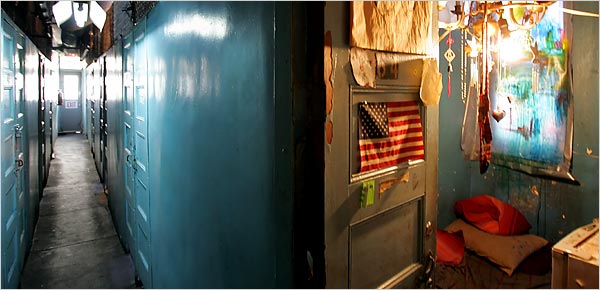
The Andrews House's cubicles, lining a 17-foot-wide space split by a corridor,
have been reinvented as compact but efficient spaces like the one pictured below.
By JANNY SCOTT
Published: April 30, 2006
The lowly flophouse has all but vanished from the urban landscape, swept away by the well-meaning forces of housing reform, city planning and gentrification. But Rosanne Haggerty, whose work housing the homeless won her a MacArthur fellowship in 2001, thinks it is time to give the flophouse a second chance.
Skip to next paragraph
Multimedia

Video: Reinventing the Flophouse
Enlarge This Image
 Rafi Elbaz
Enlarge This Image
James Estrin/The New York Times
Carl Ford, a fire director at the
Andrews House, a 97-year-old
cubicle hotel in the Bowery.
After renovation it will
accommodate 146 men.
James Estrin/The New York Times
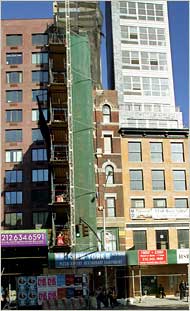
Scaffolding surrounds the Andrews House
as it undergoes renovations. Residents may
be able to move into renovated rooms by August.
The immediate object of Ms. Haggerty's affection is one of the last surviving lodging houses on the Bowery in Manhattan, the Andrews House, a 97-year-old "cubicle hotel" where aging men, many of them alcoholics, have whiled away countless decades in sunless cubicles, television screens flickering on nicotine-stained walls.
Ms. Haggerty is now reinventing the Andrews House and, in the process, she hopes to answer an unexpected question: Could a flophouse � a good flophouse, well designed and humanely managed � become, for people who have steered clear of other forms of housing in favor of the street, a critical first step toward a permanent home?
The undertaking, by the organization Ms. Haggerty founded in New York City in 1990, Common Ground Community, one of the country's largest nonprofit developers of so-called supportive housing, has attracted the attention of people who work with the homeless in other cities including Toronto, San Francisco, Minneapolis and Chicago.
"We are fundamental believers in permanent housing," said Ms. Haggerty, who hopes to move residents into renovated parts of the Andrews House in August. "We're calling the Andrews first-step housing. We want to get people now alienated from the idea of living in housing to enter in on their own terms, and then work with them from there."
Once, most major cities had a lodging house district, a skid row. In the 1930's and early 40's, there were 50 to 100 flophouses along the Bowery. The street was home to thousands of men, mostly single � a ready industrial army of unskilled migrant day laborers for any employer in need of gang labor.
But after World War II, industries moved out of cities and mechanization changed the demand for labor. Skid rows became repositories of retired, elderly men. Without lobbies, men socialized on sidewalks, some with bottle in hand. Lodging houses were perceived as squalid magnets for a rough crowd and the occasional criminal.
"Any kind of single-room-occupancy hotel was seen as a bad thing," said Paul Groth, a professor at the University of California at Berkeley and author of "Living Downtown: The History of Residential Hotels in the United States." "They were the favorite target of urban renewal. It was the old, messy city; these were people you didn't want around. They reminded you that capitalism wasn't working for everyone all the time."
Nan Roman, president of the National Alliance to End Homelessness, believes that the decline of the lodging houses, boarding houses and S.R.O.'s (where residents could rent not a mere cubicle but a fully enclosed room) "was probably a big contributor to the emergence of homelessness."
Ms. Haggerty's project arose out of more than 100 interviews that Common Ground conducted in soup kitchens and shelters in 1997. The aim was to understand the group of homeless people who seemed uninterested in the kind of housing, with on-site social services, that Common Ground offered. What would they prefer?
Many said they wanted something small, private, safe, cheap; they wanted just enough space for themselves and their belongings. They had a little money, though not enough for an apartment. They could pay. And they wanted anonymity.
"They were really talking about a lodging house," Ms. Haggerty said. "Nothing grand, a modicum of privacy, anonymity." Today in New York City, fewer than 40,000 legal S.R.O. units remain, down from 150,000 to 200,000 in the late 1950's. The number of cubicle hotels � a step down from an S.R.O. � has dwindled to fewer than a dozen, most of them within a few blocks of the Andrews.
"None of us had focused on the Bowery � a place you could get a toehold, where for a couple of bucks a night you could get something safe, private, no questions asked," Ms. Haggerty said. The interviews, she said, "got us thinking, almost against our wishes: What if you were to take what we're hearing seriously and try to fill this need?"
Common Ground invited homeless people to focus groups: What would the ideal unit look like? Over and over, people would ask for paper and pencil, then sketch the simplest outline of a Monopoly house � a three-sided box with an upside down V for a roof.
Common Ground met with the Fire Department and Department of Buildings to discuss complying with codes. Potential residents wanted the cubicles to be roofed, for security. But the Fire Department said the walls could not reach the ceiling; there had to be space for light, air circulation and sprinkler systems.
In 2000, Ms. Haggerty spent several months in Japan on a fellowship from the Japan Society studying efficient design. She met with people in the prefabricated construction industry and the designers of capsule hotels, places where businessmen bed down for the night in cubbyholes the size of refrigerator boxes for, say, $30.
She came to think that design is the great "bridger." It is not the amount of space that matters; it is how well the space is designed. The context of the space � the other amenities nearby � is also important. And there is more than one way to design a unit.
Common Ground was already looking for a suitable building. Lofts were too expensive, and Common Ground was outbid for one lodging house by a man who planned to convert it into luxury condos. Finally, Common Ground found the Andrews and bought it in 2002 for $2.3 million.
Built to house 200 people, the building was six stories high and only 17 feet wide. Inside, submarine-style corridors lined with cubicles ran lengthwise into gloom. The number of residents had dwindled to 90, men in their 40's to their 80's. Shari Siegel, now the director, said that men were dying there at a rate of about one a month.
"The only appointment I'm keeping is with the undertaker," one resident told his caseworker when she pressed him to keep a doctor's appointment, Ms. Siegel remembers. Two days later, the man was dead. A fellow resident peered over the top of the cubicle.
"Shari," he said. "I think you've got a dead body upstairs."
It took 13 Dumpsters to empty the Andrews of detritus � old suitcases, calendars, clothing, Chinese menus, whatever residents agreed to part with. The exterminator came to be called, jokingly, part of the case-management team. Common Ground installed Ms. Siegel, who is a nurse; it set up a health clinic and brought in a social worker.
In 2003, Common Ground and the Architectural League of New York held a design competition for the units, 175 to 300 square feet. They received 189 full submissions from 13 countries. A jury, including the chairman of the architecture department in the Harvard Design School, selected five winners. Two prototypes went on display at the Municipal Art Society last summer.
Among those who visited was Arthur Harttman, a 73-year-old Air Force veteran and former dance instructor who moved into the Andrews 13 years ago, drawn by the "old-timers." Mr. Harttman has become an admirer of the new Andrews House social worker, whom he calls the Princess and who recently helped him get a new set of teeth.
"Sometimes the Princess and I used to go to the nursing home, on Greenwich Street, and volunteer our time and dance with the old-timers," Mr. Harttman, rail thin with wispy gray hair, said in an interview. Offered a chance to go to the Municipal Art Society exhibit, he eagerly went.
"I thought it was great," he said. He liked the prototype called "The Ordering of Things" best. It was bigger than his current cubicle, which fits barely more than a cot. It had lots of shelves and a bed on rollers. The top half of the door could swing open � perfect for summer.
"They've done a wonderful thing for all us fellows here," Mr. Harttman said.
The first phase of the Andrews renovation will be completed this summer. Eventually, there will be room for 146 men, including the 48 current residents, who can stay as long as they like. New arrivals can stay for three weeks on their own terms; after that, they will be required to accept certain services, including housing-placement counseling. The charge will be $7 a night.
"We don't want to encourage the lodging houses to be permanent housing," Ms. Haggerty said. "But we see the need for them as a complement to other housing as a place for people who need a place to start. We need a much bigger range of housing options if we're going to find a place for everyone."
As New York Apartments Become Condos, Tenants Are Stuck in the Middle

As New York Apartments Become Condos, Tenants Are Stuck in the Middle
Keith Bedford for The New York Times

The 50-story, 852-apartment Sheffield on West 57th Street is among the buildings in the
city being converted into condominiums.
By JOSH BARBANEL
Published: April 30, 2006
At Manhattan House, the first and perhaps the grandest white brick building on the Upper East Side, every day seems to be moving day. One by one, scores of residents, most of them affluent and many of them elderly, are packing up their things and moving on � and not willingly.
The building, a block-square rental complex with five 20-story towers, where Grace Kelly and Benny Goodman once rented, is being turned into a condominium in the most expensive rental-to-condo conversion to date, valued at perhaps $1.1 billion, according to the proposed offering plan.
It is one of more than 60 pending condominium conversion projects in Manhattan listed by the New York State attorney general's office, involving more than 7,000 condominium units.
These projects, the first large wave of condominium conversions in New York in 20 years, are cutting into the supply of rental apartments, driving rents higher, and ushering in a wrenching period of uncertainty for many existing tenants.
In the 1980's, tenants facing condo conversion banded together and negotiated large discounts from developers on the sale prices of their individual apartments, and became condo owners.
But now, with rent stabilization laws weakened, landlords are taking a tougher stand, evicting market-rate tenants and offering only tiny discounts on the sale prices to rent-stabilized tenants, who are allowed to continue renting after a conversion.
Tenants say they are being rushed out so that the new purchasers can sell the apartments at the highest possible prices, and then pay off their mortgages.
"People are so frightened in this building," said Gail Amsterdam, who lives in Manhattan House and is trying to keep her mother and uncle in their market-rate apartments when their leases expire. "I don't understand why nobody is standing up for elderly people who cannot stand up for themselves."
Landlords defend the changes by saying that they are obeying the law, and that they have the right to convert buildings.
"If people are unhappy with the change, I can't help that," said N. Richard Kalikow, one of the buyers of Manhattan House. "They have rights. We have rights. Everybody is going to pursue their rights. This is a free country."
Although soaring condo prices feature prominently in dinner conversation, New York remains a renter city. Three-quarters of all households in Manhattan rent.
About half of the apartments being converted are in a handful of large buildings. Among them are Manhattan House, on East 66th Street and Second Avenue with 583 apartments; the 50-story Sheffield with 852 apartments on West 57th Street; River Terrace with 410 apartments on East 72nd Street and the East River; and 25 Broad Street, a landmark former office tower in the financial district, with 345 apartments. Many of these buildings were sold last year, some at record prices.
The rights of market-rate tenants in conversions is to some extent uncharted territory, despite a law adopted in the 1980's devised to give both market-rate and stabilized tenants bargaining power in conversions.
Although market-rate tenants in condo conversions are not usually entitled to renew their leases, owners are not permitted to empty buildings of market-rate tenants before a conversion plan is filed, or to evict or impose exorbitant rent increases on them after the conversion take place.
But, owners say, they are allowed to evict market-rate tenants during the time a conversion plan works its way through the approval process. Tenant lawyers are challenging this interpretation in a series of eviction cases pending in Housing Court. At the same time, tenants are lobbying elected officials for help.
At Manhattan House, two developers, Mr. Kalikow and Jeremiah O'Connor, paid $623 million, an average of more than $1 million per apartment, and obtained more than $750 million in financing to buy and upgrade the building, and cover their conversion costs.
The price was the highest paid for a Manhattan rental complex, according to brokers. But Mr. Kalikow said the price was not too high, and he disputed contentions by tenants that the project's high cost put him under pressure to harass tenants and empty the building.
Mr. Kalikow said that even if the broader market remained flat, he expected prices at Manhattan House to rise over time because of the shortage of high-quality condominiums on the East Side.
Their filings with the attorney general show that they expect to receive about $1,500 a square foot for the condominiums, or about $1.5 million for a typical one-bedroom unit, though an analysis by Standard & Poor's estimated that prices will average about 20 percent less.
He plans to refurbish the building, restoring the casement windows that were included in the original modernist design, and installing central air conditioning in each apartment, he said. Although Mr. Kalikow said he converted more than 7,000 apartments during the 1980's, this is his first project during the current wave of conversions.
In the last few months, more than 60 tenants have moved out, and according to a list circulated by tenants in mid-April, another 16 were to move out by the end of April. Four others were being vacated after renters had died.
Most days, boxes and sofas are wheeled down to trucks backed into loading bays, next to the tulips and daffodils blooming in the garden on East 65th Street near Second Avenue. Passenger elevators are often backed up, tenants say, as the freight elevators are overloaded.
"Are you staying or leaving?" one elderly man asked another in the elevator, and received a resigned shrug in response.
Eve W. Paul, a lawyer and former general counsel to the Planned Parenthood Federation of America, said her $4,450-a-month apartment has a lease that runs out in two months, and she is troubled by the idea of moving because the apartment is a link to her late husband, who developed a brain tumor after they moved in four years ago, and then died.
"We did everything together," said Ms. Paul, who is in her 70's. "It feels very wrenching to have to leave all of the things that we chose together."
Tenants forced to find new places are facing a shortage of good rentals. When Peggy Johnson, an advertising executive, moved out of the Sheffield on West 57th Street last month, she had to pay $200 more a month for an apartment with "60 percent of the space," she said.
The vacancy rate in Manhattan rental apartments fell from a peak of 3.8 percent in 2002, to 1.5 percent last year, and then fell again in March to 0.75 percent, according to figures calculated by Citi Habitats.
"It is a great time to be a landlord," said Jack Levy, senior managing director of Rose Associates, which manages 30,000 apartments.
Rents had lagged in the last few years, even as condominium prices climbed higher and higher. Builders turned planned rental projects into condominiums and even long-term owners of rental buildings, like the New York Life Insurance Company, which built Manhattan House in 1951 and owned it until last year, decided to sell at the high prices offered by condo-converters.
Some tenants are refusing to look for new places and are fighting instead. At Manhattan House, several hundred tenants put money into a legal fund, and have hired David Rozenholc, a tenant lawyer who specializes in battling developers on behalf of holdout tenants.
Samuel J. Himmelstein and Kevin R. McConnell, the lawyers for tenants at the Sheffield, cited legislative memos from the 1980's that suggest that the Legislature intended to protect market-rate tenants, along with other tenants throughout the conversion process.
"They have depopulated the building by telling people you have to move," said Nancy Rovelli, an insurance broker who heads the tenants association at the Sheffield and is facing an eviction hearing in May.
Kent Swig, a principal in the group that purchased the Sheffield for $418 million and 25 Broad Street for more than $200 million, both last year, declined to discuss any pending litigation. He said he would like to negotiate with the tenants, but under state law he was barred from doing so until a conversion plan was approved.
"The law puts everybody at a disadvantage because it prevents communication," he said.
At Manhattan House, Patricia Lynch, a writer and former television news producer, thought she would be protected during a conversion because she had lived in a rent-stabilized apartment in the building since 1975. She pays about $2,000 a month for a two-bedroom unit with a fireplace and a small balcony.
But after the building was sold, Ms. Lynch received a notice that her lease would not be renewed. The new building owners said that she was not entitled to a rent-stabilized lease because she lived in Southampton, where she has a country house and keeps her car, rather than in the Manhattan apartment, which she contends is her main residence.
She has put together a thick packet of documents � voting, tax and jury records and even a letter from the Southampton assessor � to support her contention that her primary residence was at Manhattan House.
She also said that other tenants had received similar notices.
"This is a really stupid allegation but stupidity isn't what it's about," she said. "It's about malicious harassment that will cost me money to defend."
The landlord, Mr. Kalikow, said that he was acting within his rights.
Ms. Amsterdam, who runs an executive search business and whose own Manhattan House apartment is rent-stabilized, found that the developer for the conversion in her building has provided no special consideration for elderly tenants.
Her mother, Elizabeth, 89, and her uncle, Martin Burwick, 96, moved into separate market-rate apartments in the building, so they could be near her. Her mother received a notice offering her a lease renewal at $4,400 per month, 63 percent above her rent of $2,700, what she said was well above market-rate rents for apartments in the neighborhood.
In order to stay, she would have to agree to be relocated to another apartment in the building on 15 days notice. Her daughter has compiled a thick file of letters to elected officials, but few answers.
Her uncle, Mr. Burwick, who has round-the-clock nursing care paid for by Medicaid, was not offered a lease extension. He has been told that he must leave his apartment by June 30. Mr. Kalikow said he was not aware of the case.
Ms. Amsterdam plans to fight any move to evict her uncle. But in the conflict between market forces and sentimental attachment, Ms. Paul has surrendered to the market. Last week she told her neighbors that she was resigning from the tenants group and would soon be moving out.
A Cajun Craftsman Preserves the Hallowed Ping of History

A Cajun Craftsman Preserves the Hallowed Ping of History
By JON PARELES
Published: April 30, 2006
SCOTT, La., April 26 � The triangle may seem like a humble instrument: nothing more than a bent steel rod hit with a steel stick, merrily clanging away behind the fiddle and accordion of a traditional Cajun band. Visitors here in the bayou country of Acadiana often buy them as souvenirs at tourist stops.
Skip to next paragraph
Enlarge This Image
Ozier Muhammad/The New York Times

Dieu Donn� Montoucet, 80, makes
triangles used in Cajun music.
But there are triangles, and then there are the triangles made by Dieu Donn� Montoucet, an 80-year-old Cajun who goes by Don and whose hand-forged, antique-steel, virtually indestructible triangles are prized by musicians for the way they ring.
"They have a lot of volume, they have a lot of clarity and they have a lot of sustain," said Barry Ancelet, a professor of Francophone studies at the University of Louisiana at Lafayette who is a historian of Cajun music and a triangle player. "On a final note they'll continue ringing like a church bell."
The simple triangle paces traditional Cajun music, and its peal echoes beyond the bayou. While Cajun music's stronghold is around Lafayette, about 130 miles west of New Orleans, its two-step beat and high, tense vocal style have made their way into American music like country and New Orleans rhythm and blues.
Cajun music is a staple of the annual New Orleans Jazz and Heritage Festival. [The 37th edition started on Friday and runs through next Sunday.] Advance ticket sales alone have topped 100,000. Among its headliners are Bruce Springsteen, Paul Simon and Dave Matthews. But the lineup also includes hundreds of Louisiana bands, among them traditionalist Cajun bands like Steve Riley and the Mamou Playboys, who use Mr. Montoucet's triangles.
Hurricane Katrina did not reach Acadiana, and Cajun music may be making new inroads in the 21st century, since many New Orleans residents � musicians included � evacuated west into Cajun country.
A small printed sign on Mr. Montoucet's workshop reads, "Don Montoucet, Lafayette � Lafayette Parish, Triangles � Cajun." His workbench and his office occupy one corner of his son-in-law's furniture warehouse. Inside, a dozen triangles hang on the wall; there's also a deer head, a stuffed raccoon and some birdhouses made from old license plates. A larger sign announces that Mr. Montoucet does Louisiana state vehicle inspections, his day job.
Mr. Montoucet has never had just one job. He drove a school bus for 45 years and began fixing cars at his own Don's Garage in 1940. From 1968 to 1996 he played accordion in his own Cajun band, Don Montoucet and the Wandering Aces. It changed its name to Don Montoucet and the Mulate Playboys when it became the house band at the well-known Mulate's restaurants in Breaux Bridge, Baton Rouge and New Orleans.
There's history in Mr. Montoucet's triangles. It's an old instrument; Mr. Ancelet says that triangles are described in accounts of medieval and Renaissance music. His triangles have a distinctive tight, flat loop at each end. He copied the design from a set � triangle and beater � that he inherited from his grandfather, a blacksmith who came to Louisiana from France. He made his first set around 40 years ago for a friend who knew he did ironwork.
Soon word got around, not just to Acadiana but to Canada and beyond. He sells the triangles himself in his workshop; they are also sold at the Savoy Music Center in Eunice, La., a stronghold of Acadian traditional music founded in 1960 by the musician and accordion builder Marc Savoy. They cost $35.
Mr. Montoucet makes the triangles from the U-shaped tines of salvaged old hayrakes: huge wheeled contraptions pulled by horses or tractors. The tines are springy and patinaed with rust from sitting in wet fields. He does not shine them up. "They can't be too rusty," he said. "The first thing that people ask me is, 'Is that the old iron?' They don't want to hear nothing else."
With an acetylene torch � he used to use a coal furnace � Mr. Montoucet heats the tines to straighten them, then cuts them to the right length. (One tine makes a triangle and its beater.) He heats them again to bend them into shape and keeps them red-hot to make the loops at the end. "It takes 250 licks of that big forge hammer to make one," he said.
The key to the sound, he says, is in the final stage: the tempering that heats and cools the steel for strength. He said: "If you heat them too hot, or not enough, it makes a difference. I can show you how to temper them, but if you don't have it here ..." He pointed to his head.
The hayrakes were collected through the years by a friend who works as a trucker. There is no new supply. "The iron is getting scarce," Mr. Montoucet said. "A lot of these farmers, they were glad to get rid of these hayrakes and glad to get them out of the way. But they got no more, pardner. I have a few of them left. My oldest son says, 'Dad, what you going to do when you can't get any more steel?' I say, 'Don't you think it's time for me to retire?' "
The triangles are guaranteed for life against the walloping a Cajun musician will give them. In the days before amplification, the triangle might have been the only thing heard by dancers at the far edges of a party. Mr. Montoucet knows of only one of his triangles that has broken: one that he made for Christine Balfa, the daughter of the great Cajun fiddler Dewey Balfa. After a forensic examination of the pieces, Mr. Montoucet found that there had been a hairline crack in the original hayrake tine.
Although Mr. Montoucet makes triangles in set sizes � usually from 8 to 12 inches on a side � they are anything but standardized. Mr. Montoucet played a few of his 9-inch triangles: each had a different note and a different ring.
"One day a lady came in and said: 'How come they're all different sounds? Why can't you make them all the same sound?' We were five or six men here, and I said, 'Lady, it's like this: if all us men liked the same woman, it wouldn't work.' Everybody likes different things. Some people like gumbo, some people don't like gumbo, but I don't know too many people who don't like gumbo."
Cajun musicians do not simply hit the triangle. A Cajun two-step or waltz is defined by a quick-changing ping and clank that vary depending on how the triangle is gripped: with a few fingers, an open palm, a closed fist. Mr. Montoucet smiled as a visitor attempted to coordinate the rhythmic tapping, clasping and unclasping.
"You ought to see my little 18-month-old great-grandchild doing that," he said. "He comes, and he gets all my tools, and then he picks up the triangle. His father says, 'He's probably going to be a mechanic.' And I say, 'He might be a musician too.' "
Fighting New Heights on the Upper West Side

Fighting New Heights on the Upper West Side
By JOSEPH BERGER
Published: May 1, 2006
When it gets mad, the upper Upper West Side springs fiercely into combat � most of the time, that is.
Skip to next paragraph
Casey Kelbaugh for The New York Times

Ariel East, one of two towers being built
on Broadway, between 99th and 100th
Streets. Some neighborhood groups that
oppose the project are seeking rezoning.
Casey Kelbaugh for The New York Times
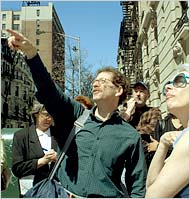
Andrew S. Dolkart of Columbia University
leading a tour of the Upper West Side for
Landmark West, a group that promotes the
neighborhood's architectural preservation.
It was in the book-cluttered apartments between 96th Street and 110th Street where much of the successful plot to defeat a $1.1 billion West Side superhighway was hatched, leaving a governor and a mayor choking in the organizers' dust in 1985. In a smaller skirmish six years ago, residents were upset that a CVS pharmacy had opened on a stretch of Broadway that already had two Duane Reades and a Rite Aid. Petitions, pickets and a boycott followed and, a year and half later, the CVS closed its doors.
Yet, almost no one had any idea about what some see as a much more serious threat to the neighborhood's character. Its zoning is so generous that it allowed Ariel East and Ariel West, two luxury towers � one that at 38 stories would be twice as tall as any other building around it � to be erected opposite each other on Broadway, without the daunting gantlet of a West Side review. Those towers are inexorably rising, and that is why the neighborhood, shocked into action, is hurrying to rezone before developers begin tearing down shops, supermarkets and other low-rise sites and replacing them with other tall apartment buildings.
"The race is to get it finished before new owners start their projects," said Miki Fiegel, president of West Siders for Responsible Development, a neighborhood group pushing for low-scale zoning.
Time is a factor, because right now any entrepreneur who assembles a lot of sufficient size can � without any community review � match the height of the two towers, and there are at least a half dozen spots ripe for such development.
The battle on the Upper West Side is also being played out in various forms in the South Bronx, in Midwood and Red Hook, Brooklyn, and in other neighborhoods as the city struggles with the blessings of low crime and rising home values. But few neighborhoods can match turnouts like the 700 residents who attended a recent meeting at a neighborhood synagogue, Ansche Chesed.
Ethel Sheffer, chairwoman of a Community Board 7 task force that is evaluating new zoning proposals, said older and poorer residents voiced fears that their apartments might be torn down and that they would be pushed out.
"They said, 'There won't be places for people like me,' " she said.
Any rezoning plan must eventually be approved by the City Council.
At stake is the personality of a neighborhood not quite like any of the city's others. It is a raffish mix of writers, leftists, musicians � Judy Collins and Lorin Hollander have apartments here � housing project tenants, the formerly homeless and, increasingly, Wall Street investors.
Politically, it is liberal and generates one of the city's largest election turnouts. Ethnically, it crosses the globe, whiter on the affluent east and west margins, more black and Latino residents in the middle.
According to the 2000 census, of the 52,032 residents in the tracts between 97th Street and 110th Street from Central Park to the Hudson River, 43.3 percent were white, 31.8 percent were Hispanic, 16.7 were black and 5.1 percent were Asian.
The stout old co-op buildings are less expensive and sometimes dingier than those to the south between 96th Street and Lincoln Center, and there are fewer brownstones, more tenements and more than 30 single-room occupancy buildings. Even though the median rent is $756, the median value of the owner-occupied co-ops, condos and brownstones is $328,561.
Many onetime socialists are, to their embarrassment, millionaires on paper. Along Broadway, there are plenty of idiosyncratic shops, but a crop of new banks and chain drugstores have piqued fears about Banana Republics or Gaps to come.
This being the West Side, the rezoning push has set off feuding. The differences among the factions sound technical, but they essentially represent a clash between those who want to keep the neighborhood as close to its present scale as possible and those who think it should do its part in building enough housing for the city's swelling population.
"After all, if neighborhoods everywhere downzone, there surely will be less housing built, and therefore the housing stock will be even less affordable," Hope Cohen of the Community Board 7 task force said in a memo to other members.
It was the absence of major development � in contrast to the spate of high-rise buildings that have gone up in the more genteel blocks below 96th Street � that seemed to lull this usually vigilant community.
"When it came to zoning, people were probably caught sleeping," said Marsha Tantleff, a dental hygienist who lives on Riverside Drive. "They didn't believe it was going to happen up here."
The sense of neighborhood urgency is one reason many West Side residents, typically fussy about the environment, are trying to avoid rezoning and require the time and effort that goes into an environmental impact statement.
The predominant existing zoning along the Broadway corridor sets no height limits as long as the lot is spacious enough. The two towers that started the controversy could be built because Extell Development bought development rights from adjoining brownstones on the cross streets and from St. Michael's Church on Amsterdam Avenue.
Most people seem to agree that the midblocks on the cross streets need to be rezoned differently from the avenues so developers cannot acquire development rights again. By city law, air rights cannot be transferred across zones. But there are sharp differences about what should be done with the avenues, with the Broadway corridor drawing the fiercest debate.
On a walk along Broadway, Ms. Fiegel pointed out clusters of short or shopworn buildings where developers could pounce. More tall buildings, she said, would cast shadows on Broadway, ruining its ambience. Her apartment on West End Avenue will have its light and views diminished by Extell's towers, which are between 99th and 100th Streets.
"Broadway is our main street � it's the place we walk," she said, adding, "It's our town square."
Her group would prefer zoning on avenues like Broadway that would create a street facade of roughly eight stories (85 feet) and permit four to five additional floors on top, but set back from the street. The City Planning Department has recommended allowing not just a denser building with more apartments, but also a taller street fronting � up to 12 stories with total height limited to 17 stories (about 170 feet).
Ms. Cohen said that she thought the department's proposal was "perfectly acceptable" but that she would prefer a zoning category that allowed a range of street heights, from 6 to 10 stories. Variety, she said, would be more in keeping with the "saw-tooth up-and-down quality" of the Broadway streetscape. The total height could be 14 stories (about 145 feet), unless a "community facility" like a post office is included.
In an interview, Extell's president, Gary Barnett, argued that opponents were exaggerating the number of development sites. He said a study that he commissioned showed that only one, a post office on 104th Street, had a footprint large enough for a tall building. He also noted that a building between 96th Street and 97th Street, the Columbia, was almost as tall as his tallest tower. Residents who have not waded into the fracas, like the Very Rev. James Parks Morton, the dean emeritus of the Cathedral of St. John the Divine, say that development is inevitable. But they would like to make sure it comes nowhere near the heights of the towers.
"I guess I base my arguments on the way the great European cities, Paris and London, have said that certain areas are sacred in terms of their scale," Dean Morton said.
Subscribe to:
Posts (Atom)


