Monday, October 31, 2005

MAYOR BLOOMBERG AND CONGRESSMAN RANGEL BREAK GROUND ON WEST HARLEM PIERS


FOR IMMEDIATE RELEASE
PR- 411-05
October 31, 2005

MAYOR BLOOMBERG AND CONGRESSMAN RANGEL BREAK GROUND ON WEST HARLEM PIERS

$18.7 Million Project To Revitalize West Harlem Waterfront


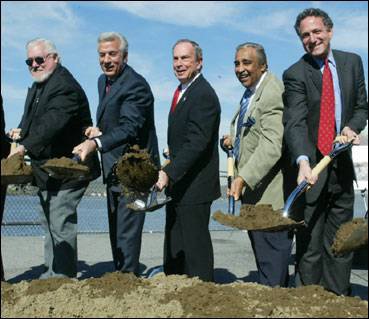
Mayor Michael R. Bloomberg and Congressman Charles B. Rangel today broke ground on construction of the West Harlem Piers, an $18.7 million project that will connect West Harlem to the rest of the Manhattan waterfront greenway. The project is a part of the City's West Harlem Master Plan that the Mayor announced in October of 2002, the goal of which is to revitalize the area between 125th and 135th Streets, Broadway and the Hudson River in West Harlem. The Harlem Piers project calls for a new bicycle and pedestrian path, a docking pier, a recreational and fishing pier, and landscaped open space that will reclaim the waterfront for pedestrian and recreational use. Deputy Mayor for Economic Development & Rebuilding Daniel L. Doctoroff, Upper Manhattan Empowerment Zone (UMEZ) President & CEO Ken Knuckles, Empire State Development Corporation (ESDC) Chairman Charles A. Gargano, Economic Development Corporation (EDC ) President Andrew M. Alper, Parks Commissioner Adrian Benepe and Community Board 9 Chairman Jordi Reyes-Montblanc attended the ceremony at 125th Street at the Hudson River.

"Reconnecting residents with New York City's vast waterfront is one of our most important economic development goals," said Mayor Bloomberg. "The West Harlem Piers will bring together various recreational uses by connecting the Manhattan greenway with the northern segment of Riverside Park, creating a destination for West Harlem residents and all New Yorkers to enjoy for years to come. I want to thank Governor Pataki and the Upper Manhattan Empowerment Zone for joining the City in committing the necessary funds for this project, and the community for its work and support of the revitalization of the West Harlem waterfront."

"The West Harlem Piers project is another important step in the ongoing economic revitalization of Harlem and the Upper West Side," said Congressman Rangel. "In addition to the commercial development and housing that has already transformed our community the Piers will provide access to green grass and recreation for our residents and their children. It will also generate business opportunities and jobs in construction and operation of the facility. I've recently secured an additional $26.8 million in federal funds that will further enhance the neighborhood with construction of a ferry terminal and streetscape improvements along 125th Street from the pier to Old Broadway."

"West Harlem is reemerging as the bustling center of commerce and recreation it once was, and this project, along with our West Harlem Master Plan, are important elements of our effort to reconnect the area to the surrounding neighborhoods and greater Manhattan, both physically and economically," said Deputy Mayor Doctoroff.

"Through a $4 million commitment from New York State, Governor Pataki continues his determination to revitalize and spur redevelopment within Harlem's historic communities. Restoring the West Harlem Piers is a masterful plan to reestablish the State's waterfront heritage, while giving these piers back to the community," said ESDC Chairman Gargano. "This latest access to the waterfront will also improve transportation and allow for new recreational uses for the community. The State will continue to utilize our resources to encourage economic development opportunities as we reaffirm our dedication to the renaissance of Harlem."

The Army Corps of Engineers approved the project last week, clearing the last regulatory hurdle before construction can begin. Work will begin on the project by the end of the year, and it is expected to be completed by spring 2007. The Upper Manhattan Empowerment Zone contributed more than $6 million for this project, with the State adding more than $4 million and the City providing more than $3 million. The Manhattan Borough President, the City Council, the State Department of Parks and the Port Authority of New York and New Jersey, among others, are providing additional funding for a total of $18.7 million.

The West Harlem Piers will improve City-owned land by transforming a parking lot between 125th and 135th streets into an attractive and accessible waterfront amenity. The new recreational pier will support various activities including fishing, water tours, boating and ecological exploration. The new pier will accommodate a variety of vessels with the main portion allowing excursion boats and water taxis to dock at West Harlem. The area will be landscaped attractively with new plantings and recreational areas, and the bicycle and pedestrian path will provide a critical link in the waterfront greenway, connecting Cherry Walk on the southern end of the site with the northern segment of Riverside Park. W Architecture and Landscape LLC designed the improvements, with support from DMJM+Harris and Philip Habib.

"The Harlem Piers reclamation represents a renewal of one of the City's most important waterfront resources," said UMEZ President & CEO Knuckles. "The people of Harlem have long desired a more accessible and attractive connection to the Hudson River. We believe that this project will fulfill their wishes. UMEZ is proud to be a part of the city-state partnership that has made this day possible."

Mayor Bloomberg announced the West Harlem Master Plan in October of 2002 with the goal of revitalizing the area between 125th and 135th Streets, Broadway and the Hudson River in West Harlem. The plan calls for the transformation of neglected City-owned land, various transportation improvements to support the neighborhood's growth, and land-use policies to promote a greater variety of uses.

"125th Street is a through street and a crucial access point to get to the waterfront on the west side," said City Planning Director Burden. "In conjunction with the West Harlem Waterfront improvements, we are working with the community on a 125th Street River-to-River study to create a comprehensive development framework to catalyze and invigorate this important corridor."

"Over the past four years, Parks & Recreation has made great progress in the development of the citywide waterfront greenway," said Parks Commissioner Benepe. "The West Harlem Piers

will provide a vital permanent link to the Hudson River and demonstrates our continued commitment to expanding and improving our waterfront property."

City Planning and EDC have worked closely with the community, including Community Board 9 and West Harlem Environmental Action, to advance plans for the area, receiving extensive input from working committees made up of various stakeholders including elected officials, government agencies and community organizations.

"Making the City more livable is one of this Administration's most vital economic development goals," said EDC President Alper. "Opening up the West Harlem waterfront to residents will take us closer to achieving the goals the State, the City and the community set forth in the West Harlem Master Plan to revitalize the area."

"The Manhattanville Piers will be a great asset to the residents of Community Board 9 and West Harlem," said Community Board Chairman Jordi Reyes-Montblanc. "This is a long-awaited and much-fought-for project, which is the symbol of the rebirth of West Harlem. It is a tribute to the dedication of many community people, but particularly Maritta Dunn, who has made the Piers her project."


MEDIA CONTACT:

Edward Skyler/Jennifer Falk (212) 788-2958

Emile Milne (Congressman Rangel) (202) 225-4365

Michael Sherman/Janel Patterson (Economic Development Corporation)
(212) 312-3523

Columbia U.-area city plan clears first hurdle


Columbia U.-area city plan clears first hurdle

By Lindsay Schubiner

Columbia Daily Spectator (Columbia U.)10/31/2005

(U-WIRE) NEW YORK — After more than 10 years, adoption of Community Board 9's 197-A plan by the City Planning Commission took a major step forward.

The board's plan, which consists of a set of broad recommendations for the long-term development of the community district, passed the preliminary "threshold" review on October 17th. This process requires approval by the City Planning Commission to ensure that the plan is logical, convincing, realistic, and consistent with sound planning policy before it can move forward into the substantive review phase, which entails obtaining input from the public and the borough president, final approval by the Planning Commission, and a City Council vote.

Although the plan is not binding, if it is approved, the City Planning Commission must consult it when reviewing any District 9 development plans.

According to board chair Jordi Reyes-Montblanc, passing this review is the primary important milestone in passing the threshold review. "We are confident that as things stand now, we stand a good chance of passing," he said.

While 197-A would not directly interfere with Columbia University's proposed expansion into West Harlem, its adoption would put in place zoning recommendations that might make it more difficult for Columbia to get the planning commission's approval to build certain types of buildings in the area. The review decision was accompanied by a letter from Amanda Burden, the chair of the Planning Commission, which noted that Columbia's re-zoning proposal for Manhattanville reflects a vision for the future of the neighborhood that is in "sharp contrast" to that of the 197-A plan. The letter asked CB9 to enter into a dialogue with Columbia about the plans before the public review process began and to "make good faith efforts to identify common ground and achieve consensus wherever possible."

Reyes-Montblanc emphasized that the discussion process between Columbia and the Community Board would be transparent. He added that an initial meeting with key players to set up ground rules for the discussions would likely occur in the very near future.

"There's no way of predicting whether that will be fruitful or not," said Pat Jones, the chair of the Board's 197-A committee of the upcoming discussions. "We can all be cautiously optimistic." University officials said they would continue to work with CB9 on the 197-A.

"Representatives of Columbia met with a committee of Community Board 9 as it was developing a draft of its 197-A plan," said Robert Kasdin, Columbia's executive vice president. "We are committed to continuing and intensifying discussions with CB9 to seek common ground wherever possible."

The Planning Commission also stipulated that the two plans enter the next review phase at the same time so that they could be considered together.

"We felt it was important that the Commission see both plans and see where they agree and where they don't agree," said Edwin Marshall, a representative from city planning who presented the 197-A plan to the Commission. Marshall noted that both plans agree on larger issues such as increasing retail areas and green space and being mindful of historic preservation.
However, he said there are some significant differences that need to be ameliorated. The two proposals conflict concerning the role of manufacturing and the height of buildings within the area. The Board's plan supports the retention of light manufacturing, especially those businesses that combine manufacturing with retail, and preserves fairly low building heights to maintain the neighborhood's character, while opposing residential displacement.

Columbia's plan would re-zone the manufacturing areas to mixed use so that they could accommodate a variety of possible uses, such as classrooms and housing, as well as taller buildings.

The 197-A plan also covers the area from 110th Street to 155th Street west of Morningside Dr. and St. Nicholas Parks, a larger area than Columbia's plan, which involves only the much smaller area between Broadway and 12th Avenue from 125th St. to 133rd St. and to the east of Broadway from 131st St. to 134th St.

It remains to be seen what might come out of the discussions between Columbia and the Board. According to Marshall, Planning Commission is "hoping that a consensus can be reached for both and that both can achieve their goals."

Community officials doubt that the changes will be substantial.

"I don't expect that the 197-A plan would change, but it may see some refinements," Jones said. As to the changes that the 197-A plan had to incorporate to pass the threshold review, it seems that there were relatively few.

"The essential elements that had been in the plan from the onset are there now," said Marshall.

Copyright ©2005 Columbia Daily Spectator via UWire

http://www.pbs.org/weta/washingtonweek/voices/200510/1031local1.html

WestSide Harlem Manhattanville Piers Groundbreaking October 31st, 2005


WestSide Harlem Manhatanville Piers Groundbreaking October 31st, 2005


From left to right: Adrian Benepe, New York City parks commissioner; Jordi Reyes-Montblanc, chairman of Manhattan Community Board 9; Charles A. Gargano, chairman of the Empire State Development Corporation; Mayor Michael R. Bloomberg; Congressman Charles B. Rangel; Daniel L. Doctoroff, deputy mayor for economic development and rebuilding; Andrew M. Alper, president of the New York City Economic Development Corporation; Kenneth J. Knuckles, president and CEO of the Upper Manhattan Empowerment Zone.
FOR IMMEDIATE RELEASE PR- 411-05
October 31, 2005
MAYOR BLOOMBERG AND CONGRESSMAN RANGEL BREAK GROUND ON WEST HARLEM PIERS
$18.7 Million Project To Revitalize West Harlem Waterfront

Mayor Michael R. Bloomberg and Congressman Charles B. Rangel today broke ground on construction of the West Harlem Piers, an $18.7 million project that will connect West Harlem to the rest of the Manhattan waterfront greenway. The project is a part of the City's West Harlem Master Plan that the Mayor announced in October of 2002, the goal of which is to revitalize the area between 125th and 135th Streets, Broadway and the Hudson River in West Harlem. The Harlem Piers project calls for a new bicycle and pedestrian path, a docking pier, a recreational and fishing pier, and landscaped open space that will reclaim the waterfront for pedestrian and recreational use. Deputy Mayor for Economic Development & Rebuilding Daniel L. Doctoroff, Upper Manhattan Empowerment Zone (UMEZ) President & CEO Ken Knuckles, Empire State Development Corporation (ESDC) Chairman Charles A. Gargano, Economic Development Corporation (EDC ) President Andrew M. Alper, Parks Commissioner Adrian Benepe and Community Board 9 Chairman Jordi Reyes-Montblanc attended the ceremony at 125th Street at the Hudson River.

"Reconnecting residents with New York City's vast waterfront is one of our most important economic development goals," said Mayor Bloomberg. "The West Harlem Piers will bring together various recreational uses by connecting the Manhattan greenway with the northern segment of Riverside Park, creating a destination for West Harlem residents and all New Yorkers to enjoy for years to come. I want to thank Governor Pataki and the Upper Manhattan Empowerment Zone for joining the City in committing the necessary funds for this project, and the community for its work and support of the revitalization of the West Harlem waterfront."

"The West Harlem Piers project is another important step in the ongoing economic revitalization of Harlem and the Upper West Side," said Congressman Rangel. "In addition to the commercial development and housing that has already transformed our community the Piers will provide access to green grass and recreation for our residents and their children. It will also generate business opportunities and jobs in construction and operation of the facility. I've recently secured an additional $26.8 million in federal funds that will further enhance the neighborhood with construction of a ferry terminal and streetscape improvements along 125th Street from the pier to Old Broadway."

"West Harlem is reemerging as the bustling center of commerce and recreation it once was, and this project, along with our West Harlem Master Plan, are important elements of our effort to reconnect the area to the surrounding neighborhoods and greater Manhattan, both physically and economically," said Deputy Mayor Doctoroff.

"Through a $4 million commitment from New York State, Governor Pataki continues his determination to revitalize and spur redevelopment within Harlem's historic communities.
Restoring the West Harlem Piers is a masterful plan to reestablish the State's waterfront heritage, while giving these piers back to the community," said ESDC Chairman Gargano. "This latest access to the waterfront will also improve transportation and allow for new recreational uses for the community. The State will continue to utilize our resources to encourage economic development opportunities as we reaffirm our dedication to the renaissance of Harlem."

The Army Corps of Engineers approved the project last week, clearing the last regulatory hurdle before construction can begin. Work will begin on the project by the end of the year, and it is expected to be completed by spring 2007. The Upper Manhattan Empowerment Zone contributed more than $6 million for this project, with the State adding more than $4 million and the City providing more than $3 million. The Manhattan Borough President, the City Council, the State Department of Parks and the Port Authority of New York and New Jersey, among others, are providing additional funding for a total of $18.7 million.

The West Harlem Piers will improve City-owned land by transforming a parking lot between 125th and 135th streets into an attractive and accessible waterfront amenity. The new recreational pier will support various activities including fishing, water tours, boating and ecological exploration. The new pier will accommodate a variety of vessels with the main portion allowing excursion boats and water taxis to dock at West Harlem. The area will be landscaped attractively with new plantings and recreational areas, and the bicycle and pedestrian path will provide a critical link in the waterfront greenway, connecting Cherry Walk on the southern end of the site with the northern segment of Riverside Park. W Architecture and Landscape LLC designed the improvements, with support from DMJM+Harris and Philip Habib.

"The Harlem Piers reclamation represents a renewal of one of the City's most important waterfront resources," said UMEZ President & CEO Knuckles. "The people of Harlem have long desired a more accessible and attractive connection to the Hudson River. We believe that this project will fulfill their wishes. UMEZ is proud to be a part of the city-state partnership that has made this day possible."

Mayor Bloomberg announced the West Harlem Master Plan in October of 2002 with the goal of revitalizing the area between 125th and 135th Streets, Broadway and the Hudson River in West Harlem. The plan calls for the transformation of neglected City-owned land, various transportation improvements to support the neighborhood's growth, and land-use policies to promote a greater variety of uses.

"125th Street is a through street and a crucial access point to get to the waterfront on the west side," said City Planning Director Burden. "In conjunction with the West Harlem Waterfront improvements, we are working with the community on a 125th Street River-to-River study to create a comprehensive development framework to catalyze and invigorate this important corridor."

"Over the past four years, Parks & Recreation has made great progress in the development of the citywide waterfront greenway," said Parks Commissioner Benepe. "The West Harlem Piers
will provide a vital permanent link to the Hudson River and demonstrates our continued commitment to expanding and improving our waterfront property."

City Planning and EDC have worked closely with the community, including Community Board 9 and West Harlem Environmental Action, to advance plans for the area, receiving extensive input from working committees made up of various stakeholders including elected officials, government agencies and community organizations.

"Making the City more livable is one of this Administration's most vital economic development goals," said EDC President Alper. "Opening up the West Harlem waterfront to residents will take us closer to achieving the goals the State, the City and the community set forth in the West Harlem Master Plan to revitalize the area."

"The Manhattanville Piers will be a great asset to the residents of Community Board 9 and West Harlem," said Community Board Chairman Jordi Reyes-Montblanc. "This is a long-awaited and much-fought-for project, which is the symbol of the rebirth of West Harlem. It is a tribute to the dedication of many community people, but particularly Maritta Dunn, who has made the Piers her project."MEDIA CONTACT: Edward Skyler/Jennifer Falk (212) 788-2958Emile Milne (Congressman Rangel) (202) 225-4365Michael Sherman/Janel Patterson (Economic Development Corporation)(212) 312-3523

Mayor Bloomberg and Congressman Rangel Break Ground On WestSide Harlem Piers


Mayor Bloomberg and Congressman Rangel Break Ground On WestSide Harlem Piers

Mayor Bloomberg and Congressman Rangel today broke ground on construction of the West Harlem Piers, an $18.7 million project that will connect West Harlem to the rest of the Manhattan waterfront greenway.

Monday, October 31, 2005
Read the press release
Watch the video in dial-up or broadband


Halloween SafetyHalloween is an exciting holiday for children in New York, but it's also a time for parents to be careful. The FDNY offers a list of Halloween safety tips to help you ensure your children have a comfortable, secure, and fun holiday. The DCA is also looking out for childrens' safety by enforcing the City ban against realistic-looking toy guns.Get safety tips from the FDNYReport a store selling illegal fake guns Find a fun Halloween event

Flu Season is ApproachingThe Department of Health & Mental Hygiene urges New Yorkers at highest risk for serious illness or death from the flu to get a flu shot now. On Tuesday, November 1, from 7:30am to 9pm, DOHMH will offer flu shots at no cost to all New Yorkers ages 4 and up at a clinic in Manhattan.Learn more Find a clinic

2005 General Election Voter GuideThe New York City Campaign Finance Board 2005 Voter Guide is now online and available to the public. This version of the Voter Guide follows in the footsteps of the printed guide by being more eye-catching, useful, and easy to read.Get the guide Find your poll site


Visit NYC TV

Mayor Bloomberg and Congressman Rangel Break Ground on West Harlem Piers


For Immediate Release
October 31, 2005


Contact:
Edward Skyler/Jennifer Falk (212) 788-2958
Emile Milne (Congressman Rangel) (202) 225-4365
Michael Sherman/Janel Patterson (EDC) (212) 312-3523

Mayor Bloomberg and Congressman Rangel Break Ground on West Harlem Piers ( 10/31/2005 )

$18.7 Million Project To Revitalize West Harlem Waterfront

Mayor Michael R. Bloomberg and Congressman Charles B. Rangel today broke ground on construction of the West Harlem Piers, an $18.7 million project that will connect West Harlem to the rest of the Manhattan waterfront greenway. The project is a part of the City�s West Harlem Master Plan that the Mayor announced in October of 2002, the goal of which is to revitalize the area between 125th and 135th Streets, Broadway and the Hudson River in West Harlem. The Harlem Piers project calls for a new bicycle and pedestrian path, a docking pier, a recreational and fishing pier, and landscaped open space that will reclaim the waterfront for pedestrian and recreational use. Deputy Mayor for Economic Development & Rebuilding Daniel L. Doctoroff, Upper Manhattan Empowerment Zone (UMEZ) Board President & CEO Ken Knuckles, Empire State Development Corporation (ESDC) Chairman Charles A. Gargano, Economic Development Corporation (EDC) President Andrew M. Alper, Parks Commissioner Adrian Benepe and Community Board 9 Chairman Jordi Reyes-Montblanc attended the ceremony at 125th Street at the Hudson River.

�Reconnecting residents with New York City�s vast waterfront is one of our most important economic development goals,� said Mayor Bloomberg. �The West Harlem Piers will bring together various recreational uses by connecting the Manhattan greenway with the northern segment of Riverside Park, creating a destination for West Harlem residents and all New Yorkers to enjoy for years to come. I want to thank Governor Pataki and the Upper Manhattan Empowerment Zone for joining the City in committing the necessary funds for this project, and the community for its work and support of the revitalization of the West Harlem waterfront.�

�The West Harlem Piers project is another important step in the ongoing economic revitalization of Harlem and the Upper West Side,� said Congressman Rangel. �In addition to the commercial development and housing that has already transformed our community the Piers will provide access to green grass and recreation for our residents and their children. It will also generate business opportunities and jobs in construction and operation of the facility. I�ve recently secured an additional $26.8 million in federal funds that will further enhance the neighborhood with construction of a ferry terminal and streetscape improvements along 125th Street from the pier to Old Broadway.�

�West Harlem is reemerging as the bustling center of commerce and recreation it once was, and this project, along with our West Harlem Master Plan, are important elements of our effort to reconnect the area to the surrounding neighborhoods and greater Manhattan, both physically and economically,� said Deputy Mayor Doctoroff.

�Through a $4 million commitment from New York State, Governor Pataki continues his determination to revitalize and spur redevelopment within Harlem�s historic communities. Restoring the West Harlem Piers is a masterful plan to reestablish the State�s waterfront heritage, while giving these piers back to the community,� said ESDC Chairman Gargano. �This latest access to the waterfront will also improve transportation and allow for new recreational uses for the community. The State will continue to utilize our resources to encourage economic development opportunities as we reaffirm our dedication to the renaissance of Harlem.�

The Army Corps of Engineers approved the project last week, clearing the last regulatory hurdle before construction can begin. Work will begin on the project by the end of the year, and it is expected to be completed by spring 2007. The Upper Manhattan Empowerment Zone contributed more than $6 million for this project, with the State adding more than $4 million and the City providing more than $3 million. The Manhattan Borough President, the City Council, the State Department of Parks and the Port Authority of New York and New Jersey, among others, are providing additional funding for a total of $18.7 million.

The West Harlem Piers will improve City-owned land by transforming a parking lot between 125th and 135th streets into an attractive and accessible waterfront amenity. The new recreational pier will support various activities including fishing, water tours, boating and ecological exploration. The new pier will accommodate a variety of vessels with the main portion allowing excursion boats and water taxis to dock at West Harlem. The area will be landscaped attractively with new plantings and recreational areas, and the bicycle and pedestrian path will provide a critical link in the waterfront greenway, connecting Cherry Walk on the southern end of the site with the northern segment of Riverside Park. W Architecture and Landscape LLC designed the improvements, with support from DMJM+Harris and Philip Habib.

�The Harlem Piers reclamation represents a renewal of one of the City�s most important waterfront resources,� said UMEZ Board President & CEO Knuckles. �The people of Harlem have long desired a more accessible and attractive connection to the Hudson River. We believe that this project will fulfill their wishes. UMEZ is proud to be a part of the city-state partnership that has made this day possible.�

Mayor Bloomberg announced the West Harlem Master Plan in October of 2002 with the goal of revitalizing the area between 125th and 135th Streets, Broadway and the Hudson River in West Harlem. The plan calls for the transformation of neglected City-owned land, various transportation improvements to support the neighborhood�s growth, and land-use policies to promote a greater variety of uses.

�125th Street is a through street and a crucial access point to get to the waterfront on the west side,� said City Planning Director Burden. �In conjunction with the West Harlem Waterfront improvements, we are working with the community on a 125th Street River-to-River study to create a comprehensive development framework to catalyze and invigorate this important corridor.�

�Over the past four years, Parks & Recreation has made great progress in the development of the citywide waterfront greenway,� said Parks Commissioner Benepe. �The West Harlem Piers will provide a vital permanent link to the Hudson River and demonstrates our continued commitment to expanding and improving our waterfront property.�

City Planning and EDC have worked closely with the community, including Community Board 9 and West Harlem Environmental Action, to advance plans for the area, receiving extensive input from working committees made up of various stakeholders including elected officials, government agencies and community organizations.

�Making the City more livable is one of this Administration�s most vital economic development goals,� said EDC President Alper. �Opening up the West Harlem waterfront to residents will take us closer to achieving the goals the State, the City and the community set forth in the West Harlem Master Plan to revitalize the area.�

�The Manhattanville Piers will be a great asset to the residents of Community Board 9 and West Harlem,� said Community Board Chairman Jordi Reyes-Montblanc. �This is a long-awaited and much-fought-for project, which is the symbol of the rebirth of West Harlem. It is a tribute to the dedication of many community people, but particularly Maritta Dunn, who has made the Piers her project.�

In Memoriam Ana Pereira

HERITAGE HEALTH & HOUSING, INC.


MEMORANDUM
TO: The Heritage Health and Housing Family
FROM: Jorge L. Abreu, CSW � Acting Executive Director
RE: THE LIFE OF ANA PEREIRA
DATE: October 31, 2005
It is with regret and deep sorrow that I must inform you that Ana Pereira is no longer with us. She died of natural causes on Sunday October 30th at 9:10pm. She was in the company of family and she will be deeply missed by us all.
Ana Pereira cared about consumers and staff alike, she fought hard to create housing programs, jobs, and help homeless individuals get a key in their hands. Ana would check staff and consumers to make certain they bathed and ate properly. She even did that to Board members, elected officials, and even perfect strangers in the street.
During the course of this week, we will be paying respects to her memory, as well as continuing her legacy of tireless work. Today we will reminisce and celebrate the life of Ana Pereira. At 2:30PM we invite all staff to join us once again in the conference room, in the company of Board members, consumers, and others dear and close to the heart of Ana Pereira.
Please remember, throughout this time of sorrow, we should reflect on Ana�s work, her dreams, her love of bright colors, and her efforts to better our City, feed the hungry and establish a community of healing.
/JLA
file

Rosa Parks lying in state, live online

For those who cannot go to Washington DC the Washington Post has a live video feed of the rotunda where Rosa Parky lies in state.

Visit
www.washingtonpost.com

If you are not a subscriber log in with user name
lala@mailinator.com
and password
lalala

[hat tip to www.bugmenot.com]

Sunday, October 30, 2005

School District 3 and 5 Children Residing within CB7M and CB9M Receive Preference at The School at Columbia University

School District 3 and 5 Children Residing within
CB7M and CB9M
Receive Preference at The School at Columbia University
The School at Columbia University
is now accepting
lottery entry forms for its
kindergarten - sixth grades for fall 2006.
Once the lottery is held, a list is generated for the distribution
of applications. Receiving an application does not
mean that a child has gained admission to The School.
Families entering the lottery
must reside in School Districts 3 or 5.
Proof of residence will be required.
Financial aid is available.
DEADLINE: November 2, 2005 at noon.
For more information
or to obtain a lottery form:
Phone: 212.851.4216

Saturday, October 29, 2005

20 Eagle Street: The Court of Appeals

Subject: 20 Eagle Street: The Court of Appeals
Date: 10/29/2005 1:13:20 A.M. Eastern Daylight Time
From: starquest@nycivic.org
To: reysmontj@aol.com
Sent from the Internet (Details)


NOTE: At the end of the article, you will find an invitation to a Museum of the City of New York event on November 1, free to members of New York Civic.


NEW YORK COURT OF APPEALS, IN 2005,
READS THE FOURTH AMENDMENT (1791)
TO AID MAN WITH COKE IN CAR TRUNK
WHO CONSENTED TO VEHICLE SEARCH


By Henry J. Stern
October 28, 2005

This is a link to the text of a decision issued Tuesday by the Court of Appeals, the highest court in New York State, in the case of People v. Gomez. In a nutshell, Gomez, now indicted for drug trafficking, consented to a search of his car. The police, noting new carpeting on part of the floor and new painting on the undercarriage, pried open the gas tank with a crowbar and found one and a half pounds of cocaine. The Court of Appeals reversed the Appellate Division and threw out the conviction on the ground that Gomez's consent to a search of the car did not include permission to search the gas tank, In this case, external evidence indicated to the police that the tank had recently been altered. Judge Carmen Ciparick, appointed by Governor Cuomo, wrote for the Court majority, Judge Susan Read, appointed by Governor Pataki, was the lone dissenter. Two of the three Pataki judges voted with the four Cuomo judges to comprise the majority. Link to the judges' names for their bios, link to their opinions in the Gomez case here.

There were two stories in the tabloids about the case. The longer one consisted of nine paragraphs on page 13 of Wednesday's Daily News. It was written by Joe Mahoney of the paper's Albany News Bureau.

The New York Post dealt with the case Wednesday in a two-paragraph squib on page 19, by Kenneth Lovett. That story was clearly truncated because space was limited. The newspapers of record have not as yet reported the Court of Appeals decision.

The case was remanded to the Appellate Division for consideration pursuant to the Court of Appeals decision, so Gomez will not necessarily go free. The lower court will consider the extent of the consent, the effect of the defendant's silence when the search was conducted in his presence, and the reasonableness of the police officers' suspicion, which was based on the physical appearance of the car - the repainted undercarriage and a fresh carpet over part of the floor of the rear compartment.

Nonetheless, the Court of Appeals seems to have rejected the 'reasonable man' standard in favor of the protection of gas tanks, even when they contain cocaine. It would, however, be only fair that in the event no drugs were found in the tank, the city should have the obligation to repair the tank, refill it with gas, and reinstall or replace the carpet.

This is a case you are qualified to judge for yourself after reading what the judges wrote. Both opinions read like Talmudic disputations, parsing and twisting past precedents so they appear to govern this fact situation. We, in our naivet�, see what we believe is the interest of the general public. It is better to interfere with the distribution of cocaine before it reaches the streets for resale than to collaborate with drug dealers by limiting the scope of their consent, or forbidding the police to follow clues which they discern because of their experience in dealing with subterfuge of this sort. Query, if a police dog had sniffed the cocaine, would that be reasonable cause for a search?

What we derive from this case is that these judges are erudite and display skills in reasoning and communication. What sort of opinion might Harriet Miers have written; we'll never know. But the Court of Appeals majority, in our judgment, just doesn't get the underlying situation. What if it were a terrorist transporting an infernal device? Should he get away with his crime just because the search of his car was more intense than the terrorist had anticipated when he consented to the search? What if he had said "Stop" in the middle of the search? That sounds ridiculous to us. But you will find that concept in the majority opinion, dealing with the nuances of defendant's expectations, scope and extent of Gomez' consent.

Clearly, most of the Court of Appeals is not persuaded by pragmatic arguments. They see the case as an exercise in the meaning and scope of consent. Others see People v. Gomez as a rebuke to cops using their jobs and doing their job by making a more thorough search than Gomez may have had in mind.

The New York State Court of Appeals has traditionally been even more protective of defendants' rights than the United States Supreme Court. That may be a blue-state phenomenon (you see it also on the Ninth Circuit). Prosecutors can go too far, and the courts are a necessary check. Both opinions discuss a 'bright line rule' in different contexts to prove their point. The bright line can be drawn in different places.

Rules are helpful guides, as long as they can be modified by common sense. In People v. Gomez, we suggest that the Court has let technicalities impede reasonable judgment as to what conduct is appropriate for police officers. We train cops to use insight and to follow small clues. We should not disregard their findings when they do what we have hired and trained them to do.


#261 10.28.05 848wds


Tuesday, November 1 � 6:30 PM

The Works: Anatomy of a City


One of the great challenges of the Koch administration was to address the aging infrastructure of the city in the aftermath of the fiscal crisis. Kate Ascher, Executive Vice President of the New York City Economic Development Corporation, brings the vitally important story of the city's hidden systems up to date in her new book, The Works: Anatomy of a City (Penguin, 2005). Ascher offers a riveting account of the extraordinarily complex, often invisible, and wholly taken for granted technologies, and the people behind them, that make urban life possible. Reception and book signing follow. A special viewing at 6:00 pm of the new exhibition New York Comes Back: Mayor Ed Koch and the City precedes the program.

FREE FOR NY CIVIC MEMBERS

$5 for MCNY Museum members, seniors and students; $7 for non-members. For more information or to purchase tickets, please call 212-534-1672 ext. 3395


Henry J. Stern
starquest@nycivic.org
New York Civic
520 Eighth Avenue
22nd Floor
New York, NY 10018
(212) 564-4441
(212) 564-5588 (fax)

www.nycivic.org

Friday, October 28, 2005

Announcement - Last Permit for Harlem Piers Issued

Have been advised that the last permit for the Harlem Piers has now been signed by the Army Corps of Engineers and that Mayor Michael Bloomberg and US Representative Charles B. Rangel will hold a press conference on Monday 31 October 2005 at 11am at 125th Street and Marginal street Both Councilmember Robert Jackson and CB9M Chair are scheduled speakers.

Come One - Come All

JRM

Jordi (George) Reyes-Montblanc, Chair
ReysmontJ@aol.com
Community Board 9 Manhattan
565 West 125th Street
New York, NY 10027-2301
Tel: (212) 864-6200
Fax: 212-662-7396

Chair's Blog: Click here: CB9M Chair's Blog

web: http://www.cb9m.org/

AOL Group: Click here: Main Paage WestSide Heights - CB9M
http://groups.aol.com/jrmcb9m?mmch_=0&_GM_crgrAlias_ST=jrmcb9m

CB9M Web Calendar: CB9M - Community Board 9 ManhattanCommunity Calendar

http://www.neighborhoodlink.com/public/events.html?nneighid=979042641&nsupercity=396025635&ncity=962051086

NYC Health Department Is offering FLU SHOTS

Subject: NYC Health Department Is offering FLU SHOTS
Date: 10/28/2005 3:15:30 P.M. Eastern Daylight Time
From: SKalinowski@manhattanbp.org
Sent from the Internet (Details)

JRM,

I received a flier from the New York City Health Department that I would like to share with you. If you know anyone who might be interested please feel free to share this information with them, or post this where it can be seen. I can also email a PDF version of the information, if requested. Please note that this particular flu shot clinic is not only to help the residents of NYC combat the flu but it is also a drill in emergency preparedness for the NYC Health Department. If you have questions regarding additional flu clinics feel free to check out www.nyc.gov/health/flu or call 311.

Thank You,

Stephanie


NYC Health Department
Is offering FLU SHOTS to
anyone age 4 or older

Tuesday, November 1
7:30AM � 9:00PM

346 West 17TH Street
(between 8TH and 9TH Aves.)

? There is NO COST to you for the flu shot.
? You CANNOT get the flu from a flu shot.
? You NEED this year�s flu shot to protect
you against the flu this year.
? This effort is a medication distribution
emergency drill.

Getting a flu shot on November 1st will not only protect you from the flu, but will also help the City prepare for emergencies.

For information about regular flu clinic hours
Call 311 or visit nyc.gov/health/flu

NEW YORK CITY DEPARTMENT OF HEALTH AND MENTAL HYGIENE

New York Council Calendar for the week of 10/31/2005 to 11/04/2005:

New York Council Calendar for the week of 10/31/2005 to 11/04/2005:

COMMITTEE: Education, Chairperson(s):Eva S. Moskowitz
TIME: 10:00 AM
LOCATION: Council Chambers - City Hall
DETAILS:

Oversight - Arts Education

Proposed Int. 464-A - By Council Members Monserrate, Yassky, Barron, Comrie, Gerson, Gonzalez, James, Koppell, Palma, Martinez, Reyna, Brewer, Clarke, Foster, Jackson, Liu, Quinn, Recchia, Reed, Rivera, Sanders, Sears, Stewart, Weprin, Dilan, DeBlasio, Lopez, Vann, Gennaro, Moskowitz, Arroyo, Nelson, Seabrook, Gioia, The Speaker (Council Member Miller) and The Public Advocate (Ms. Gotbaum) - A Local Law - to amend the administrative code of the city of New York, in relation to the provision of language assistance services by the Department of Education.

Proposed Int. 550-A - By Council Members Martinez, Moskowitz, Barron, Brewer, Comrie, Dilan, Fidler, Gennaro, Gentile, Gerson, Gonzalez, Jennings, Koppell, Liu, Monserrate, Nelson, Palma, Quinn, Recchia Jr., Sanders Jr., Stewart, Weprin, deBlasio, Jackson and The Public Advocate (Ms. Gotbaum) - A Local Law - to amend the New York city charter, in relation to requiring the New York City Department of Education to report on the number of temporary and non-standard classrooms in use in the public school system.

Proposed Int. 619-A - By Council Members Moskowitz, Baez, Brewer, Fidler, Foster, Gennaro, Gerson, James, Koppell, Liu, Martinez, Nelson, Palma, Sanders Jr., Sears, Vann, Weprin, deBlasio, Jackson and The Public Advocate (Ms. Gotbaum) - A Local Law - to amend the New York city charter, in relation to requiring the New York City Department of Education to report average class sizes in each school to the City Council.


COMMITTEE: Public Safety, Chairperson(s):Peter F. Vallone, Jr.
TIME: 10:00 AM
LOCATION: Hearing Room - 250 Broadway, 14th Floor
DETAILS:

Proposed Int. 343-A - By Council Members Vallone Jr., Clarke, Fidler, Foster, Gennaro, Gentile, Gerson, Nelson, Reed, Rivera, Sanders Jr., Sears, Weprin, Liu and Palma - A Local Law - to amend the administrative code of the city of New York, in relation to increasing the fines for the offense of failing to yield the right of way to emergency vehicles en route to an emergency.

Proposed Int. 528-A - By Council Members Vallone Jr., Addabbo Jr., Fidler, Gennaro, Jennings, Katz, Koppell, Nelson, Recchia Jr., Rivera and Vann - A Local Law - to amend the administrative code of the city of New York, in relation to Makes it Illegal for Any Person to Subject or Attempt to Subject a Sports Participant at a Professional Sporting Event to Contact by any Object, Substance or Dangerous Instrument, or to Toss or Hurl any Object, Substance or Dangerous Instrument onto the Playing Area of a Professional Sporting.

Int. 703 ? By Council Members Oddo, Gallagher, Lanza, The Speaker (Council Member Miller), Addabbo Jr., Arroyo, Avella, Fidler, Gennaro, Gentile, Jackson, James, Martinez, McMahon, Nelson, Recchia Jr., Stewart, Vallone Jr., Weprin, Brewer, Clarke, Foster, Gerson, Gonzalez, Koppell, Liu, Perkins, Rivera, Sanders Jr., Vann and Reed - A Local Law - Increase Civil Penalties for Vandalizing Houses of Religious Worship or Articles Therein.


COMMITTEE: Governmental Operations, Chairperson(s):Bill Perkins
TIME: 11:00 AM
LOCATION: Committee Room - City Hall
DETAILS:

Int. 604 - By Council Members Gioia, Barron, Brewer, Comrie, Gennaro, Gerson, James, Koppell, Liu, Martinez, McMahon, Palma, Quinn, Reed, Rivera, Sanders Jr., Weprin and The Public Advocate (Ms. Gotbaum) - A Local Law - to amend the New York city charter, in relation to regularly updated online performance measures and statistics on city agencies.


COMMITTEE: Health, Chairperson(s):Christine C. Quinn
TIME: 1:00 PM LOCATION: Hearing Room - 250 Broadway, 14th Floor
DETAILS:

Int. 700 - By Council Members Moskowitz, the Speaker (Council Member Miller), Quinn, Katz, Rivera, Comrie, Brewer, Sears, Reyna, Weprin, Liu and Seabrook - A Local Law - to amend the effective date of local law one of the year 2002.


COMMITTEE: Housing & Buildings, Chairperson(s):Madeline T. Provenzano
TIME: 1:00 PM
LOCATION: Council Chambers - City Hall
DETAILS:

Proposed Int. 478-A - By Council Members Provenzano, Lopez, Oddo, Comrie, Sanders Jr., Katz, Rivera, Lanza, Weprin, Vallone Jr., Felder, Sears, Gallagher, Jennings, Reed, Stewart, Avella, Foster and Brewer (by request of the Mayor) - A Local Law - to provide a time frame for the adoption and periodic updating of a modern construction code or codes based on the national model construction codes developed by the International Code Council to replace the city?s outdated building code.


COMMITTEE: DEFERRED* Small Business, Chairperson(s):Michael C. Nelson
TIME: 1:00 PM
LOCATION: Committee Room - City Hall
DETAILS: Agenda to be announced


COMMITTEE: ADDITION* Joint Meeting. Health; Consumer Affairs , Chairperson(s):Christine C. Quinn, Philip Reed
TIME: 1:15 PM LOCATION: Hearing Room - 250 Broadway, 14th Floor
DETAILS:

Int. 708 - By Council Members Yassky, Nelson, Barron, Brewer, Fidler, Gentile, Gerson, Liu and Seabrook - A Local Law - to amend the administrative code of the city of New York, in relation to reducing no-fault motor vehicle insurance fraud.


*Selected Commitees are not listed.
This is an automated mailer, so please confirm these dates by checking the Hearings and Meetings Calendar on our website, for the schedule may change at the last minute.

Thank you.
Sincerely,
The Webmaster of the New York City Council

Manhattanville: The Three-Step Plan - The Way

Columbia Spectator
Opinion

Manhattanville: The Three-Step Plan
The Way
By Tao Tan

October 26, 2005

Call me a cynic, but I see three phases in Columbia�s operations in Manhattanville: buy, bulldoze, and bring in. �Buy� was three summers ago, when Columbia first announced its land purchases and plans to expand into Manhattanville. �Bulldoze� started last spring, when Columbia�s request for the Empire State Development Corporation to consider eminent domain proceedings began. If we learned anything from that, it�s that �buy� and �bulldoze� don�t really work all the time.

�Buy� put Columbia in the uncomfortable position of dealing with six businesses that simply refused to sell. �Bulldoze,� to put it lightly, wasn�t received too well. Last May, Columbia visibly dipped its toe into the third phase for the first time by creating a $900,000 endowed position at Harlem Legal Services to protect and provide tenant advocacy services for low-income residents.

The results were fascinating. Jordi Reyes-Montblanc, the outspoken chairman of Community Board 9, was all smiles that day, commenting that �[Columbia] did this out of their own generosity, and that�s all there is to it.� This was the same man who had threatened �some kind of reaction, and it will not be pretty� in response to news of eminent domain proceedings the month before. What a sudden change of heart.

Why does the community resent Columbia anyway? It�s not because it�s one of New York�s oldest, wealthiest, and most acclaimed institutions, birthplace of the atomic bomb, home of 71 Nobel Prizes, and alma mater to John Jay, Alexander Hamilton, and, of course, Spider-Man. The real reason anyone would resent Columbia is not because it is accomplished, but because it is exclusive, both in granting access and in setting priorities.

There is value to exclusivity, and Columbia�s first priority remains ensuring that its 24,000 students receive the first-rate education they paid and worked for, but there is a way to bring in the community without compromising anything.

Andrew Carnegie put it best when he talked about the American ideal of teaching a man how to fish rather than just giving him a fish. The truth is that nobody wants a handout. The $900,000 legal endowment is a drop in the bucket. The ends for which it was used, however, gave a positive impression of Columbia in a way that a $900,000 higher buyout offer or a $900,000 donation to a Harlem group never could. Money can come from anywhere, but this specific grant gave the community access to something far more valuable than Columbia�s financial capital: its intellectual capital.

I believe that the community�s ultimate desire is that Columbia abandons what are seen as token gestures, such as a few grants here and there, and the mobilization of the undergraduate student body for, gee, one day of community service. They want Columbia to stop pushing its short-term financial capital and start sharing its intellectual capital for their benefit in the long term.

Therefore, one of the first buildings built in Manhattanville�s Phase I should be a community education center. The center should do two things: it should combine all of Columbia�s institutional and student-driven outreach and service programs under one roof, and it should offer an informal environment.

The first would make apparent that Columbia�s myriad of existing efforts, such as the Double Discovery Center, the �Let�s Get Ready� SAT tutoring program, and Community Impact, currently individually spread out, are hardly token if centralized. The second is just as important. Enrolling in a formal course of study at General Studies or even at Continuing Education requires a tremendous commitment of time, effort, and money, and Columbia shouldn�t even try to open its formal academic programs to all. But it can set up computer classes, job training seminars, and make its course material, in the model of MIT�s OpenCourseWorks, freely available. In the evenings, star faculty might be persuaded to offer general-interest public lectures. That was how Frontiers of Science more or less began.

The center can also offer public computer labs and provide a new home for the decaying and inadequate George Bruce branch of the New York Public Library. Since the whole purpose is to make Columbia less draconian and bureaucratic and more accessible and user-friendly, this center should focus on accommodating �walk-ins� and de-emphasize registration and paperwork.

Manhattanville must remain a strictly academic campus. There is value in a close-knit academic community, and we are not, after all, NYU. But an academic home need not be an academic castle. Tens of millions of dollars in buyout offers earned Columbia distrust and resentment, but a financial drop in the bucket and a real commitment of intellectual capital earned praise from the University�s fiercest detractors. There�s a lesson to be learned in this: buyouts and bulldozing can win land, but it�s bringing in instead of shutting out that wins hearts and minds.

Thursday, October 27, 2005

Newsday.com: A hazard to the environment

Subject: Fwd: [tb-cyberharbor]: A hazard to the environment + CIUS newsletter
Date: 10/26/2005 2:29:20 PM Eastern Daylight Time
From: SBaileymcc
To: Reysmontj


A hazard to the environment
Experts estimate that billions of gallons of raw sewage were dumped into the city's waterways after storm

BY DANIEL HENDRICK
Daniel Hendrick is a freelance writer.

October 24, 2005


Along with downed wires and flooded basements, the torrential rains that fell earlier this month triggered another kind of problem that will take far more time and money to fix.

At least 7.5 billion gallons of raw sewage flowed into rivers, creeks and bays throughout New York City during the Oct. 7-15 storms, according to the environmental group Riverkeeper.

Brimming with waste from homes and businesses as well as chemicals washed down street drains, the sewage exacts a heavy toll on the environment, scientists and environmentalists say, and underscores a long-term problem that the city has struggled to confront.

"As long as New York City does not modify our current storm sewers, the impact always exists," said Paul Lu, an environmental science professor at Jamaica's York College. "Especially in the cumulative, if it doesn't rain for a couple of weeks ... everything goes into the pipe and washes down, and basically you have an open-water dumping system."


Flaws in the system

The culprit is the city's 6,000-mile-long sewer network, which captures sanitary waste and stormwater in the same pipes. This "combined" system was state-of-the-art in the 19th century, but has one major design flaw: It can easily be overwhelmed when it rains. An average of one out of every two storms that hit the city - or roughly once a week - puts more material into the sewers than the system can handle.

Rather than allow the city's 14 sewage treatment plants to be flooded, the excess is released into the environment through 460 valves called combined sewer overflows. Because the material they contain has not been treated, the overflows dump a toxic brew of anything and everything flushed down a toilet or left on the street. That includes human and animal feces, pesticides, antifreeze and petroleum products, tampon applicators, lead paint and industrial solvents. Some of these substances persist in the environment for years, while others lead to bacterial and algae growth that harms fish and other marine life.

All this pollution also violates water quality standards. The state Department of Environmental Conservation counted 18 city waterways on its most recent annual "impaired" list because of pathogens, nitrogen or trash discharged from the overflow valves.


In the works

And it's not just fish that pay the price, because anyone fishing, swimming or boating in New York City is affected. Groups such as the Long Island City Boathouse, which sponsors free paddling excursions and classes, canceled programs after the recent storms because of health concerns. "Cuts or open wounds, some people fall off the kayaks or people splash and get their hands wet and touch their mouths later. It's the internal contact we are worried about," said Erik Baard, the boathouse's chairman.

The city Department of Environmental Protection is working on the problem, said spokesman Charles Sturcken. By separating some storm and sanitary sewers, and reconfiguring pipes so they can hold more water, the system now captures 72 percent of the wet-weather flow, up from 18 percent in 1989. Last year, the department inked a consent order with state regulators to increase the capture to 75 percent. The department has also committed to a 10-year, $6.5-billion upgrade to its treatment plants, including the construction of massive stormwater holding tanks - although the tank nearest completion is already behind schedule.

But those improvements will only keep pace with the city's growing population and development, and won't reduce overflow valve pollution, said Natural Resources Defense Council attorney Brad Sewell. The city needs to look at a variety of solutions, he said, including installing permeable pavement and temporary stormwater retention tanks on new buildings.

Sturcken acknowledged this approach "may be right," but was noncommittal.

"With the amount of money we are spending and the amount of capture, we have to look at the projected demand," Sturcken added. "But there is a delicate balance to it. We have to balance that against the economy of the five boroughs, the rest of the city and the amount of money we can use from ratepayers."

Daniel Hendrick is a freelance writer.

........................................................................................

really, really very good related issue:

The latest newsletter from the CUNY Institute for Urban Systems (CIUS) is now
available online at http://www.ccny.cuny.edu/cius/newsletters/CIUS-News14.pdf.

Contents of this issue include:

- NYC's new high-performance guidelines for streets and other public
infrastructure

- Energy initiatives across CUNY

- CUNY's participants in NYMTC's Sept. 11th Memorial Program for Regional
Transportation Planning

- New CIUS Senior Fellow and Intern

- "Road to Energy Independence" conference

- Other upcoming classes and events

........................................................................................

by extension from the preceding entry:

URBAN PLANNING PRESS ADVISORY
October 25, 2005

Ten Common Sense Rules For TOD

Los Angeles, CA -- What are the necessary ingredients for
successful Transit Oriented Development (TOD)? Bruce
Liedstrand, Planner for Liedstrand Associates, lists the ten
fundamental, common-sense elements of TOD.

Ten Common Sense Rules For TOD
http://www.planetizen.com/node/17471

Bruce Liedstrand is a planner for Liedstrand Associates.

Contact:
Chris Steins, Editor
Planetizen: The Urban Planning and Development Network
Email steins@planetizen.com, 323-966-4540

Planetizen (plan-NET'-a-zen) is a one-stop source for urban
planning news, commentary, press releases, jobs and events.
http://www.planetizen.com/

........................................................................

lastly, not infrastructure, but still transportation-related - sort of - with
recyclables:

Whitney Museum of American Art at Altria
SW corner 42nd St & 5th Ave, opp Grand Central Terminal
October 27, 2005-January 22, 2006


Brooklyn-based Rob Fischer draws deeply on the vernacular forms and architecture
of his native Minnesota in his sculptural installations, painted photographs and
paintings. His most ambitious to date, Fischer's project addresses the tension
between transience and memory and the specifics of site. His hybrid sculptures
are amalgamations of parts (transport vehicles, including boats, airplane parts,
flatbed trucks, and dumpsters) that have seemingly discordant functions. Made of
industrial materials like steel and glass, the sculptures remain at once
utilitarian and intensely personal, elucidating a deeply human and personal
relationship to space, place, and origin. They explore both our desire to
escape*our eternal wanderlust and need for mobility*and our contradictory
impulse to root ourselves to an exact place.

For more information, please call (212) 570-3676 or visit www.whitney.org

City Hall Library Notes, October 2005

Subject: City Hall Library Notes, October 2005
Date: 10/26/2005 5:48:46 PM Eastern Daylight Time
From: MyNYC@nyc.gov
Reply To: msngrprdb2-1.5ngr1.6082.rs.0.5fqme.-nc2thg@popcsms.csc.nycnet
To: reysmontj@aol.com
Sent from the Internet (Details)


"CITY HALL LIBRARY NOTES"
City Hall Library Notes, October 2005

SPOTLIGHT ON: QUEENS

The largest borough in land area, about 120 square miles, according to the Encyclopedia of New York City, Queens is home to many varied neighborhoods from Long Island City to New Hyde Park. The population of Queens is known for its diversity. According to the 2002 Annual Report on Social Indicators from the Dept. of City Planning, Queens added over 321,000 foreign-born persons in the last decade. Its total foreign-born population surpassed one million in 2000, making Queens the most diverse borough in population, according to City Planning�s report. The City Hall Library collection offers a number of resources about the borough, its neighborhoods and the fascinating mix of populations living there.

Queens: A Pictorial History by Vincent Seyfreid explores the history of Queens from the 16th century to the 1980�s. Original photos and drawings are accompanied by text, covering such topics as settlement, transportation, leisure and profiles of selected neighborhoods. Among the neighborhoods are Flushing, Jamaica, Woodside and College Point.

A Modern Arcadia: Frederick Law Olmsted Jr. and the Plan for Forest Hills Gardens by Susan L. Klaus, offers a history of one of the first middle-class suburban communities within the New York City limits. Conceived and planned in 1909, Forest Hills Gardens still exists today. This book discusses the construction, planning, architectural design and enduring legacy of the community.

The Story of Queens Village, also by Vincent F. Seyfried, published in 1974 to celebrate the centennial of the neighborhood, is a history of Queens Village starting with it s establishment in colonial times. Included are the growth of Queens Village in the nineteenth century, histories of the Bellaire and Creedmoor sections, the story of the Snyder-Gray murder case, which brought notoriety to Queens Village, transportation, churches of Queens Village and descriptions of some well-known institutions such as Martin Van Buren High School and Antun�s restaurant. Historical photos and drawings enhance the text.

The City Planning Dept. has prepared various zoning and redevelopment reports for different areas of Queens over the years. Community District Needs from Office of Management and Budget is another useful source to consult for statistical information and current conditions and needs in neighborhood community district. There is one volume for each borough.

Vertical files are a great source for newspaper and magazine articles on Queens in general and specific neighborhoods. You can learn about the history, population, housing, business and many other aspects of Queens life. Any of these materials and more can provide a fascinating view of the borough closest to Long Island.

ACQUISITIONS LIST, SEPTEMBER 2005

The following publications were received by the City Hall Library in the month of September. Additional government publications can be found online in our Government Publications section.

Bankoff, H. Arthur, Christopher Ricciardi and Alyssa Loorya.
Gerritsen�s Creek: 1997 archaeological field excavations. Submitted to Historic House Trust Division, N. Y. City Department of Parks and Recreation. January 1998.

CTE Engineers/Daniel Frankfurt, P.C.
Reconstruction of the East 153rd Street Bridge over Metro-North Railroad: final environmental impact statement. CEQR No. 03DOT005X. May 2005.

Center for an Urban Future.
Child welfare watch, the innovation issue: new initiatives in New York child welfare. Sum. 2003.

Citizens Union.
Voters� directory: a non-partisan guide to informed voting. Primary elections, Tuesday, September 13, 2005. 2005.

Community Service Society of New York.
Poverty in New York City, 2004: recovery? September 2005.

Community Service Society of New York.
The unheard third 2005: bringing the voices of low-income New Yorkers to the policy debate. August 2005.

Fiscal Policy Institute.
The state of working New York 2005: treading water in a tenuous recovery. September 2005.

Geismar, Joan.
Archaeological monitoring and assessment of wood timbers, Wall Street Triangle Park, New York City: letter report. Prepared for New York City Department of Parks and Recreation through Trocum Construction Corporation, Inc. April 2005.

Geismar, Joan.
Fort Greene Park, Borough of Brooklyn archaeological assessment. Prepared for the N.Y. City Department of Parks through Gandhi Engineering, Inc. March 2005.

Geismar, Joan H.
Construction of Coenties Slip: report on the log water main discovery and monitoring (October 22-26, 2004). Prepared for N. Y. City Department of Parks and Recreation, through Trocum Construction Corporation, Inc. March 2005.

Grassroots Initiative.
Democracy takes a nap: party politics in New York�s five boroughs. A report by Grassroots Initiative, September 2005.

Hardesty & Hanover, LLP, et al.
Willis Avenue Bridge reconstruction: draft design report/draft environmental impact statement. Prepared for N.Y. City Department of Transportation. CEQR 06DOT003X. August 2005.

Loorya, Alyssa.
Gerritsen�s Creek and Mill: [archaeological survey at the Marine Park Creek]. Prepared for N.Y. City Department of Parks and Recreation. May 10, 1996.

Loorya, Alyssa, and Christopher Ricciardi.
Phase I archaeological documentary and field testing study for the proposed development at Page Avenue �., Staten Island, NY. Final report. Prepared for Bay Properties, Inc. and N.Y. State Office of Parks, Recreation and Historic Preservation. Albany, New York. July 2005.

Loorya, Alyssa, and Christopher Ricciardi.
Phase IA documentary study for 311 West Broadway Project, Block 228, Lot 12, New York, New York. Final report. Prepared for Philip Habib and Associates and N. Y. City Landmarks Preservation Commission. June 2005.

Lower Manhattan Development Corporation.
Amended partial action plan no. 7 for World Trade Center Memorial and Cultural Program and lower Manhattan tourism. As approved by HUD 06/08/2005.

Lower Manhattan Development Corporation.
International Freedom Center: content and governance report. September 23, 2005.

N. Y. City. Aging, Department for the.
Annual plan summary April 1, 2006�March 31, 2007 for Older Americans Act and New York State Community Services for the Elderly Program.... September 2005.

N. Y. City. Campaign Finance Board.
Voter guide: educate yourself and vote. Inside the citywide candidates issue. 2005. (Also in Chinese).

N. Y. City. Campaign Finance Board.
Voter guide: educate yourself and vote. Inside the Bronx issue. (Districts 8-18). 2005.

N. Y. City. Campaign Finance Board.
Voter guide: educate yourself and vote. Inside the Brooklyn issue. (Districts 41-48). 2005.

N. Y. City. Campaign Finance Board.
Voter guide: educate yourself and vote. Inside the Manhattan issue. (Districts 8-10). 2005.

N. Y. City. Campaign Finance Board.
Voter guide: educate yourself and vote. Inside the Queens issue. (Districts 21-34). 2005.

N. Y. Council.
Sharing space: rethinking the implementation of small high school reform in New York City. August 2005.

N. Y. Council. Education Committee.
The Chancellor�s regulations for parents: a reference for New Yorkers. [2005].

N. Y. City. Cultural Affairs, Department of.
City art: New York�s Percent for Art Program. 2005.

N. Y. City. Health, Department of. Bureau of Tuberculosis Control.
Annual reports: 1969-1999.

N. Y. City. Independent Budget Office.
Atlantic Yards: a net fiscal benefit for the City? (IBO Fiscal Brief). September 2005.

N. Y. City. Independent Budget Office.
Follow the money: were school construction dollars spent as planned? (IBO Fiscal Brief). September 2005.

N. Y. City. Landmarks Preservation Commission.
Austin, Nichols & Co., Warehouse: designated landmark. (Designation List 368). Sept. 20, 2005.

N. Y. City. Landmarks Preservation Commission.
Fitzgerald/Ginsberg Mansion: designated landmark. (Designation List 368). September 20, 2005.

N. Y. City. Mayor.
Mayor�s management report, fiscal 2005. 2005.

New York City Transit Riders Council.
Analysis of alternative fuel technologies for New York City Transit buses. February 2000.

New York City Transit Riders Council.
Hit or miss: a survey of New York City subway stations. August 2004.

New York City Transit Riders Council.
Reopening closed subway entrances using high entry/exit turnstiles. November 2001.

New York City Transit Riders Council.
Troubling signs: a signage survey of the New York City subway system. September 2002.

New York Civil Liberties Union.
Rights and wrongs at the RNC: a special report about police and protest at the Republican National Convention. 2005.

New York State Association of Counties.
2005 County directory. 2005.

N. Y. State. Comptroller.
Economic trends in the Hudson Valley. (Report 5-2006). September 2005.

N. Y. State. Comptroller.
Financial outlook for the Metropolitan Transportation Authority. (Report 6-2006). Sept. 2005.

N. Y. State. Health, Department of. Bureau of Tuberculosis Control.
Annual report: 1968. 1969.

New York Tuberculosis and Health Association.
A half century�s progress against tuburculosis in New York City: 1900-1950. 1952.

New York Tuberculosis and Health Association.
Net tuberculosis mortality in 46 large American cities, 1939. 1940.

New York Tuberculosis and Health Association.
Reported tuberculosis data 1964. As reported by U. S. Department of Health, Education, and Welfare. 1966.

New York Tuberculosis and Health Association.
Tuberculosis and other respiratory diseases in New York City, 1966. Complete set of data sheets. [1967].

New York Tuberculosis and Health Association.
Tuburculosis in New York City, 1953-62. An annual review by Anthony M. Lowell. 1954-1963.

Permanent Citizens Advisory Committee to the MTA.
Mixed signals: assessment of the MTA�s handling of customer inquiries received via mail, phone, and web. May 2000.

Permanent Citizens Advisory Committee to the MTA.
Right of passage: reducing barriers to the use of public transportation in the MTA region.
April 2001.

Permanent Citizens Advisory Committee to the MTA.
You�ve got connections: increasing shuttle bus services to the MTA railroads. December 2002.

RBA Group/Daniel Frankfurt, P.C., A Joint Venture.
Reconstruction of 20th Avenue from Whitestone Expressway to Parsons Boulevard. Prepared for N. Y. City Department of Design & Construction, August 2005. Preliminary design investigation for Contract No. HWQP186.

Ricciardi, Christopher.
From legend to reality: the history and archaeology of the Canarsee Indians of Brooklyn, New York. Fall 1996.

Staten Island Economic Development Corporation.
Comprehensive economic development strategy. 2005 Staten Island.

U. S. Geological Survey.
Water resources data New York water year 2004 (2 volumes). 2005.

U. S. Government Accountability Office.
September 11: federal assistance for New York workers� compensation costs. Testimony before the Subcommittee on National Security, Emerging Threats, and International Relations, Committee on Government Reform, House of Representatives, September 8, 2004.

U. S. Government Accountability Office.
September 11: health effects in the aftermath of the World Trade Center attack. Testimony before the Subcommittee on National Security, Emerging Threats, and International Relations, Committee on Government Reform, House of Representatives, September 8, 2004.

U. S. Government Accountability Office.
September 11: monitoring of World Trade Center health effects has progressed, but not for federal responders. Testimony before the Subcommittee on National Security, Emerging Threats, and International Relations, Committee on Government Reform, House of Representatives, September 10, 2005.


--------------------------------------------------------------------------------

For more info on the City Hall Library, please visit our website.

To unsubscribe please go to this link:
https://www.nyc.gov/portal/signin.jsp

Comment on this news service:
http://www.nyc.gov/html/misc/html/news_feedback.html

PLEASE DO NOT REPLY TO THIS MESSAGE!

Herald.com | 10/26/2005 | Utilities warn: The worst may be yet to come

Miami Herald
Posted on Wed, Oct. 26, 2005


POWER AND PHONES


Utilities warn: The worst may be yet to come

South Florida residents should expect days or weeks without electricity -- making other critical services harder to come by. And yes, it will be getting warmer soon.

BY SCOTT HIAASEN AND MONICA HATCHER

shiaasen@herald.com


As millions of South Floridians began to clean up the damage left by Hurricane Wilma, they found even the most basic functions -- getting cash, getting gasoline, getting a phone call out -- paralyzed by the storm-inflicted blackout that gripped more than 90 percent of the region.

For many, relief will be weeks away.

Because of the lack of power, land-line phones weren't working in nearly all of Broward County and parts of Miami-Dade County. Cellphone service -- already spotty at best -- could become increasingly unreliable in the days ahead.

Many Broward residents must boil their drinking water because of low water pressure -- another symptom of the blackout.

Schools in Miami-Dade and Broward will be closed for the rest of the week -- if not longer -- because of the lack of power. The courts are closed -- no power.

Power problems shut down Fort Lauderdale-Hollywood International Airport, though Miami International Airport resumed flights late Tuesday.

For the moment, South Florida will largely be a cash-only economy -- but without many working ATMs. In Miami, the few gas stations with the power to pump fuel on Tuesday were surrounded by lines of desperate customers.

In sum, South Florida residents can expect more frustration in coming days -- days that soon will be getting hotter and stickier.

Monday's storm left more than three million people in darkness in South Florida alone. Florida Power & Light officials said it could take two to four weeks to fully restore power to the region.

Unlike in past storms, FPL suffered extensive damage from flying debris at transmission substations that transmit power to entire neighborhoods, company President Armando Olivera said. So FPL must repair not only downed power lines but the stations that feed them.

Olivera said crews were first bringing power to critical facilities like hospitals and utilities before targeting residential neighborhoods.

1.7 MILLION IN DARK

By Tuesday afternoon, FPL said it had restored power to 57,300 customers in Miami-Dade and 5,400 in Broward. More than 1.7 million customers in the two counties remained without power.

Port Everglades -- the distribution hub for much of the region's gasoline -- was expected to be back on line by late Tuesday.

State officials do not anticipate the shortages of gas that followed last year's hurricane season. There are 199 million gallons of gasoline available at the ports, and many gasoline retailers complied with the governor's request to store extra fuel, said Colleen Castille, secretary of the Florida Department of Environmental Protection.

But getting the gas out of the gas stations is the problem. Gas stations aren't considered critical facilities, so they receive power just as neighborhoods get restored.

At least one retail chain, Hess Petroleum, has committed to supplying generators to each of its gas stations, Castille said.

Where gas did become available, the people soon followed. Just moments after a shopping center on South Dixie Highway in Palmetto Bay lit up with power, drivers began lining up at the U-Gas station. Before long, more than 100 drivers were waiting.

''I just have to have gas,'' said Laura Saavedra of Cutler Ridge, who had crawled halfway to the pump after nearly an hour in line. ``Hope there's some left when I get there.''

Mass transit was slowed by the blackout. While Miami-Dade transit officials worked to repair damaged Metrorail lines, they said the system won't be working until they get electricity from Florida Power & Light.

''They can fix it, but we still need to wait for FPL,'' said Cynthia Martinez of the county's Office of Emergency Management. ``Without power, the Metrorail's not going to go anywhere.''

Phone service has been hampered by the power outage -- and it could get worse. A BellSouth spokeswoman said it may become harder for customers to find a dial tone if power outages persist.

''The earlier power went out in a neighborhood, the sooner that neighborhood will likely lose service,'' said spokeswoman Marta Casas-Celaya.

From Brevard County south through Monroe, BellSouth reported some 855,000 outages.

THREAT TO BACKUPS

Switching stations that route calls from neighborhoods into individual homes rely on electricity to operate. When the power goes out, back-up batteries and generators kick in to power these stations, Casas-Celaya said. Those batteries have a life of eight to 10 hours; and generators eventually can run out of fuel, cutting off service.

''The more people use phones and the longer they use them, the faster the backup batteries are going to drain,'' Casas-Celaya said.

Cellular phone service also relies on electricity. Cellphones are ''cellular'' only from the transmission tower to your handset. Transmission towers rely on land-line switching stations, which rely on power.

Without electricity, the cellular transmission towers rely on generators. But with time and increased demand, the generators can run out of fuel.

Water service was cut or disrupted throughout nearly all of Broward County, where dozens of water main breaks -- created by tree roots yanked free by the hurricane -- caused water pressure to drop. Service remained sporadic even after crews patched up the leaks Tuesday because low power at pumping stations left many cities unable to propel water into homes and businesses.

PIPE BREAKS

Fort Lauderdale suffered many serious water line breaks, but pressure began to return late Tuesday. Many other North Broward cities, including Deerfield Beach, Tamarac and Coconut Creek had no water. Broward Mayor Kristin Jacobs said she hoped all households would regain flowing water by Wednesday but said water service would hinge on how quickly FPL could restore power.

The Miami-Dade Water and Sewer Department is operating facilities on generators, and residents are being urged to conserve water.

Use water ''only for the basics,'' said Adriana Lamar, Miami-Dade Water and Sewer Department spokeswoman. ``This is not the time to be cleaning cars or sidewalks.''

She added that her department believes it has ''plenty of fuel'' for the generators until electricity is restored.

Meanwhile, Miami Beach is under orders to boil water after a boat apparently hit and ruptured a 16-inch water line Monday near the Venetian Causeway, Lamar said.

Other customers throughout Miami-Dade may be experiencing low water pressure while crews repair main lines broken by uprooted trees. Less than 100 customers are completely without water, but crews are working to restore their water lines, she said.

Herald staff writers John Dorschner, Tere Figueras Negrete, Mary Ellen Klas, Nikki Waller, Yudy Pineiro, Luisa Yanez and Donna Gehrke-White contributed to this report.


R E L A T E D C O N T E N T


People abandon their cars waiting
in line for water at Markham Park
in the aftermath of Hurricane Wilma.
JOE RIMKUS JR./MIAMI HERALD STAFF


R E L A T E D L I N K S

On the Web Estimated restoration times by county
Utilities warn: The worst may be yet to come
Glass failure in high-rises shocks experts
7 deaths, bill in billions and an unreal landscape
Delayed ice giveaways get cold reception
FPL substations `severely damaged'
FEMA to offer money to victims
'At least we have our lives, you guys'
Anxious drivers face a rough road ahead
Taps down to trickle and unsafe for many
Fine print may cut payout
Gas plentiful, but most pumps still out of order
Supply and demand: Ice never looked so good
Boat Show: Docked and damaged
Late storm sobers Florida tourists
Signs of flood greet many on return to Keys
Farmers suffer another major blow
S. Florida hospitals contending with shortages
Damage to shipping limited if ports open soon
Passenger ships dodge hurricane and change itineraries
For some migrants, everything is lost
No classes now could shorten vacations later
Storm wreaks havoc on Florida citrus farms
Broward school brass copes, hopes
Media struggled on-air as storm blew through
Death toll climbs to 7 across the state
Chaos rules at traffic stops
Broward courthouse to be shut through next week
Airports limping toward normalcy
Garbage pickup -- he's the cleanup king
After floods, saltwater a concern in Cuba
Curfews help halt incidents of looting
15 dead, a dozen missing from Tropical Storm Alpha
Hurricane center accurately predicted Wilma's path
Courthouses to remain closed through next week in Broward
SW Broward: Roughed up and `lucky'
Battered hospitals struggling, filling up
Mobile homes hit hard by storm
Game delayed; rink damaged
Electric lights become a powerful attraction
Dade notebook Hurricane Wilma gave an unexpected blow to parts of South
Historic building, Collier's first county seat, badly damaged
Big hearts help small town heal
For city firefighters, the calm came AFTER the storm
Thirsty residents wait in line for water, ice
List of Winn-Dixie, Publix and Home Depots that are open
Panthers game delayed; practice rink is damaged
Firefighters battle blaze, winds
Reporter's notebook around Broward
Disaster draws new neighbors together
Hurricane Wilma in photos
Submit your Wilma photos
Recovering after the storm
What's open/closed, city services
All the weather maps
Hurricane preparation guide
More on Storm.Herald.com
Report downed power lines
Local airports unsure of opening
FPL: Up to '4 weeks' to fix power
Storm surge isolates islands
`This is total. A disaster. I lost everything.'
Canc�n in ruins; looters strike
President Bush declares state disaster area, opens up aid
Warnings couldn't stop damage
Broward blown out
Storm blasts Brickell area
Hospitals function on emergency power
The answers homeowners need to know
Marinas, houseboats destroyed
South Dade farmers: `The wind got us this time'
Where to call if you have a damage claim
Comcast cable assesses damage, seeks to restore service
After the storm Advice for staying safe and caring for your home
President declares disaster area
Summary of Dade, Broward damage
Blind Eye Miami Herald investigative report on problems with hurricane forecasting
How to purify water
How to help
How to make an insurance claim
The damage is 'heart-rending'

Tuesday, October 25, 2005

Buy your copy of Housing NYC: Rents, Markets and Trends 2005 today!

Subject: Buy your copy of Housing NYC: Rents, Markets and Trends 2005 today!
Date: 10/25/2005 5:14:51 PM Eastern Daylight Time
From: MyNYC@nyc.gov
Reply To: msngrprdb2-1.5l5nx.5yok.rs.0.5dgk0.-nc2thg@popcsms.csc.nycnet
To: reysmontj@aol.com
Sent from the Internet (Details)


October 25, 2005

"GENERAL NEW YORK CITY NEWS & EVENTS"


HOUSING NYC: Rents, Markets, and Trends 2005
JUST PUBLISHED!


Housing NYC: Rents, Markets and Trends 2005 published by The New York City Rent Guideline Board. With the most recent information on economic trends, owner revenues and costs, multifamily mortgages, tenant income and affordability, and housing supply changes, Housing NYC is an extensive compilation of research on the New York City rental market today.

Housing NYC: Rents, Markets and Trends 2005 contains all six of the Rent Guidelines Board reports issued during 2005: Price Index of Operating Costs; Income and Expense Study; Mortgage Survey; Income and Affordability Study; Housing Supply Report and the Changes to the Rent Stabilized Housing Stock in NYC in 2004 study. In addition, the book contains the 2005-06 apartment, loft and hotel guidelines adopted by the Board, comprehensive data from the most recent NYC Housing and Vacancy Survey, a glossary of rent regulation and more.

Don't miss out - buy your copy of Housing NYC: Rents, Markets and Trends 2005 today!


Order exclusively at CityStore, on-line or at our two store locations:

CityStoreManhattan Municipal Building
One Centre Street
North Plaza

CityStore
New York & Company Visitor Center
810 Seventh Avenue (between 52-53rd Streets)

Call 311 for telephone orders and information.

All proceeds from CityStore go to the City of New York's General Fund, which funds all government activities, including public safety, health services, parks maintenance and other municipal services. CityStore is operated by the Department of Citywide Administrative Services (DCAS).

To subscribe please go to this link: https://www.nyc.gov/portal/signin.jsp
Comment on this news service.

PLEASE DO NOT REPLY TO THIS MESSAGE!

Applications Available for Condominiums and Brownstones in Harlem

Subject: APPLICATIONS AVAILABLE FOR CONDOMINIUMS AND BROWNSTONES IN HARLEM
Date: 10/25/2005 9:11:00 PM Eastern Daylight Time
From: MyNYC@nyc.gov
Reply To: msngrprdb2-1.5mtbj.5yoh.rs.0.5f4x3.-nc2thg@popcsms.csc.nycnet
To: reysmontj@aol.com
Sent from the Internet (Details)


"Homes for Sale"


Applications Available for Condominiums and Brownstones in Harlem

The New York City Department of Housing Preservation and Development (HPD) has updated its web content concerning homes for sale in Manhattan.

Applications are available for condominiums and two-family brownstones in the Harlem neighborhood of Manhattan. For more information, visit the HPD website at www.nyc.gov/hpd

We suggest you look at HPD's apartment and home lists at least once a month.


This is the NYC.gov News You Requested For:

Homes for Sale

To subscribe please go to this link:
https://www.nyc.gov/portal/signin.jsp

Comment on this news service:
http://www.nyc.gov/html/misc/html/news_feedback.html

PLEASE DO NOT REPLY TO THIS MESSAGE!


Homes for Sale: Manhattan
If you would like to receive an e-mail when the New York City Department of Housing Preservation and Development has updated its web content concerning apartment and home listings for City-sponsored housing in the five boroughs, please register for this feature at www.nyc.gov/hpd

Type of HousingBorough-->
Location
Contact
Status
Renderings & Floor Plans*

Condominiums
Hamilton Heights

See advertisement (.PDF)
Applications are now being accepted. Applications must be postmarked by November 11, 2005. See advertisement (.PDF) for details.
NA

Cooperative Apartments
Harlem

See advertisement (.PDF), visit http://www.thesuttoncoop.com/ or call 212-234-8840
Applications are now being accepted. Applications must be postmarked by November 30, 2005. See advertisement (.PDF) for details.
NA

Two-Family Brownstones
Central Harlem
See advertisement (.PDF)
Applications are now being accepted. Applications must be postmarked by December 1, 2005. See advertisement (.PDF)
NA

Two-Family Brownstones and Condominiums
Harlem

See advertisement (.PDF)
Applications are now being accepted. Applications must be postmarked by December 14, 2005. See advertisement (.PDF)
NA

HURRICANE KATRINA CENTER UPDATE

Subject: Shorter Hours at Hurricane Katrina Assistance Center
Date: 10/25/2005 10:34:57 A.M. Eastern Daylight Time
From: MyNYC@nyc.gov
Reply To: msngrprdb2-1.5kuo3.5wd6.rs.0.5d4y5.-nc2thg@popcsms.csc.nycnet
To: reysmontj@aol.com
Sent from the Internet (Details)


OEM News and Events & Information for Community-Based Organizations

October 25, 2005


HURRICANE KATRINA CENTER UPDATE

As of Monday, October 31, New York City's Katrina Welcome Center for Hurricane Katrina evacuees will be open Monday to Friday, 8:30 a.m. to 5 p.m. Evacuees seeking social services from the City may now call 311 to schedule an appointment or go to the Welcome Center at 80 Centre St. in lower Manhattan.

Additionally, the Welcome Center and Disaster Assistance Service Center will be closed November 8 for Election Day and November 11 in observance of Veterans Day.

Staffed by representatives of several City, State and federal agencies and disaster relief organizations, the Katrina disaster assistance center addresses the needs of those displaced by Hurricane Katrina, including housing, clothing, and financial recovery.

For more information about the City's efforts to support victims of Hurricane Katrina, call 311 or visit NYC.gov.

This is the NYC.gov news you requested for:OEM News and EventsInformation for Community-Based Organizations

To unsubscribe please go to this link: https://www.nyc.gov/portal/signin.jsp

Comment on this news service: http://www.nyc.gov/html/misc/html/news_feedback.html

PLEASE DO NOT REPLY TO THIS MESSAGE!

Bloomberg's School


Subject: The Columbia Spectator - article from Anne Whitman
Date: 10/25/2005 12:46:12 P.M. Eastern Daylight Time
From: whitmananne@yahoo.com
To: reysmontj@aol.com
Sent from the Internet (Details)


Columbia Spectator
Opinion

STAFF EDITORIAL: Bloomberg's School
Don�t conflate magnet school plans with expansion
October 25, 2005

Mayor Michael Bloomberg�s plan for a public high school devoted to science and engineering in the Manhattanville area holds great potential for the neighborhood. Announced at a campaign event held in Low Library last Friday, the project will be linked to Columbia, with faculty helping to design the curriculum and providing research opportunities for students. But don�t mistake this school for something it�s not.

It is not a Columbia-run project, and it is at most a corollary to the University�s expansion plans. Unlike Columbia�s elementary school, this school will be public, under the jurisdiction of the city�s Department of Education. Mayor Bloomberg made the announcement; Lee Bollinger listened politely from the audience.

So however nice the school might be for the neighborhood, it appears to be more an example of Columbia grabbing on to the mayor�s coattails than a real example of Columbia reaching out to the community. After Bloomberg�s announcement, Bollinger said proudly that �it�s my view that the general sense of Columbia in [Manhattanville discussions] ought to be and will be affected by what we are doing in conjunction with this project.� That statement provides cause for concern.

The worst mentality Columbia could bring to the community is one of a balance sheet��We did a good thing by helping with the school, so the community should be willing to give a little on the eminent domain issue,� or whatever the primary bone of contention turns out to be. Regardless of what we might like to think, expansion is not a meeting of equals, nor is it not a game of give-and-take. Columbia�s participation in Bloomberg�s campaign project cannot be used to justify any fudging of community benefits in its expansion plans. Community Board 9 Chairman Jordi Reyes-Montblanc characterized the situation aptly: �The expansion is the expansion and the school is the school.�

The school itself may present problems as well. The assurance that it will give preference to children from above 96th is no guarantee that it will in fact benefit the residents of the immediate neighborhood. And while it is nice to imagine Columbia faculty helping create the school�s curriculum, that commitment should not detract from the faculty�s research duties and, most importantly, their ability to teach college classes.

That said, the school can offer great promise for a lagging area, as long as Mayor Bloomberg (or his successor) treats it as more than a political score. Although it will be a small school capable of enrolling only a tiny percentage of the area�s children, a top school could have a strong halo effect, raising the profile of Manhattanville as a neighborhood�expansion or no expansion.

Monday, October 24, 2005

Civil Rights Icon Dies at 92


Click here: AOL News - Civil Rights Icon Dies at 92
http://articles.news.aol.com/news/article.adp?id=20051024223309990004&ncid=NWS00010000000001


Updated: 11:06 PM EDT

Civil Rights Icon Dies at 92


DETROIT (Oct. 24) - Rosa Lee Parks, whose refusal to give up her bus seat to a white man sparked the modern U.S. civil rights movement, died at age 92.


Kevin Glackmeyer, AP
Rosa Parks' refusal to give up her seat on a
Montgomery, Ala., bus for a white passenger in
Dec. 1955 helped spark the civil rights movement.


Mrs. Parks died Monday at her home of natural causes, said Karen Morgan, a spokeswoman for U.S. Rep. John Conyers, a Michigan Democrat.

Mrs. Parks was 42 when she committed an act of defiance in 1955 that was to change the course of American history and earn her the title "mother of the civil rights movement."

At that time, segregation laws in place since the post-Civil War Reconstruction required separation of the races in buses, restaurants and public accommodations throughout the South, while legally sanctioned racial discrimination kept blacks out of many jobs and neighborhoods in the North.

The Montgomery, Alabama, seamstress, an active member of the local chapter of the National Association for the Advancement of Colored People, was riding on a city bus Dec. 1, 1955, when a white man demanded her seat.

Mrs. Parks refused, despite rules requiring blacks to yield their seats to whites. Two black Montgomery women had been arrested earlier that year on the same charge, but Mrs. Parks was jailed. She also was fined $14.

Speaking in 1992, she said history too often maintains "that my feet were hurting and I didn't know why I refused to stand up when they told me. But the real reason of my not standing up was I felt that I had a right to be treated as any other passenger. We had endured that kind of treatment for too long."

Her arrest triggered a 381-day boycott of the bus system organized by a then little-known Baptist minister, the Rev. Martin Luther King Jr., who later earned the Nobel Peace Prize for his work.

"At the time I was arrested I had no idea it would turn into this," Mrs. Parks said 30 years later. "It was just a day like any other day. The only thing that made it significant was that the masses of the people joined in."

The Montgomery bus boycott, which came one year after the U.S. Supreme Court's landmark declaration that separate schools for blacks and whites were "inherently unequal," marked the start of the modern civil rights movement.

The movement culminated in the 1964 federal Civil Rights Act, which banned racial discrimination in public accommodations.

After taking her public stand for civil rights, Mrs. Parks had trouble finding work in Alabama. Amid threats and harassment, she and her husband Raymond moved to Detroit in 1957. She worked as an aide in Conyers' Detroit office from 1965 until retiring Sept. 30, 1988. Raymond Parks died in 1977.

Mrs. Parks became a revered figure in Detroit, where a street and middle school were named for her and a papier-mache likeness of her was featured in the city's Thanksgiving Day Parade.
Mrs. Parks said upon retiring from her job with Conyers that she wanted to devote more time to the Rosa and Raymond Parks Institute for Self Development. The institute, incorporated in 1987, is devoted to developing leadership among Detroit's young people and initiating them into the struggle for civil rights.

"Rosa Parks: My Story" was published in February 1992. In 1994 she brought out "Quiet Strength: The Faith, the Hope and the Heart of a Woman Who Changed a Nation," and in 1996 a collection of letters called "Dear Mrs. Parks: A Dialogue With Today's Youth."
She was among the civil rights leaders who addressed the Million Man March in October 1995.
In 1996, she received the Presidential Medal of Freedom, awarded to civilians making outstanding contributions to American life. In 1999, she was awarded the Congressional Gold Medal, the nation's highest civilian honor.

Mrs. Parks received dozens of other awards, ranging from induction into the Alabama Academy of Honor to an NAACP Image Award for her 1999 appearance on CBS' "Touched by an Angel."
The Rosa Parks Library and Museum opened in November 2000 in Montgomery. The museum features a 1955-era bus and a video that recreates the conversation that preceded Parks' arrest.
"Are you going to stand up?" the bus driver asked.

"No," Parks answered.

"Well, by God, I'm going to have you arrested," the driver said.

"You may do that," Parks responded.

Mrs. Parks' later years were not without difficult moments.

In 1994, Mrs. Parks' home was invaded by a 28-year-old man who beat her and took $53. She was treated at a hospital and released. The man, Joseph Skipper, pleaded guilty, blaming the crime on his drug problem.

The Parks Institute struggled financially since its inception. The charity's principal activity - the annual Pathways to Freedom bus tour taking students to the sites of key events in the civil rights movement - routinely cost more money than the institute could raise.

Mrs. Parks lost a 1999 lawsuit that sought to prevent the hip-hop duo OutKast from using her name as the title of a Grammy-nominated song. In 2000, she threatened legal action against an Oklahoma man who planned to auction Internet domain name rights to http://www.rosaparks.com.

After losing the OutKast lawsuit, attorney Gregory Reed, who represented Mrs. Parks, said his client "has once again suffered the pains of exploitation." A later suit against OutKast's record company was settled out of court.

She was born Rosa Louise McCauley on Feb. 4, 1913, in Tuskegee, Ala. Family illness interrupted her high school education, but after she married Raymond Parks in 1932, he encouraged her and she earned a diploma in 1934. He also inspired her to become involved in the NAACP.

Looking back in 1988, Mrs. Parks said she worried that black young people took legal equality for granted.

Older blacks, she said "have tried to shield young people from what we have suffered. And in so doing, we seem to have a more complacent attitude.

"We must double and redouble our efforts to try to say to our youth, to try to give them an inspiration, an incentive and the will to study our heritage and to know what it means to be black in America today."

At a celebration in her honor that same year, she said: "I am leaving this legacy to all of you ... to bring peace, justice, equality, love and a fulfillment of what our lives should be. Without vision, the people will perish, and without courage and inspiration, dreams will die - the dream of freedom and peace."

High Winds, Heavy Rain & Coastal Flooding Forecast for NYC Area

Subject: High Winds, Heavy Rain & Coastal Flooding Forecast for NYC Area
Date: 10/24/2005 5:58:17 PM Eastern Daylight Time
From: MyNYC@nyc.gov
Reply To: msngrprdb2-1.5ka18.5vld.rs.0.5cjya.-nc2thg@popcsms.csc.nycnet
To: reysmontj@aol.com
Sent from the Internet (Details)


October 24 , 2005

Emergency Notifications, Preparedness & Alerts


HIGH WINDS, HEAVY RAIN & COASTAL FLOODING FORECAST FOR NYC AREA

As the remnants of Hurricane Wilma combine with a developing nor'easter off the Delmarva pennisula, the New York City area will experience high winds, heavy rain and minor coastal flooding through early Wednesday.

The National Weather Service has issued a Wind Advisory for the New York City area through 4 p.m. Tuesday, as well as a Flood Watch through Tuesday night. Northeasterly winds will increase to 25-35 mph, with gusts up to 50 mph. Heavy rain will also affect the city, with localized flooding possible, and minor coastal flooding is likely at high tide on Tuesday and Wednesday.

New Yorkers should exercise caution, as winds may knock down trees and power lines, and heavy rain may create hazardous driving conditions.OEM encourages residents to heed the following safety tips:

If you are caught outside during high winds, take cover next to a building or under a shelter and watch for flying debris.

Report downed lines to your local utility emergency center and the police. Do not try to free lines or to remove debris yourself. Avoid anything that may be touching downed lines, including vehicles or tree branches. Puddles and even wet or snow-covered ground can conduct electricity in some cases.

Seek high ground quickly if you see or hear rapidly rising water. Do not attempt to cross flowing water that may be more than knee deep.

Never attempt to drive your vehicle through standing water.

For more information about high winds, flooding and other storm hazards, visit OEM's website at NYC.gov/oem.

For a free copy of the Ready New York household preparedness guide, visit NYC.gov/readynewyork or call 311.

This is the NYC.gov news you requested for:Emergency Notifications, Preparedness & Alerts

To subscribe please go to this link: https://www.nyc.gov/portal/signin.jsp Comment on this news service: http://www.nyc.gov/html/misc/html/news_feedback.html

PLEASE DO NOT REPLY TO THIS MESSAGE!

Friday, October 21, 2005

WEEKLY EVENTS WRAP-UP: CU�s Expansion Plan Comes Under Fire at Forum. Community Service Replaces Eminent Domain as CB9�s Focus

Columbia Spectator
WEEKLY EVENTS WRAP-UP

October 21, 2005

CU�s Expansion Plan Comes Under Fire at Forum

A panel of community activists and business owners blasted Columbia�s possible use of eminent domain in Manhattanville yesterday, addressing a standing-room-only crowd at a forum hosted by the Municipal Art Society in Midtown.

The event began with an historical presentation on the neighborhood by Manhattanville historian Eric Washington, who traced the area�s history from the battle of Harlem Heights in the American Revolution to the revitalization plans put forth by Community Board 9 during the last decade.

In the ensuing discussion, panelists criticized Columbia�s plan for the 17-acre site north of 125th Street, which would include academic and residential buildings as well as biotechnology research facilities.

�It�s so ugly to see raw, naked greed,� said Anne Whitman, president of Hudson Moving and Storage, a business that would be displaced under Columbia�s plan. �[Eminent domain] is the equivalent of putting a gun to somebody�s head. It�s not good faith negotiation, it�s bullying.�

In the subsequent question and answer session, Columbia�s Director of Campus Planning Jeremiah Stoldt rose from the audience to defend the school�s actions, saying �The University would love to not to ever have to ask any agency to use eminent domain,� but that �we feel it�s an option that we have to continue to have open.�

Stoldt was greeted with boos and hisses from members of the audience. �The longer you talk, the longer your nose is getting,� responded panelist and CB9 member Walter South.

� Lydia DePillis


Community Service Replaces Eminent Domain as CB9�s Focus

Columbia University�s expansion into Manhattanville has long been the focus of Community Board 9�s activities, but as board members and Harlem residents await the November 15th scoping session, the conversation at CB9�s monthly meeting returned to business as usual.

The meeting�s discussion shifted from the lack of affordable housing, to legislation pending approval and possible neighborhood programs.

State Assemblyman Keith Wright (D-Harlem) presented HR 1018, a bill proposed by Congressman Charlie Rangel (D-Harlem) that would repeal mandated community service by public housing residents. Wright compared the current program to indentured servitude, and followed the bill�s mention with the introduction of his Amistad bill�which would require that more about slavery be taught in New York�s public school system.

Robert Sann, the executive director of We Can, presented his organization�s interest in operating on 127th Street under a limited lease. We Can is a nonprofit organization that pays homeless and impoverished people for the bottles and cans they collect, and although the board has yet to discuss We Can�s presence in the community, CB9 member Maritta Dunn said she would not support the plan.

Dunn suggested that the type of people such a service would attract to the community are not the kind of people she wants to attract to the neighborhood.

Existing tension soon softened when Tom Kappner, an active member of the Coalition to Preserve Community, announced that he has been diagnosed with tongue cancer. Kappner has fought for affordable housing in Harlem for decades, and used what may be his last appearance to criticize Columbia�s efforts to buy apartments and convert them to dormitory living for students.

The issue of eminent domain resurfaced throughout the evening as candidates in the November election made brief appearances. Inez Dickens, the local Democratic candidate for city council, Assemblyman Scott Stringer, a Democrat running for Manhattan borough president, and State Assemblyman Danny O�Donnell (D-Morningside Heights) stopped by to express clear disapproval of eminent domain and ask CB9 and its audience for support.

� Anna Phillips

Bloomberg Announces Magnet School as Part of Manhattanville Campus

Columbia Spectator
WEB UPDATE

Bloomberg Announces Magnet School as Part of Manhattanville Campus

New School Will House Six Hundred in Grades 6-12, Will Receive Advice From Columbia Faculty

By David Greenhouse
Spectator Senior Staff Writer

October 20, 2005

Columbia's proposed Manhattanville campus will include a new public high school for science and engineering, Mayor Michael Bloomberg announced Friday afternoon at a news conference in Butler Library.

The school will serve students in grades six through 12; the first of the city's specialized high schools to begin in the sixth grade and the first in which Columbia faculty will play a major role in designing the curriculum.

�[I] always love to collaborate with the city on projects that are mutually beneficial,� University President Lee Bollinger said in an interview after the announcement. �There are many ways we can have a very significant impact.�

The mayor's announcement, part of a larger plan for educational improvement, comes as University officials are moving into a key first round of publicly mandated meetings over their proposed expansion into west Harlem. �I would never say we would never do something like this without Manhattanville, but it would certainly make it far more difficult for us to do a project like this,� Bollinger said. �At the same time, it's my view that the general sense of Columbia in [Manhattanville expansion] discussions ought to be and will be affected by what we are doing in conjunction with this project.�

Against a backdrop of library books and laptops, the mayor said the Columbia school would ease the burden on the city's seven existing specialized high schools, which only accept 15 percent of the eighth-graders who take the citywide specialized admissions test.

�Every year, these schools are forced to turn away thousands of students who perform well on these tests,� Bloomberg said. �These high-achieving students who are turned away need and deserve more options."

Under Bloomberg's tenure, three of those schools have been opened at public colleges. Columbia would be the first private university to integrate one of the schools into its campus, although President Bollinger emphasized that the school would be funded entirely by public money, with the University providing a site to the city on a long-term lease.

The extent of Columbia's involvement in the new school is still being worked out, University officials said. The city's Education Department will run the school, but Columbia professors will help design its curriculum. Faculty members or graduate students might teach classes or give lectures. After science departments move to Manhattanville, high school students would have easy access to research opportunities, and seniors would be able to take undergraduate courses side-by-side with Columbia students.

The school is not the University's first foray into high school science education. Columbia professors teach high school students on weekends in the Science Honors Program, and many SHP students end up majoring in hard science or engineering as Columbia undergraduates.

And high school students also do research in laboratories. University Professor Eric Kandel, a neurobiologist and Nobel laureate who was on hand for the mayor's announcement, said he had a winner of the prestigious Westinghouse science competition and several other outstanding students working with him.

The school will give preference to children living north of 96th Street entering in the sixth grade and will open additional spaces in the ninth grade for students who score high on the test.

But Community Board 9 chair Jordi Reyes-Montblanc dismissed the significance of the preferential admissions for Upper Manhattan residents.

�That doesn't really impress me,� he said. �I don't like these generalities about Upper Manhattan. I don't care about Upper Manhattan. I only care about Community Board 9. � I would expect that CB9 children would be the ones who would receive the lion's share of the preference.�

And with only 650 seats spread over seven grades, the school may have little effect on the space crunch in the existing specialized high schools, especially the three traditional ones, which are many times larger. Stuyvesant High School, considered by many to be the city's best, has 3,000 students; Bronx High School of Science has 2,400; and Brooklyn Technical High School has 4,200.

Bollinger responded that the size of the school was optimal. �We want this to be a very selective school,� he said. �Also, since it's on our campus, we have an interest in not having a very large high school.�

It is unclear how the new school would affect Roberto Clemente Middle School, just north of the site of the proposed campus on 133rd Street. Nevertheless, parents and students expressed enthusiasm for a new school option in the area.

�I think it would be great; I'd want my son to go,� said Helga Rotgans, a teacher's aide at the school and the mother of a 7th grader. �We do have kids here who would benefit from that. � Our classes are pretty large. The less [students] we have, the better.�

But Rotgans, who lives on 140th Street, added that she hoped the school would recognize hardships faced by many neighborhood students, such as single-parent households and drug addiction at home. �I want them to be sensitive to the kids from this neighborhood,� she said. �They're different from kids who live downtown.�

Tiffany Lewis, an eighth-grader at Corpus Christi School and a West Harlem resident, said the magnet school sounded like a place she would like to go to high school. Told that children from northern Manhattan would get preference in admission, she said, �I think that's fair. Other kids might not know the way we operate. Our learning system might be different from theirs.�

Her friend Cierrah Sankar, also in the eighth grade at Corpus Christi, agreed. �I think it's good. It's a great opportunity for kids,� she said.

Erin Durkin, Morgan Sellers, and Jimmy Vielkind contributed reporting for this article.

THE EMPERORS STRIKE BACK. Silver and Bruno Would Diminish Governor's Authority Over Budget. PUBLIC TO DECIDE THE ISSUE.

Subject: The Stealth Amendment
Date: 10/22/2005 1:10:13 AM Eastern Daylight Time
From: starquest@nycivic.org
To: reysmontj@aol.com
Sent from the Internet (Details)


THE EMPERORS STRIKE BACK.
Silver and Bruno Would Diminish
Governor's Authority Over Budget.
PUBLIC TO DECIDE THE ISSUE.


By Henry J. Stern
October 21, 2005

A sleeper proposal, on the ballot November 8, would drastically change the way New York State adopts its annual budget, and substantially alter the balance of power between the governor and the legislature.

Let us be clear, the way the budget is currently put together is deeply flawed. Twenty out of the last twenty one state budgets have been months late. In 2005, the budget was on time for show purposes, but some issues were left unresolved. The sums appropriated in the budget exceed the revenues received, which results in increased borrowing and ever-rising debt service costs.

The City is required by law to balance its budget. The Federal government prints money and now owes over seven trillion dollars, much of it held by foreign banks who could topple the system by pulling the plug. The State should balance its budget according to generally accepted accounting principles (GAAP). Instead New York has the highest public debt of any state in the union, with the exception of California.

The State in theory balances its budget, but the balance is heavily dependent on one-shots (revenues which will not be available in future years) and such schemes as securitization of the receipts from the settlement with the tobacco industry (which means borrowing against money the state is supposed to receive in the future from the industry to compensate for state funds spent on the care of smokers).

There is nothing new about the state's fiscal irresponsibility. We have been writing about it for over three years. All but the willfully ignorant know that, most of the time, the state spends more money than it receives in taxes.

But this year, something is new. The State Legislature has come up with a proposal to deal with the budget problem. Their plan: to give themselves more power to adopt a budget and drastically reduce the governor's role. Although the governor would still be allowed to propose a budget, if it were not adopted by a certain date, the legislature would take over and pass its own budget.

Under the New York State Constitution, amendments must be passed by two successive legislatures and then submitted to the people for a referendum. Without public attention, the plan was adopted by the legislature in 2004 and again in 2005. Now it is up for a popular vote as Proposal One.

It would only affect Governor Pataki for one year, since he is not running for re-election. But, on taking office in January 2007, the new governor, whether he be Eliot Spitzer, Tom Suozzi, Tom Golisano, Bill Weld or anyone else, would find himself with substantially less authority than his predecessors have enjoyed since Alfred E. Smith was governor (1923-29).

The power that would be stripped from the elected governor would be divided between two men. Their names are Joseph Bruno and Sheldon Silver. Bruno is majority leader of the state senate and Silver is speaker of the assembly. They control their branches of the legislature. They are elected, as all legislators are, from relatively small districts. They are not accountable to the public in any real way. They appoint most of their colleagues to other positions of leadership, under which their members receive additional public funds as 'lulus', payments in lieu of expenses. The leaders therefore determine the actual salary of every member of their branch. Would you argue with a man who can reduce your salary, and your family's pension, if you do not walk, talk or vote as he wishes?

You may wonder how such a proposal could be put before the public. Well, the legislature has the authority to do just that, and it exercised it, in its own self-interest by augmenting its power in state government. There is a large crowd that depends on legislative largesse for contracts and subsidies for their organizations, protection from regulation or deregulation, for all the reasons businesses pay millions of dollars to hire lobbyists, some of whom are former members of the legislature. They will have new reasons to contribute to incumbents on both parties; because a legislature that obtains, fully and completely, the power of the purse, is even more worthy of receiving tribute from the supplicants who seek to benefit from its authority.

Articles have been and will be written on this subject. We cite one, by Donna Arduin, in today's Post. She was the first deputy budget director for New York State and, later, California's finance director. She is now a practicing econometrician. While in state government, she was regarded as a professional who was an authority on government spending.

Organizations divide on the question. Citizens Union, the Citizens Budget Commission and the Association of the Bar of the City of New York oppose the proposal. Common Cause, the League of Women Voters and NYPIRG support it; they participated in its formation. Both the Liberal Party and the Conservative Party have come out against it, for different reasons. Most New York State newspapers have editorialized against the proposal along with a coalition of business and taxpayer groups. People who want the state to spend more money are more likely to support the proposal.

This issue is not an arcane matter of public finance. It is a serious question of political power. But the Constitutional amendment, written in gobbledygook, may very well pass. The Board of Elections website will give you its precise wording. If people understood what it meant, most would probably be disinclined to support it. Many citizens will be unable to decipher the legalistic language in which the proposal is couched. Others will skip over it, leaving special interest groups to have greater influence over the vote.

Let us go to the heart of the matter. If you believe that Joe Bruno and Shelly Silver would do a more honest, more equitable and more efficient job than an elected governor and his professional staff, you should support this Constitutional amendment. If you, from experience or insight, doubt that will be the likely result of this amendment, you should oppose it.

That is not to say that the budget process could not be improved, by open, public hearings, conference committees and time constraints. There is plenty of room for genuine reform of the tortuous process. But reform should not be used as a carrot to lure people and organizations to support the emasculation of the governor and the exaltation of the speaker and majority leader. In no way have our Democratic assemblymembers and Republican senators shown themselves worthy of such elevation.

It is remarkable to us that, after years of complaint about the budget and the bargaining process by which it is adopted, we will be faced at the polls by a plan to replace three men in a room with two men in a room, cutting out the one man who is elected by all the people of the State of New York.

NOTE: As always, we welcome expressions of opinion on both sides of the issue, and will publish your remarks, if they are printable, on our blog.


#260 10.21.05 1167wds


Henry J. Stern
starquest@nycivic.org
New York Civic
520 Eighth Avenue
22nd Floor
New York, NY 10018
(212) 564-4441
(212) 564-5588 (fax)

www.nycivic.org

NYC Council Calendar for the week of 10/24/2005 to 10/28/2005

Subject: RE: Council Calendar
Date: 10/21/2005 4:30:58 AM Eastern Daylight Time
From: webmaster@council.nyc.ny.us
To: ReysmontJ@aol.com
Sent from the Internet (Details)


New York Council Calendar for the week of 10/24/2005 to 10/28/2005:
*************************************************************
DATE: Monday, October 24, 2005
*************************************************************
COMMITTEE: ADDITION* Zoning & Franchises, Chairperson(s):Tony Avella
TIME: 9:45 AM LOCATION: Committee Room - City Hall
DETAILS: See Land Use Calendar Available Monday, October 17, 2005, Room 5 City Hall


COMMITTEE: Land Use, Chairperson(s):Melinda R. Katz
TIME: 10:00 AM LOCATION: Committee Room - City Hall
DETAILS: All items reported out of the subcommittees
AND SUCH OTHER BUSINESS AS MAY BE NECESSARY


COMMITTEE: Transportation, Chairperson(s):John C. Liu
TIME: 10:00 AM LOCATION: Hearing Room - 250 Broadway, 14th Floor
DETAILS:

Oversight - Private Security Enforcement of and Compliance with DOT Rules and Regulations

Int 731-A - By Council Members Comrie, Liu, Jackson, Fidler, Nelson, Stewart and Weprin -A Local Law - To amend the administrative code of the city of New York, in relation to establishing a citywide stoop line stand task force.


COMMITTEE: DEFERRED* Immigration, Chairperson(s):Kendall Stewart
TIME: 10:00 AM LOCATION: Council Chambers - City Hall
DETAILS: Agenda to be announced


COMMITTEE: Parks & Recreation, Chairperson(s):Helen D. Foster
TIME: 10:00 AM LOCATION: Hearing Room - 250 Broadway, 16th Floor
DETAILS:

Oversight - Playground Mats in New York City Parks


COMMITTEE: Joint Meeting. Contracts; Economic Development , Chairperson(s):James Sanders, Jr., Robert Jackson
TIME: 1:00 PM LOCATION: Hearing Room - 250 Broadway, 16th Floor
DETAILS:

Proposed Int. 727-A - By Council Members Sanders, Jr., Jackson, Monserrate, Rivera, Liu, Clarke, Gonzalez, Foster, Vann, James, Reyna, Martinez, Comrie, Palma, Perkins, Seabrook, Arroyo, Boyland, Stewart, Lopez and Reed - A Local Law - to amend the administrative code of the city of New York, in relation to the enhancement of opportunities for minority and women owned business enterprises in city contracting.


COMMITTEE: Higher Education, Chairperson(s):Charles Barron
TIME: 1:00 PM LOCATION: Council Chambers - City Hall
DETAILS:

Oversight - The CUNY Contracting Process: Are People of Color Getting Their Fair Share


COMMITTEE: Sanitation & Solid Waste Management, Chairperson(s):Michael E. McMahon
TIME: 1:00 PM LOCATION: Hearing Room - 250 Broadway, 14th Floor
DETAILS:

Proposed Int. 70-A -By Council Members Koppell, Yassky, Liu, Nelson, Vann, Dilan, Fidler, Gerson, Jackson, Lopez, Quinn, Sanders, Seabrook, Stewart, Weprin, Brewer, Clarke, James and Gennaro - A Local Law - to amend the administrative code of the city of New York, in relation to requiring a recycling program for all rechargeable batteries.

Int. 643 - By The Speaker (Council Member Miller) and Council Members DeBlasio, McMahon, Brewer, Clarke, Comrie, Fidler, Gennaro, Gerson, Gonzalez, Jackson, James, Liu, Nelson, Palma, Perkins, Recchia Jr., Seabrook, Stewart, Weprin, Lopez, Avella and The Public Advocate (Ms. Gotbaum) - A Local Law to amend the administrative code of the city of New York, in relation to the recycling, reuse and safe handling of electronic equipment sold in the city of New York.


COMMITTEE: DEFERRED* Women's Issues, Chairperson(s):Tracy L. Boyland
TIME: 1:00 PM LOCATION: Committee Room - City Hall
DETAILS:

Oversight - Child Support Enforcement, Part II


*************************************************************
DATE: Thursday, October 27, 2005
*************************************************************
COMMITTEE: DEFERRED* Environmental Protection, Chairperson(s):James F. Gennaro
TIME: 10:45 AM LOCATION: Committee Room - City Hall
DETAILS:

Proposed Int. 661-A - By Council Members Gennaro, Barron, Fidler, Gonzalez, James, Jennings, Koppell, Seabrook, Weprin, Liu, Vallone Jr., Lopez, Moskowitz, Avella, Yassky, Recchia Jr., McMahon, Katz, Perkins, Nelson, DeBlasio, Sanders Jr., Palma, Gentile, Brewer, Gerson, Quinn, Gioia, Jackson, The Speaker (Council Member Miller) and The Public Advocate (Ms. Gotbaum) - A Local Law - to amend the administrative code of the city of New York, in relation to reducing the emission of global warming pollution.


COMMITTEE: , Chairperson(s):
TIME: 1:30 PM LOCATION: Committee Room - City Hall
DETAILS:

Stated Council Meeting Ceremonial Tributes......... - 1:00 p.m. Agenda.............................................................................. - 1:30 p.m.


*************************************************************
DATE: Friday, October 28, 2005
*************************************************************
COMMITTEE: Finance, Chairperson(s):David I. Weprin
TIME: 10:00 AM LOCATION: Committee Room - City Hall
DETAILS:

Oversight - Off Track Betting Corporation and its Financial Condition


COMMITTEE: Cultural Affairs, Libraries & International Intergroup Relations, Chairperson(s):Domenic M. Recchia, Jr.
TIME: 10:00 AM LOCATION: Council Chambers - City Hall
DETAILS:

Oversight - In Search of a Blueprint for a Cultural Community, Part II: Issues Facing the Performing Arts Community in New York City


COMMITTEE: ADDITION* Technology in Government, Chairperson(s):Gale A. Brewer
TIME: 1:00 PM LOCATION: Council Chambers - City Hall
DETAILS:

Oversight - Circuits and Seniors: Assessing the Technology Needs of Senior Citizens


*Selected Commitees are not listed.
This is an automated mailer, so please confirm these dates by checking the Hearings and Meetings Calendar on our website, for the schedule may change at the last minute. Thank you.


Sincerely,

The Webmaster of the New York City Council

Wednesday, October 19, 2005

Panel discussion: Images of Women in Pop Culture

"That Ain�t Me, Babe"
Panel discussion: Images of Women in Pop Culture
The National Organization for Women-New York City, Manhattan Borough President C. Virginia Fields, and City Councilwoman Gale Brewer are hosting an exciting panel discussion on images of women in pop culture. The event will be held on Thursday, October 20, 2005 from 6:30-9:00 p.m. Distinguished panelists from a variety of disciplines will be discussing the pervasive nature of our media-driven culture, how women are portrayed in the media and pop culture, and how to promote positive images of women. In addition, we will be screening highlights of author and filmmaker Jean Kilbourne�s award-winning documentary �Killing Us Softly,� which focuses on the portrayal of women in advertisements.
Speakers

Julia Barry, musician, writer, and creator/director: �In Her Image: Producing Womanhood in America�

Ayana Byrd, writer, co-editor: Naked: Black Women Bare All About Their Hair, Skin, Hips, Lips, and Other Parts

Catherine Orenstein, award�winning author: Little Red Riding Hood Uncloaked: Sex, Morality & the Evolution of a Fairy Tale, journalist: The New York Times, The Washington Post, Tikkun and Ms. Magazine

Pamela Paul, author: PORNIFIED: How Pornography is Transforming Our Lives, Our Relationships and Our Families, journalist: Psychology Today, Time, Self, Marie Claire, Ladies� Home Journal, and The New York Times Book Review

Wendy Shanker, author: The Fat Girl�s Guide to Life, comedian, spokesperson: Love Your Body Campaign

Akiba Solomon, award-winning advocacy journalist, columnist, and editor, co-editor: Naked: Black Women Bare All About Their Hair, Skin, Hips, Lips, and Other Parts

When

Thursday, October 20th � 6:30 PM

Where

City Hall (City Council Chamber)

Subways: 4,5,6 to Brooklyn Bridge/City Hall, N/R to City Hall, 2,3 to Park Place
Free!

For more information visit www.nownyc.org or call 212-627-9895

[Gvshp] NEWS: Huge Turnout at Landmarks Hearing; Maintaining Integrity of Far West Village Downzoning; Dorm Victory

Forwarded Message:
Subj: [Gvshp] NEWS: Huge Turnout at Landmarks Hearing; Maintaining Integrity of Far West Village Downzoning; Dorm Victory
Date: 10/19/2005 5:25:37 PM Eastern Daylight Time
From: aberman@gvshp.org
To: gvshp@lists.mayfirst.org
Sent from the Internet (Details)


N E W S from
the Greenwich Village Society for Historic Preservation
www.gvshp.org

*HUGE TURNOUT AT LANDMARKS HEARING
on FAR WEST VILLAGE
*GVSHP FIGHTS ATTEMPTS TO SKIRT NEW
FAR WEST VILLAGE ZONING RESTRICTIONS
*VICTORY IN DORM BATTLE


LANDMARKS HEARING: A standing room only crowd packed the Landmarks Preservation Commission yesterday to show support for the proposed expansion of landmark protections in the Far West Village and to ask the Commission to go even further (for maps of the proposed Far West Village Historic districts heard yesterday, go to www.nyc.gov/html/lpc/downloads/pdf/maps/gvexten.pdf and www.nyc.gov/html/lpc/downloads/pdf/maps/weehawk.pdf).

The Commission was clearly impressed by the turnout, acknowledging the hard work done by many including GVSHP to bring us to this point. However, we still need the Commission to vote these entire proposed landmark districts into law, we need them to designate the other sites in the Far West Village they have promised to consider for landmarking, and we need to get them to expand their proposal to include gravely endangered sites like the Superior Inks factory.

HOW TO HELP:
Go to www.gvshp.org/FWVletters.htm for sample letters to send to the Commission urging they designate these districts in their entirety as soon as possible, that they hold hearings on the other sites in the Far West Village they have committed to consider, and that also include other worthy endangered buildings like the Superior Inks factory.

NEW ZONING VIOLATIONS: Now that the Far West Village rezoning is law, GVSHP is fighting to ensure that several developments which were in motion before the rezoning are forced to abide by the new zoning that does not allow high-rises, rather than the older, less restrictive zoning. The City determines if a project under construction when a rezoning passes is allowed to continue under the old zoning, based upon how far along the work has gotten.

One development at 393 West 12th Street was already prevented from going ahead under the old zoning. But at 360 West 11th Street, owner Julian Schnabel began work on adding a 110-ft. tall tower atop his turn-of-the-century stable just before the rezoning passed in the hopes of "beating the clock" and completing enough of his work in time for the City to allow him to finish. GVSHP immediately asked the City to inspect the site and revoke the permits, but neighbors say his work continued after the rezoning and that illegal after-hours work took place before that. We have also asked the City to consider a revocation of permits at 163 Charles Street, where a developer had demolished an 1831 house to make way for a new apartment tower but has apparently not yet completed the project's foundations.

HOW TO HELP:
Go to www.gvshp.org/DOBletter.htm for sample letters to the City urging them to revoke the permits for these two developments and ensure that they conform with the new zoning. PLEASE WRITE AS SOON AS POSSIBLE, AS WE EXPECT A DECISION FROM THE CITY AT ANY MOMENT.

DORM VICTORY: Yesterday the Board of Standards and Appeals announced that they rejected a request by developer Gregg Singer to allow him to build an extra-large dorm using a community facility bulk bonus at 605 E. 9th Street, because he had no school to occupy the supposed 'dorm.' GVSHP had joined local East Village groups in fighting this case, and we have consistently fought against attempts by developers to abuse community facility regulations and build the larger buildings that our zoning regulations allow for dorms, which then turn out to be nothing more than residential high-rises.

In a further victory for local advocates, yesterday the City also announced they will formally consider landmarking the existing historic building on the site, the former P.S. 64, which for many years housed the Charas/El Bohio Community Center.


For more information on the fight to save the Far West Village,
go to www.gvshp.org/protectingFWV.htm.

To join GVSHP or support its preservation efforts,
go to www.gvshp.org/membership.htm.


_______________________________________________
Gvshp mailing list

Post: Gvshp@lists.mayfirst.org
List info: https://lists.mayfirst.org/mailman/listinfo/gvshp

To Unsubscribe
Send email to: Gvshp-unsubscribe@lists.mayfirst.org

Tuesday, October 18, 2005

HOUSING COMMISSIONER DETAILS PROGRESS ON MAYOR'S HOUSING PLAN

Subject: HPD Press Releases
Date: 10/18/2005 9:38:33 PM Eastern Daylight Time
From: MyNYC@nyc.gov
Reply To: msngrprdb2-1.5j8ou.5ta2.rs.0.5bs43.-nc2thg@popcsms.csc.nycnet
To: reysmontj@aol.com
Sent from the Internet (Details)


October 18, 2005

This is the NYC.gov News You Requested For: "HPD Press Releases"

The New York City Department of Housing Preservation and Development (HPD) has issued the following three press releases:

HOUSING COMMISSIONER DETAILS PROGRESS ON MAYOR'S HOUSING PLAN
MAYOR BLOOMBERG ANNOUNCES INNOVATIVE INITIATIVE TO COMBAT PREDATORY LENDING AND PREVENT MORTGAGE FORECLOSURES
MAYOR BLOOMBERG ANNOUNCES HISTORIC COLLABORATION WITH NATIONAL CHARITIES AND FINANCIAL INSTITUTIONS FOR THE BUILDING AND PRESERVATION OF AFFORDABLE HOUSING
--------------------------------------------------------------------------------

HOUSING COMMISSIONER DETAILS PROGRESS ON MAYOR'S HOUSING PLAN

42% of the Way to Mayor Bloomberg's Goal of Creating and Preserving 68,000 Homes and Apartments

Housing Commissioner Shaun Donovan released a Progress Report on the first two years of Mayor Michael R. Bloomberg's $3 billion New Housing Marketplace plan to fund the creation and preservation of more than 68,000 homes and apartments over five years. The Progress Report shows that at the end of the second year of the plan, 28,550 units have been completed or funded. Even with a recent increase in the plan to 68,000 units (from the original goal of 65,000) the Bloomberg Administration is ahead of target, 42 percent of the way to reaching the five-year goal. Seventy six percent of the units created and preserved are expected to go to families with incomes under $50,240 per year for a family of four.


To read the complete press release, visit HPD's website at www.nyc.gov/hpd

FOR IMMEDIATE RELEASE
October 18, 2005

Press contact: Carol Abrams (212) 863-5176

HOUSING COMMISSIONER DETAILS PROGRESS ON MAYOR'S HOUSING PLAN

42% of the Way to Mayor Bloomberg's Goal of Creating and Preserving 68,000 Homes and Apartments

Housing Commissioner Shaun Donovan today released a Progress Report on the first two years of Mayor Michael R. Bloomberg's $3 billion New Housing Marketplace plan to fund the creation and preservation of more than 68,000 homes and apartments over five years. The Progress Report shows that at the end of the second year of the plan, 28,550 units have been completed or funded. Even with a recent increase in the plan to 68,000 units (from the original goal of 65,000) the Bloomberg Administration is ahead of target, 42 percent of the way to reaching the five-year goal. Seventy six percent of the units created and preserved are expected to go to families with incomes under $50,240 per year for a family of four.

Mayor Bloomberg said, " We have made enormous progress towards our goal of providing affordable homes for 200,000 New Yorkers. By fostering the conditions that encourage a robust housing market, we have convinced housing developers that this is a city with a boundless future - one where businesses want to locate and expand, and where people want to live and raise their families. Last year, new housing construction in New York reached a 32-year high, and continues to climb. This new construction is crucial to the City's future because it provides homes for the 840,000 new residents New York has added since 1990.

The construction boom will help to relieve the housing shortage that is driving rents and prices beyond what many can afford. But a housing boom alone will not meet all our needs - we must also ensure that a large share of the new housing is affordable to low- and middle-income New Yorkers. Even before the announcement of the New Housing Marketplace plan my Administration had already completed 18,550 units of affordable housing. The 68,000 units of housing being created and preserved through the plan brings us that much closer to fulfilling the great promise of New York as a city of opportunity for all."

The Mayor's plan addresses New York City's changing housing marketplace. In the 1970s and 1980s, the City became the "landlord of last resort", eventually assuming ownership of more than 100,000 units of housing and thousands of vacant lots surrendered in tax foreclosure following the widespread arson and abandonment of neighborhoods primarily in Brooklyn, the Bronx, and northern Manhattan. Today, the City's centrally managed stock has shrunk to fewer than 2,400 units. This represents a dramatic decrease of 95 percent of the in rem stock since 1994. With a dwindling supply of city-owned properties, the City has to find new ways to create affordable housing.

Commissioner Donovan said, "The New York City success story of revitalizing neighborhoods through City-owned land is admired around the world. Now in the new housing marketplace we are making use of new tools to ensure that affordable housing continues to be built and preserved in every borough. We are working with other government agencies and our private and non-profit affordable housing partners to create new homes and new opportunities for thousands of New Yorkers."

The report details progress on the two areas of focus that make up the 68,000 unit goal: creating new affordable housing, and preserving existing housing as affordable.

Creating New Affordable Housing

In the first two years of the New Housing Marketplace plan, the Department of Housing Preservation and Development (HPD) and the Housing Development Corporation (HDC) have started new construction of 12,229 affordable units, more than 40% of the five-year target of 28,500 new units. The Progress Report charts substantial progress on creating affordable housing:

In 2005, three major rezonings proposed by the Bloomberg Administration in Hudson Yards, Greenpoint-Williamsburg and West Chelsea were adopted. Changes to the use and density of previously under-utilized land should result in the creation of approximately 30,000 new housing units. Thanks to an aggressive inclusionary zoning policy that gives developers a density bonus in exchange for constructing affordable housing, 8,500 of those units will be affordable.

In August 2005, HPD announced four Requests for Proposals (RFPs) for private and non-profit housing developers to create more than 3,200 units of mixed-income housing in all five boroughs, the last major RFPs HPD will conduct on city-owned land taken in rem through tax foreclosure.

HPD is collaborating with the New York City Housing Authority (NYCHA) to create additional affordable housing on NYCHA land. Nine initial projects will result in up to 1,800 new affordable units - with additional projects already in the planning stages.

In April 2005, HPD's existing budget for supportive housing was increased by 65%. The new Ten-Year Capital Plan includes $472 million in funding. This increase and other new resources will make good on the Mayor's commitment to create 12,000 units of supportive housing with our state and federal partners as part of a sweeping strategy to re-direct the City's response to homelessness.

In April 2005, Mayor Bloomberg and New York City Comptroller William C. Thompson, Jr. proposed the creation of the New York City Housing Trust Fund, which will be funded by $130 million in Battery Park City Authority revenues. The Fund would be used to create or preserve 4,500 affordable housing units over the next four years.
Preserving Affordable Housing

HPD and HDC have started the preservation of 16,321 units, more than 40% of the five-year target of 39,500 rehabilitated units. The Progress Report highlights that:

Through its refinancing and repair loan programs, in the first two years of the plan HDC funded the rehabilitation of 6,501 units in Mitchell-Lama developments across New York City and extended their affordability for at least ten years. An additional 558 units in Mitchell-Lama developments, whose owners participated only in HDC's refinancing program, have been preserved for an additional 15 years.

With support from the MacArthur Foundation, HPD held a national preservation symposium in June 2005 to develop strategies for preserving 250,000 assisted housing units in New York City, including HUD properties, Low-Income Housing Tax Credit developments, and Mitchell-Lama developments.

In Fiscal Year 2005, over 25,000 people enrolled in HPD education classes such as Lead Awareness, Safe Work Practices, Building Finance, Fair Housing and Advanced Property Management for Owners.

HPD has been implementing the new lead law, Local Law 1. 298 new personnel have been hired to implement the law, including 108 lead inspectors. In Fiscal Year 2005 HPD issued 35,729 lead violations, a dramatic increase from the 20,068 violations issued in Fiscal Year 2004.

HPD kicked off the Bushwick Initiative, where HPD staff went door-to-door in a 23-square block area in Bushwick, Brooklyn and assessed conditions in 757 residential and mixed-use properties. These assessments are the first step in a comprehensive effort to improve housing conditions in the area.

The Bloomberg Administration and the City Council signed a Memorandum of Understanding (MOU) in July 2005 to conduct building-wide inspections in buildings where extensive housing code violations persist to ensure that all New Yorkers live in safe and decent housing. The MOU targets approximately 7,000 units per year.

The report includes examples of New Yorkers who have realized the American Dream through tools provided by the New Housing Marketplace Plan. For example, Lucesita Collado who has moved into a new house in Rheingold Gardens, Brooklyn says of her search for a home, "I looked for almost four years but everything was so small and so expensive. Then I found out about Rheingold Gardens." The Collados applied successfully to the lottery and are now delighted to own an affordable, spacious two-family house in a new neighborhood created through city-sponsored programs on the former site of the Rheingold Brewery in Bushwick, Brooklyn. The Rheingold development site includes 61 two- and three-family homes, thirty cooperative and rental units, commercial development and open space. Ms. Collado is pleased with her three bedrooms, multiple closets, private backyard, and easy commute to her job. She is also excited to be a part of building a new community. "We already know our neighbors; it's terrific to be part of something new-this is a great place to live."

The Progress Report is available by clicking here.

# # #

HPD's mission is to promote quality housing and viable neighborhoods for New Yorkers. The department is the nation's largest municipal housing development agency. Since Fiscal Year 1987, the agency has completed the construction or rehabilitation of over 229,000 units of affordable housing. To request a Homeownership Kit or for information abut affordable rental housing, call 311 or log on to www.nyc.gov/hpd


Last Updated: October 18, 2005


--------------------------------------------------------------------------------

MAYOR BLOOMBERG ANNOUNCES INNOVATIVE INITIATIVE TO COMBAT PREDATORY LENDING AND PREVENT MORTGAGE FORECLOSURES

Mayor Michael R. Bloomberg and Department of Housing Preservation and Development (HPD) Commissioner Shaun Donovan launched a new $1.35 million initiative to combat predatory lending, one of the most daunting challenges facing elderly home homeowners, first-time home buyers, fixed-income homeowners, and minority and immigrant homeowners.

To read the complete press release, visit HPD's website at www.nyc.gov/hpd


FOR IMMEDIATE RELEASE
October 18, 2005

MAYOR BLOOMBERG ANNOUNCES INNOVATIVE INITIATIVE TO COMBATPREDATORY LENDING AND PREVENT MORTGAGE FORECLOSURES

Partnership to Provide Intensive Education, Financial Counseling and Legal Assistance for First-Time Homebuyers and Low-Income, Senior Citizen, Minority and Immigrant Homeowners
Mayor Michael R. Bloomberg and Department of Housing Preservation and Development (HPD) Commissioner Shaun Donovan today launched a new $1.35 million initiative to combat predatory lending, one of the most daunting challenges facing elderly home homeowners, first-time home buyers, fixed-income homeowners, and minority and immigrant homeowners.
"Preserve Assets and Community Equity" (PACE) is a comprehensive new program that includes outreach, education, financial assistance and legal strategies to current homeowners and new home buyers who are a part of groups and neighborhoods historically targeted by predatory lenders. Irresponsible lending practices and risky mortgages can result in homeowners losing their homes, which is the most traditional vehicle for asset building and wealth creation.

This new financial education, legal and credit assistance measure will focus first on reaching residents in the communities of Southeast Queens, Bedford-Stuyvesant and Bushwick, which are neighborhoods that have experienced high rates of predatory lending. Mayor Bloomberg and Commissioner Donovan visited the Queens Village home of Leonard and Irene Richards, past victims of a predatory loan that nearly cost them their house, and the Mayor announced his initiative to combat predatory lending and prevent mortgage foreclosures at Wayanda Park.

Mayor Bloomberg, Queens Borough President Helen Marshall and City Council member Leroy Comrie were joined by representatives of participating non-profits as well as banks and foundations that are providing financial support for PACE.

"In Southeast Queens, Bedford-Stuyvesant and Bushwick we have seen the result of lenders who prey on vulnerable homeowners," said Mayor Bloomberg. "We know that families have been uprooted and communities have been hurt as a result of high interest rate mortgages, undisclosed rates and fees and other unethical gimmicks practiced in the name of making a quick buck. By educating homeowners and those who aspire to own their own home about the dangers of high-risk lending, we are working hard to make sure people aren't taken advantage of.

In addition, we will work with our partners in the private sector, charitable organizations and community based organizations to help resolve the legal and financial problems of those who have already fallen victim to predatory lending practices. Through our efforts, New Yorkers who work and save to own a home should be able to do so."

Predatory lending practices strip equity away from homeowners. A few examples include when a financial provider repeatedly refinances a loan within a short period of time and charges high points and fees with each refinance, when a financial provider packs a loan with single premium credit insurance products like credit life insurance and does not adequately disclose the inclusion, cost or any additional fees associated with the insurance, or when financial providers charge excessive rates and fees to a borrower who qualifies for lower rates and fees. Studies have shown that black and Hispanic homeowners are too often sold mortgages that require higher than normal interest rates.

In 2005, a Federal Reserve Bank study revealed that in 2004, regardless of income levels, blacks were about three times as likely as whites to borrow through mortgages with excessively high rates. The target neighborhoods in the PACE pilot have foreclosure action rates two to four times higher than other neighborhoods in the City. The foreclosure filing rates in the target neighborhoods run approximately 10% of the total residential 1-4 family homes there.

"We are extremely grateful to our partners and funders for contributing over $1 million," said HPD Commissioner Donovan. "This ground-breaking partnership between government, non-profits, banks and philanthropic institutions will protect homeowners and build stronger neighborhoods. Seniors, recent immigrants, first-time and minority homeowners and people on low-incomes are often the targets of scams and risky mortgages. PACE will help homeowners recognize when they have a bad loan and point them towards financial strategies to help get them back on their feet. A home is far too valuable an asset for people to lose because of unscrupulous lenders."

A targeted marketing initiative will focus first on homeowners who have taken predatory and high-risk loans, or are at risk of doing so. It will also target people who are planning to buy their first home. The public education outreach effort will include posters, brochures, postcards and targeted advertisements on bus shelters and in community newspapers with the slogan, "Don't Borrow Trouble." Over 30,000 postcards and 20,000 brochures will be distributed and phone kiosk and bus shelter ads will be placed.

The City's 311 citizen service center will be used to refer callers to community-based organizations whose staff will be given comprehensive legal and technical training, and ongoing back-up assistance. The initiative is expected to reach thousands of households in its target market and result in thousands receiving financial or legal counseling.

The initial participating community-based organizations are Margert Community Corporation (serving homeowners in Southeast Queens), Ridgewood Bushwick Senior Citizens Council (Bushwick), and Pratt Area Community Council (Bedford-Stuyvesant). In conjunction with South Brooklyn Legal Services and the Parodneck Foundation, the community-based organizations will provide legal assistance, counseling, and loan remediation to hundreds of homeowners at risk of foreclosure. These community based organizations will also help to arrange financing for rehabilitation loans, educate clients about credit repair, and improve their access to traditional credit.

HPD will work with the non-profit organizations South Brooklyn Legal Services (SBLS), the Neighborhood Economic Development Advocacy Project (NEDAP), and the Parodneck Foundation as well as the Queens Legal Aid Society to develop the PACE program. Implementation has begun in North Central Brooklyn and Southeast Queens to assess homeowners' complicated financial and legal situations and provide early intervention, followed by counseling and referrals for appropriate legal and financial assistance.

After assessing the pilot, the PACE program partners, in collaboration with private sector support, expand to the northeast Bronx and the north shore of Staten Island and then it will build a citywide network of organizations with these capabilities. PACE has been made possible due to the leadership and financial contributions of both local and national banks and foundations. To date foundations, banks, and the New York City Council have contributed $1.07 million of the $1.35 million operating budget. HPD is still soliciting the balance of the operating cost. Funding includes commitments from Astoria Bank, Bank of America, Citibank Foundation, Deutsche Bank, Fannie Mae, Freddie Mac, HSBC, Independence Community Bank, JPMorgan Chase Foundation, M&T Bank, Northfork Bank, Washington Mutual, and the New York City Council as well as an in-kind contribution from the New York State Banking Department.

Before the press conference, the Mayor toured Leonard and Irene Richards' home in Queens Village. After nearly losing their home due to difficulty paying their mortgage and property taxes due to a high-interest loan, the Richards were helped by HPD's Owner Services Program and the Parodneck Foundation and were able to refinance their mortgage. The Richards took the high-interest loan when they refinanced their mortgage to cover medical and other expenses. The Parodneck Foundation also underwrote a Senior Citizens Home Assistance Program loan to redo the aluminum siding on the Richards' home.

"HPD urgently moved to secure a prime refinance of my mortgage," said Leonard Richards. "The expertise and urgency with which my case was handled in a very critical situation gave me a chance to stabilize my financial situation and keep my home. I wish to extend a thank you from my family and let others know of the services of protecting senior homeowners."

New York City's PACE program was developed in consultation with many of the participating non-profit organizations and program funders. Additionally, PACE is pleased to be a participant in the national "Don't Borrow Trouble" campaign. Pioneered in Boston by Mayor Thomas M. Menino and the Massachusetts Community Banking Council, Freddie Mac is the principal sponsor of the "Don't Borrow Trouble" program's expansion, which is now active in 36 locations throughout the United States.

"At a time when the focus has been on new development, it is equally critical to ensure that those who already have achieved homeownership, and built up equity, can preserve those hard-won gains," said Daniel Nissenbaum of HSBC Bank USA, N.A., representing the coalition of lenders supporting the program. "This program, combining the resources of HPD, community-based organizations and bank funders, will provide a three-pronged approach of legal assistance, homeownership counseling and loan remediation to combat predatory lending."

"Predatory lending remains a problem statewide," said New York State Banking Superintendent Diana L. Taylor. "We are all painfully aware that those most likely to be targeted by predators and unaffordable loans are also those with the lowest per capita income.

Thus, our least prosperous citizens are the ones who suffer the most at the hands of unscrupulous lenders. The Banking Department, as licenser and regulator for the mortgage industry, is proud to join with HPD, NEDAP, SBLS and the Parodneck Foundation in combating predatory lending. The PACE program is an elegant idea put into practice. I congratulate all of the participants -- particularly the banks that are helping to fund and develop this pilot effort -- for their vision and their determination. Providing direct aid and intervention in combination with strong consumer education programs can make all the difference. I look forward to seeing PACE expanded into every needy neighborhood and using it as a model for similar efforts statewide."

"Here in southeast Queens and elsewhere, predatory lending is a serious and growing problem that affects senior citizens, immigrants and many other innocent victims who have invested their life savings in buying a piece of the American Dream," said Queens Borough President Helen Marshall. "Unscrupulous lenders well-versed in the tricks of the trade create unnecessary misery and hardship in the wake of years of sacrifices and hard work by homeowners. I want to thank Mayor Bloomberg and HPD Commissioner Donovan for recognizing and responding to this mounting problem and continue to work with them to make the dream of owning a home a reality for many years."

"It's critical to coordinate the efforts of all entities involved in preventing predatory lending as more and more people are taking advantage of our growing elderly and new homeowner populations," said Council Member Leroy Comrie.

-30-
Contact: Edward Skyler/Paul Elliott (212) 788-2958Carol Abrams (HPD) (212) 863-5176
Last Updated: October 18, 2005

--------------------------------------------------------------------------------

MAYOR BLOOMBERG ANNOUNCES HISTORIC COLLABORATION WITH NATIONAL CHARITIES AND FINANCIAL INSTITUTIONS FOR THE BUILDING AND PRESERVATION OF AFFORDABLE HOUSING

Mayor Michael R. Bloomberg announced that seven national philanthropies, the City's leading financial institutions and the City of New York will launch a $200 million initiative, the New York Acquisition Fund, to serve as catalyst for the construction and preservation of more than 30,000 units of affordable housing Citywide in the next 10 years. The Fund will provide local and not-for-profit developers with a financial mechanism to acquire private property for the construction and preservation of affordable housing. The affordable developments to be financed by the Fund include rental, homeownership, and supportive housing.


To read the complete press release, visit HPD's website at www.nyc.gov/hpd

FOR IMMEDIATE RELEASE
October 14, 2005

MAYOR BLOOMBERG ANNOUNCES HISTORIC COLLABORATION WITH NATIONAL CHARITIES AND FINANCIAL INSTITUTIONS FOR THE BUILDING AND PRESERVATION OF AFFORDABLE HOUSING

$200 Million Fund Will Help Local and Not-for-Profit Developers Acquire Privately-owned Sites For the Construction and Preservation of Affordable Housing

Mayor Michael R. Bloomberg announced today that seven national philanthropies, the City's leading financial institutions and the City of New York will launch a $200 million initiative, the New York Acquisition Fund, to serve as catalyst for the construction and preservation of more than 30,000 units of affordable housing Citywide in the next 10 years. The Fund will provide local and not-for-profit developers with a financial mechanism to acquire private property for the construction and preservation of affordable housing. The affordable developments to be financed by the Fund include rental, homeownership, and supportive housing. Mayor Bloomberg, New York City Department of Housing Preservation Commissioner Shaun Donovan and the chief executives of the charities announced the New York Acquisition Fund at a 207-unit supportive housing residence on West 24th Street in Manhattan, the Christopher, which includes 167 permanent affordable apartments for low-income working adults and the formerly homeless.

"The New York Acquisition Fund is a wonderful example of the desire to improve the material, social and spiritual welfare of humanity through charitable activities - the very definition of philanthropy," said Mayor Bloomberg. "By joining resources to construct affordable housing on privately-owned property, the City of New York and these seven national philanthropies acknowledge that the quest for affordable and quality housing is the most complex and pressing challenge facing working New Yorkers and their families today."

The four national philanthropies that have committed $26.5 million to the New York Acquisition Fund are the Ford Foundation, the John D. and Catherine T. MacArthur Foundation, the Rockefeller Foundation, and the Starr Foundation. The Open Society Institute has committed operating support for the start up of the Fund. The Enterprise Foundation will serve as the managing general partner of the Fund, and the Local Initiatives Support Corporation will serve as the general partner. The City of New York will allocate $8 million from the corporate reserves of the New York City Housing Development Corporation (HDC) to the New York Acquisition Fund. Some of the City's major banks and financial institutions will provide $160 million for the fund.

The supply of City-owned land for affordable housing is nearly exhausted. In August, Mayor Bloomberg announced the issuance of the last citywide Requests for Proposals for 248 vacant HPD-owned sites suitable for residential development. While the redevelopment of the formerly City-owned portfolio of land and buildings has produced more than 229,000 apartments and houses since 1987, New York City continues to experience a shortage of affordable housing. Developers most interested in developing affordable housing are non-profit organizations and smaller local developers who typically do not have the financial resources to compete to acquire property in the private market. The Fund will give developers of affordable housing assistance in acquiring property to ensure that they can continue developing affordable housing and to ensure the preservation of affordable housing.

Financial Institutions will fund loans to affordable housing developers through non-profit lenders including the Enterprise Foundation, LISC, The Corporation for Supportive Housing and the Low Income Investment Fund. The $40 million provided by the Foundations will secure the loans being made by the financial institutions and the non-profit lenders should a developer default on a loan. Through this $40 million "guarantee pool," the Fund helps to minimize the risk taken by the financial institutions by providing security.

"New York City is renowned for our success story of revitalizing neighborhoods through using City-owned land for affordable housing, but that supply is nearly exhausted," said HPD Commissioner Shaun Donovan. "As HPD develops a new housing pipeline, the Acquisition Fund will create a new set of opportunities for affordable housing using land and buildings in the private market. Developers interested in building or acquiring affordable housing will now receive a helping hand when competing for privately-owned land or housing. We are extremely grateful to our partners for their generosity and commitment to creating and preserving affordable homes for thousands of New Yorkers."

"It is impossible for the city to remain diverse if large numbers of New Yorkers are effectively priced out of the local housing market," said Starr Foundation Chairman Maurice R. Greenberg. "That's why The Starr Foundation made the initial $12.5 million challenge grant that helped lead to the creation of the $200 million housing fund we are announcing today."

"Hurricane Katrina has underscored the vital importance of housing, and of doing everything we can to expand the supply of affordable housing, particularly for low-income families," said Rockefeller Foundation President Judith Rodin. "The New York Acquisition Fund is precisely the type of innovative approach these times demand. With aggressive strategies like these, we can help ensure that thousands of New Yorkers can make their dreams of living in a decent home a reality."

"The shortage of reasonably priced apartments is a national problem," said The John D. and Catherine T. MacArthur Foundation President Jonathan Fanton. "This new Fund will make it possible to build more affordable housing where there is vacant land and fresh opportunity. It also will provide funds to preserve and improve the existing homes of lower-income families and seniors across the city. This is a winning combination."

"The limited availability of land for development of affordable housing has become a major issue in many cities," said Ford Foundation President Susan V. Berresford. "This unique partnership will provide much-needed capital to build and preserve affordable housing for tens of thousands of New Yorkers who otherwise might lack a secure home. It shows the power of collaborations that generate public and private investments to improve opportunities for low-income families.""This effort to bring affordable housing to thousands of New Yorkers reflects the mission of the Open Society Institute to foster vibrant civic life in our communities," said Open Society Institute US Programs Vice President Gara La Marche. "OSI created a similar program in South Africa, where it worked with the post-apartheid government to finance the construction of homes for low-income families. We are confident that this unprecedented alliance between foundations and the City will build stronger neighborhoods in New York."

"Enterprise is proud to have been a part of the remarkable evolution of this project," said Enterprise Foundation Board of Trustee Chairman and CEO Bart Harvey. "What started as collaboration with the Starr Foundation to advance our Billion Dollar Promise of affordable housing in New York has become a city-wide partnership of unprecedented scale. This kind of innovative thinking and public-private collaborations with the City of New York are a central force in all of our work to create and preserve affordable, quality homes here."

"For nearly twenty years, LISC has worked in close partnership with the City of New York to finance affordable housing sponsored by community-based groups throughout the city," said LISC President and Chief Executive Officer Michael Rubinger. "This acquisition fund will provide an important new resource to continue that effort, even in the face of escalating costs and property values. We are pleased to be part of this new initiative."

The New York Acquisition Fund was announced at The Christopher - a 207-unit supportive housing residence on West 24th Street in Manhattan that opened in September 2004. The Christopher, which is owned and operated by Common Ground Community, includes 167 permanent affordable apartments for low-income working adults and the formerly homeless, as well as New York's first Foyer Program, a forty-unit housing-based career development program for young adults who are aging out of foster or residential care, are homeless, or at risk of homelessness. On-site supportive services are provided by the Center for Urban Community Services and Good Shepherd Services. The Christopher is located in a former YMCA purchased from the prior owner with financing from government, foundation and private sources, and therefore represents the type of property that will be assisted by the Fund.

"In developing the Christopher, we had to manage the requirements and deadlines of 17 funding sources, a process that took four years," said Common Ground President Rosanne Haggerty. "The New York Acquisition Fund will streamline and accelerate the development of housing for homeless and low-income New Yorkers."

"In the first 18 months of our administration, we invested $750 million into building and rehabbing more than 18,500 units of housing throughout the City," said Mayor Bloomberg. "About 15,000 of them have already been completed. We have also launched a $3 billion initiative to build and renovate 68,000 units of affordable housing for 200,000 New Yorkers by the end of 2008. Since announcing our New Marketplace Housing Plan we have completed or started work on more than 28,500 units of affordable housing. In total, over the last four years we have committed to build or rehab 86,500 units of affordable housing for over 250,000 New Yorkers at the cost of almost $4 billion and today 47,000 units have either been completed or are in the pipeline. Only a public-private partnership of the magnitude of the New York Acquisition Fund can continue to stimulate large scale affordable housing for the New Yorkers who need it the most."

Mayor Bloomberg and Department of Housing Preservation and Development (HPD) Commissioner Shaun Donovan were joined in announcing the Fund by Starr Foundation President Florence Davis, Rockefeller Foundation President Dr. Judith Rodin, John D. and Catherine T. MacArthur Foundation President Jonathan Fanton, Open Society Institute Trustee Herbert Sturz, Ford Foundation Vice President for Asset Building and Community Development Pablo Farias, Enterprise Foundation Board of Trustee Chairman and CEO Bart Harvey, Local Initiatives Support Corporation President and CEO Michael Rubinger, New York City Housing Development Corporation President Emily Youssouf, Corporation for Supportive Housing Regional Director Connie Tempel, and Low Income Investment Fund Director Brian Segel.
-30-

Contact: Edward Skyler / Paul Elliott (212) 788-2958 Neill Coleman (HPD) (212) 863-8076
Michael Gordon (Charities) (212) 780 1946 ext.601

Last Updated: October 14, 2005


This is the NYC.gov News You Requested For:

HPD Press Releases

To unsubscribe please go to this link:
https://www.nyc.gov/portal/signin.jsp

Comment on this news service:
http://www.nyc.gov/html/misc/html/news_feedback.html

PLEASE DO NOT REPLY TO THIS MESSAGE!

Why Manhattanville Matters

Subject: Fwd: Join us, Thurs. Oct. 20, 8:30am forum, Why Manhattanville Matters
Date: 10/18/2005 2:24:41 PM Eastern Daylight Time
From: Mvilleheritage


===================================================
The Hunger Site : Give Food for Free to Hungry People in the World


-----------------
Forwarded Message:
Subj: Join us, Thurs. Oct. 20, 8:30am forum, Why Manhattanville Matters
Date: 10/17/2005 2:19:58 PM Eastern Daylight Time
From: placematters@citylore.org
Reply-to: 21700-feedback-82@lb.bcentral.com
To: mvilleheritage@aol.com
Sent from the Internet (Details)


Join us for coffee, bagels, and an important discussion �.

"Is Eminent Domain Necessary for Neighborhood Redevelopment?
Manhattanville: A Case Study"

Thursday, October 20, 2005, 8:30-10am
The Urban Center, ground floor
457 Madison (50th & 51st Sts)

Sponsored by the Municipal Art Society Planning Center
Co-sponsored by Place Matters

We're looking forward to a lively discussion about the area of West Harlem called Manhattanville, where Columbia University intends to expand its campus. Community Board 9 and local groups have spent years documenting local history and planning for community improvements. Now they're trying to get out the word about their vision for Manhattanville, and raise questions about beneficiaries and losers should Columbia move forward using tools such as eminent domain.

Moderator: Jonanthan Bowles, Director, Center for an Urban Future

Panelists:
Maritta Dunn, Executive Director, Manhattanville Area Consortium of Businesses
Pat Jones, Manhattan CB 9, 197-A Plan Committee Chair
Ron Shiffman, Professor, Pratt Graduate Center for Planning and the Environment
Walter South, Manhattan CB 9, 197-A Plan Committee Vice Chair
Eric K. Washington, Author of "Manhattanville: Old Heart of West Harlem"
Anne Whitman, President, Hudson North American (local business owner)

Free admission. Seating is limited. RSVP to Maia Mordana at 212/935-3960 or planning@mas.org.

Many thanks to the Hamilton Heights-West Harlem Community Preservation Organization, Community Board 9, and The City College Architectural Center for helping to organize the forum.

We look forward to seeing you there,

Marci Reaven
Place Matters
placematters@citylore.org

Monday, October 17, 2005

Who Will Cleanse Brooklyn? Corrections

Subject: Corrections
Date: 10/17/2005 6:26:42 PM Eastern Daylight Time
From: starquest@nycivic.org
To: reysmontj@aol.com
Sent from the Internet (Details)


Who Will Cleanse Brooklyn? Corrections


By Henry J. Stern
October 17, 2005

In Friday's article, "Who Will Cleanse Brooklyn", I made a serious error. In writing about the judicial candidate who testified that he brought $35,000 to the Brooklyn Democratic leaders and was shortly thereafter nominated for the Supreme Court, I incorrectly named the judge as William C. Thompson. In fact, it was Judge Thomas R. Jones. The mistake was called to my attention over the weekend in an e-mail from a knowledgeable former City Councilmember from Brooklyn who is familiar with party affairs. I was thus prepared to apologize immediately when the Comptroller called this morning.

Even in reporting the payment, which had previously been published in the press, I did not criticize the judge, describing him only as a victim of extortion in a corrupt system. The payment took place in 1969, and the judge deserves credit for coming forward to tell the story. But I misidentified him, for which I am very sorry. I have changed our home page to make the story accurate.

There was a comparatively minor mistake in the same article. In a link labeled "Digression", on the seven Jewish justices of the Supreme Court, I wrote that Arthur J. Goldberg had been appointed by President Johnson. In fact, he was appointed by President Kennedy in 1962. He had been Secretary of Labor in the Kennedy administration.

Mr. Justice Goldberg was coaxed from the High Court in 1965 by President Johnson to become the U.S. Ambassador to the United Nations. LBJ then appointed his friend, Abe Fortas, to what had become known as "the Jewish seat" on the Court, since Goldberg had succeeded Felix Frankfurter, who succeeded Benjamin N. Cardozo. Goldberg was the Democratic-Liberal candidate for governor of New York State in 1970, losing to Nelson A. Rockefeller, who won his fourth term. Rockefeller died in 1979, Goldberg passed away in 1990.

Thanks to Professor Kenneth Sherrill of Hunter College for advising me of the error.

ANYONE who finds an error of fact in an article is asked to let us know at once, so we can make a correction. You will be publicly thanked, unless you ask not to be identified.

Normally, a correction will be appended to the next article published, and made right away on the home page. But we believe the misidentification of the judge was so serious that it required immediate correction. From now on, we will use Google more frequently.

We apologize again to Judge Thompson and his family.


Henry J. Stern
starquest@nycivic.org
New York Civic
520 Eighth Avenue
22nd Floor
New York, NY 10018
(212) 564-4441
(212) 564-5588 (fax)

www.nycivic.org

NYC Department of Consumer Affairs Launches New Website

Subject: NYC Department of Consumer Affairs Launches New Website
Date: 10/17/2005 12:32:16 PM Eastern Daylight Time
From: MyNYC@nyc.gov
Reply To: msngrprdb2-1.5ijl0.5qys.rs.0.5b20p.-nc2thg@popcsms.csc.nycnet
To: reysmontj@aol.com
Sent from the Internet (Details)

Monday, October 17, 2005


NYC DEPARTMENT OF CONSUMER AFFAIRS

LAUNCHES NEW WEBSITE


The New York City Department of Consumer Affairs (DCA) has launched a new and improved website - www.NYC.gov/consumers - chock full of important information for City businesses and consumers. It�s easy and fun to navigate, so take a look!

What you will find surfing on www.NYC.gov/consumers:

Are you a small business owner? Find out if you need a license, the laws you are required to follow, and information about government resources available.

Do you have a consumer complaint against a business operating in New York City? Find out how DCA can help resolve your complaint and get restitution. Last year DCA was able to get back more than $3 million in restitution to aggrieved consumers.

Are you curious about the laws that DCA enforces? Weights and Measures regulations that �balance the scales� and ensure you�re getting what you pay for; Licensing Laws that protect consumers and honest businesses; Truth-in-Pricing Laws that make sure consumers know the right price of a product or service; and the City�s landmark Consumer Protection Law all fall under the purview of the DCA. Read more under the site�s Know the Law section.

Want to know the latest news from DCA? Read current press releases.

Want to know if the home improvement contractor you hired is licensed and has insurance? Check DCA�s instant online Home Improvement License Check. Coming soon: The DCA will expand the site�s online license check to additionally include electronics stores, employment agencies, tow truck companies, and debt collection agencies.

Want to know about the DCA�s special initiatives and citywide educational campaigns? Find out if you qualify for as much as $6,000 in tax dollars by filing for the Earned Income Tax Credit; Get information about low-cost basic banking options to keep your money safe; Read about the measures DCA is taking to prevent teen tobacco use and check out Consumer Campus, DCA�s one-stop shop for City high school and college students.

Download DCA�s free publications. From "What Businesses Need to Know" to "Debt Collection Guide" to" Funeral Planning Guide," DCA offers a range of publications help educate consumers and businesses alike.

And check back often to see new features and updates!

Sincerely,The New York City Department of Consumer Affairs


This is the NYC.gov News You Requested for:

Consumer Updates

To subscribe please go to this link: https://www.nyc.gov/portal/signin.jsp


Comment on this news service

PLEASE DO NOT REPLY TO THIS MESSAGE!

MAYOR BLOOMBERG ANNOUNCES HISTORIC COLLABORATION WITH NATIONAL CHARITIES AND FINANCIAL INSTITUTIONS FOR THE BUILDING AND PRESERVATION OF AFFORDABLE HO

FOR IMMEDIATE RELEASE
PR- 390-05
October 14, 2005

MAYOR BLOOMBERG ANNOUNCES HISTORIC COLLABORATION WITH NATIONAL CHARITIES AND FINANCIAL INSTITUTIONS FOR THE BUILDING AND PRESERVATION OF AFFORDABLE HOUSING

$200 Million Fund Will Help Local and Not-for-Profit Developers Acquire Privately-owned Sites For the Construction and Preservation of Affordable Housing


Mayor Michael R. Bloomberg announced today that seven national philanthropies, the City's leading financial institutions and the City of New York will launch a $200 million initiative, the New York Acquisition Fund, to serve as catalyst for the construction and preservation of more than 30,000 units of affordable housing Citywide in the next 10 years. The Fund will provide local and not-for-profit developers with a financial mechanism to acquire private property for the construction and preservation of affordable housing. The affordable developments to be financed by the Fund include rental, homeownership, and supportive housing. Mayor Bloomberg, New York City Department of Housing Preservation Commissioner Shaun Donovan and the chief executives of the charities announced the New York Acquisition Fund at a 207-unit supportive housing residence on West 24th Street in Manhattan, the Christopher, which includes 167 permanent affordable apartments for low-income working adults and the formerly homeless.

"The New York Acquisition Fund is a wonderful example of the desire to improve the material, social and spiritual welfare of humanity through charitable activities - the very definition of philanthropy," said Mayor Bloomberg. "By joining resources to construct affordable housing on privately-owned property, the City of New York and these seven national philanthropies acknowledge that the quest for affordable and quality housing is the most complex and pressing challenge facing working New Yorkers and their families today."

The four national philanthropies that have committed $26.5 million to the New York Acquisition Fund are the Ford Foundation, the John D. and Catherine T. MacArthur Foundation, the Rockefeller Foundation, and the Starr Foundation. The Open Society Institute has committed operating support for the start up of the Fund. The Enterprise Foundation will serve as the managing general partner of the Fund, and the Local Initiatives Support Corporation will serve as the general partner. The City of New York will allocate $8 million from the corporate reserves of the New York City Housing Development Corporation (HDC) to the New York Acquisition Fund. Some of the City's major banks and financial institutions will provide $160 million for the fund.

The supply of City-owned land for affordable housing is nearly exhausted. In August, Mayor Bloomberg announced the issuance of the last citywide Requests for Proposals for 248 vacant HPD-owned sites suitable for residential development. While the redevelopment of the formerly City-owned portfolio of land and buildings has produced more than 229,000 apartments and houses since 1987, New York City continues to experience a shortage of affordable housing. Developers most interested in developing affordable housing are non-profit organizations and smaller local developers who typically do not have the financial resources to compete to acquire property in the private market. The Fund will give developers of affordable housing assistance in acquiring property to ensure that they can continue developing affordable housing and to ensure the preservation of affordable housing.

Financial Institutions will fund loans to affordable housing developers through non-profit lenders including the Enterprise Foundation, LISC, The Corporation for Supportive Housing and the Low Income Investment Fund. The $40 million provided by the Foundations will secure the loans being made by the financial institutions and the non-profit lenders should a developer default on a loan. Through this $40 million "guarantee pool," the Fund helps to minimize the risk taken by the financial institutions by providing security.

"New York City is renowned for our success story of revitalizing neighborhoods through using City-owned land for affordable housing, but that supply is nearly exhausted," said HPD Commissioner Shaun Donovan. "As HPD develops a new housing pipeline, the Acquisition Fund will create a new set of opportunities for affordable housing using land and buildings in the private market. Developers interested in building or acquiring affordable housing will now receive a helping hand when competing for privately-owned land or housing. We are extremely grateful to our partners for their generosity and commitment to creating and preserving affordable homes for thousands of New Yorkers."

"It is impossible for the city to remain diverse if large numbers of New Yorkers are effectively priced out of the local housing market," said Starr Foundation Chairman Maurice R. Greenberg. "That's why The Starr Foundation made the initial $12.5 million challenge grant that helped lead to the creation of the $200 million housing fund we are announcing today."

"Hurricane Katrina has underscored the vital importance of housing, and of doing everything we can to expand the supply of affordable housing, particularly for low-income families," said Rockefeller Foundation President Judith Rodin. "The New York Acquisition Fund is precisely the type of innovative approach these times demand. With aggressive strategies like these, we can help ensure that thousands of New Yorkers can make their dreams of living in a decent home a reality."

"The shortage of reasonably priced apartments is a national problem," said The John D. and Catherine T. MacArthur Foundation President Jonathan Fanton. "This new Fund will make it possible to build more affordable housing where there is vacant land and fresh opportunity. It also will provide funds to preserve and improve the existing homes of lower-income families and seniors across the city. This is a winning combination."

"The limited availability of land for development of affordable housing has become a major issue in many cities," said Ford Foundation President Susan V. Berresford. "This unique partnership will provide much-needed capital to build and preserve affordable housing for tens of thousands of New Yorkers who otherwise might lack a secure home. It shows the power of collaborations that generate public and private investments to improve opportunities for low-income families."

"This effort to bring affordable housing to thousands of New Yorkers reflects the mission of the Open Society Institute to foster vibrant civic life in our communities," said Open Society Institute US Programs Vice President Gara La Marche. "OSI created a similar program in South Africa, where it worked with the post-apartheid government to finance the construction of homes for low-income families. We are confident that this unprecedented alliance between foundations and the City will build stronger neighborhoods in New York."

"Enterprise is proud to have been a part of the remarkable evolution of this project," said Enterprise Foundation Board of Trustee Chairman and CEO Bart Harvey. "What started as collaboration with the Starr Foundation to advance our Billion Dollar Promise of affordable housing in New York has become a city-wide partnership of unprecedented scale. This kind of innovative thinking and public-private collaborations with the City of New York are a central force in all of our work to create and preserve affordable, quality homes here."

"For nearly twenty years, LISC has worked in close partnership with the City of New York to finance affordable housing sponsored by community-based groups throughout the city," said LISC President and Chief Executive Officer Michael Rubinger. "This acquisition fund will provide an important new resource to continue that effort, even in the face of escalating costs and property values. We are pleased to be part of this new initiative."

The New York Acquisition Fund was announced at The Christopher - a 207-unit supportive housing residence on West 24th Street in Manhattan that opened in September 2004. The Christopher, which is owned and operated by Common Ground Community, includes 167 permanent affordable apartments for low-income working adults and the formerly homeless, as well as New York's first Foyer Program, a forty-unit housing-based career development program for young adults who are aging out of foster or residential care, are homeless, or at risk of homelessness. On-site supportive services are provided by the Center for Urban Community Services and Good Shepherd Services. The Christopher is located in a former YMCA purchased from the prior owner with financing from government, foundation and private sources, and therefore represents the type of property that will be assisted by the Fund.

"In developing the Christopher, we had to manage the requirements and deadlines of 17 funding sources, a process that took four years," said Common Ground President Rosanne Haggerty. "The New York Acquisition Fund will streamline and accelerate the development of housing for homeless and low-income New Yorkers."

"In the first 18 months of our administration, we invested $750 million into building and rehabbing more than 18,500 units of housing throughout the City," said Mayor Bloomberg. "About 15,000 of them have already been completed. We have also launched a $3 billion initiative to build and renovate 68,000 units of affordable housing for 200,000 New Yorkers by the end of 2008. Since announcing our New Marketplace Housing Plan we have completed or started work on more than 28,500 units of affordable housing. In total, over the last four years we have committed to build or rehab 86,500 units of affordable housing for over 250,000 New Yorkers at the cost of almost $4 billion and today 47,000 units have either been completed or are in the pipeline. Only a public-private partnership of the magnitude of the New York Acquisition Fund can continue to stimulate large scale affordable housing for the New Yorkers who need it the most."

Mayor Bloomberg and Department of Housing Preservation and Development (HPD) Commissioner Shaun Donovan were joined in announcing the Fund by Starr Foundation President Florence Davis, Rockefeller Foundation President Dr. Judith Rodin, John D. and Catherine T. MacArthur Foundation President Jonathan Fanton, Open Society Institute Trustee Herbert Sturz, Ford Foundation Vice President for Asset Building and Community Development Pablo Farias, Enterprise Foundation Board of Trustee Chairman and CEO Bart Harvey, Local Initiatives Support Corporation President and CEO Michael Rubinger, New York City Housing Development Corporation President Emily Youssouf, Corporation for Supportive Housing Regional Director Connie Tempel, and Low Income Investment Fund Director Brian Segel.


MEDIA CONTACT:

Edward Skyler / Paul Elliott (212) 788-2958

Neill Coleman (Department of Housing Preservation and Development)
(212) 863-8076

Michael Gordon (Charities) (212) 780 1946 ext.601

Saturday, October 15, 2005

The Four Cs of Franchise Financing

The Four Cs of Franchise Financing

Keep these in mind when seeking money for your franchise.

By Jeff Elgin

When purchasing a franchise, the best source of information about your financing options is the franchisor. They should be able to tell you, from experience, how likely it is for you to obtain financing from any particular source.

It may also be helpful to understand the principles that underlie your ability to get financing, regardless of the lending source. There are "Cs" involved in any decision to loan money to someone: Cash, Credit, Collateral and Character.

The fact is that it doesn't matter whether you go to a bank, use the SBA guarantee service or go to a friend or relative for the loan. The same basic rules apply to any successful attempt to get credit. Here's how the four Cs work:

Cash. One of the most common misconceptions people have is that they can borrow all the money they need to open a business. Unless your personal net worth is far larger than what you need to borrow, this is almost certainly not true. For SBA loans, you'll most likely have to come up with funds�either from your own assets or other sources�probably equal to at least 25 to 30 percent of the total investment needed to start the business, before the SBA will consider lending to you. Lenders like to make sure you personally have "skin in the game."

Credit. Another thing lenders insist on is a strong credit history. This means they want to see a track record of you borrowing money and making your payments on time. Though your home mortgage might be the best example of a large loan you have serviced well, you'll find you get almost no credit for that type of loan. Everyone realizes most people will take care of their mortgage before their other bills, so what they really want to see is a pattern involving timely payments on other types of loans. While a good credit history doesn't mean you'll get a loan, a bad one almost guarantees that you won't.

Collateral. Most lenders require you to completely secure any loan you want with personal assets sufficient to provide for 100 percent recovery if you default on the loan. It doesn't matter one bit whether your business is a corporation or any other type of entity, or whether you go through the SBA process�they are going to look to you for collateral.

Character. The final condition you must meet relates to your character or reputation. Frankly, this is like your credit history�having great character won't ensure you'll receive a loan, but having a bad reputation will almost guarantee that you won't. Having strong enough character and a great reputation used to be enough to offset a lack in some of the other Cs, but those days went out the window with the S&L crisis 15 years ago, at least as far as any regulated lender is concerned.

You also mentioned a lender's request for a complete business plan. You should have a complete business plan before embarking on any new business startup for a host of other reasons besides just financing. If you don't have one, stop everything else and put it together. The franchisor you're working with should have a lot of helpful information or even a template already developed for this purpose.

Many franchisors have also set up programs with selected financial sources to facilitate rapid funding of their franchisees. In this case, they should be able to walk you through the process with a minimum of hassle for you. The first thing you should do, once you're fairly certain you've found the franchise you want to buy, is to request this information from the franchisor and start looking into your options.

Good luck on finding your loan and for the success of your new business.

Jeff Elgin has almost 20 years of experience in franchising, both as a franchisee and a senior franchise company executive. He is currently the CEO of FranChoice Inc., a company that provides free consulting to consumers looking for a franchise that best matches their needs.


--------------------------------------------------------------------------------
The opinions expressed in this column are those of the author, not of Entrepreneur.com. All answers are intended to be general in nature, without regard to specific geographical areas or circumstances, and should only be relied upon after consulting an appropriate expert, such as an attorney or accountant.


Click here for more resources from

Franchise, Biz Opp and MLM: What's the Difference?

Franchise, Biz Opp and MLM: What's the Difference?

What you don't know CAN hurt you. Here's how to choose the entrepreneurial investment that's best.

By Andrew A. Caffey

Being an entrepreneur means constantly making choices. Good businesspeople weigh the options, make a decision and move on. Great businesspeople measure the advantages and disadvantages of the options against their business plans, make the right decision and move on.

You know you want to go into business, but you're not interested in starting from scratch; instead, you want to research investment packages available to you. Here are your options: a business-format franchise, a business opportunity venture or a multilevel marketing package. Each has advantages and disadvantages. Before you decide which route to take, understand the structures of the various formats. Their pluses and minuses may make all the difference.


Franchise Facts

Franchising is defined by state and federal laws as a commercial relationship in which three factors are present: a licensed trademark, a prescribed marketing plan, and the payment of a franchise fee for the right to participate in the program. When these three factors exist, the relationship is regulated as a franchise by state and federal laws.

In business terms, a franchise is a continuing commercial relationship in which the buyer, or franchisee, owns a business but agrees to operate it using the trademark and business system developed by the franchisor. The franchisor provides the franchisee with detailed training and assistance to start and run the business. In exchange, the franchisee pays an initial fee, typically $5,000 to $25,000, as well as an ongoing weekly or monthly royalty fee of anywhere from 3 percent to 8 percent of his or her gross sales.

The greatest strength of franchising is its ability to bring independent retailers together using a single trademark and business concept. The benefits of this affiliation are many: brand awareness, uniformity in meeting customer expectations, the power of pooled advertising and the efficiencies of group purchasing.

For the individual owner, there are several advantages to franchising. The ever-present risk of business failure is reduced when the business program has already proved successful in the marketplace; the use of an established trademark saves the business owner the cost of creating and advertising a name that customers will recognize; and the advantages of group advertising and purchasing make operations more profitable. In addition, ongoing training creates an instant operational expertise that would otherwise need to be acquired through trial and error. Also, with franchising, expansion seems to come more naturally. Operating a successful franchise may quickly lead to building a second and then a third business, and so on. Fortunes have been built this way.

Franchising, however, is not for everyone. Fiercely independent entrepreneurial types (you know who you are) may chafe under the strict operational requirements and specifications of a franchised business. If things have to be done your way, you may want to head in another direction.

Remember that some franchise systems are better than others. A weak franchise program will not train you well to handle the challenges of the business, will not do a good job of assisting you when problems arise, and will not make the best use of your advertising dollars.

If you're considering buying a franchise, don't let wild expectations influence your decision. While franchising is designed to put people into business who have never owned a business before, the excitement of ownership can create an impulse to move forward without proper planning. If you rush headlong into buying a franchise expecting to boost your current working salary, but the earnings don't allow you to pull out more than half your former salary, you will be one unhappy camper. Work with a good CPA to prepare a cash-flow projection for the business before you take the plunge. Know how long it will take to break even and turn a profit, as well as the amount of salary you'll realistically be able to pay yourself.


Road Map

Federal and state franchise laws require a franchisor to provide each franchise buyer with an offering prospectus, otherwise known as a Uniform Franchise Offering Circular (UFOC). This document provides a detailed description of the franchisor as well as the franchise program being offered, and it's required reading if you're serious about investing in a franchise.

Key sections in the UFOC will answer these questions for you:

*What exactly is the franchise company all about, and how long has it been in this business? (Items 1 and 2)


*What is the company's litigation and bankruptcy history? (Items 3 and 4)


*How much will the total investment be, and what are the fees involved? (Items 5, 6 and 7)


*Do I have to buy supplies, inventory or product from the franchisor or from third parties designated by the company? (Items 8 and 16)


*How much training will I receive? (Item 11)


*Must I buy a computer system, and will the franchisor have access to my computer data? (Item 11)


*Will I receive a protected territory? (Item 12)


*Is the company's trademark on solid legal footing? (Item 13)


*Must I personally manage the business, or can I hire a manager? (Item 15)


*Can the franchisor terminate the contract under any circumstances? (Item 17)


*What are the names and addresses of the current franchise owners and those who have left the system in the past year? (Item 20)


*Can I see a copy of the franchisor's audited financial statements for the past three years? (Item 21)


*Can I see samples of the contracts I will be asked to sign? (Item 22)

Franchise laws require that a UFOC be delivered to you, the prospective franchisee, at the earlier of either the first personal meeting to discuss the specifics of the franchise (a trade show presentation generally doesn't count), or 10 business days before you pay money or sign a binding contract.


Biz Opps & Network Marketing

Business opportunities are less structured than franchises, so the definition of what constitutes a business opportunity isn't easy to pin down. In essence, a business opportunity is any package of goods or services that enables the purchaser to begin a business and in which the seller represents that it will provide a marketing plan or sales plan, that a market exists for the product or service, and that the venture will be profitable.

This definition encompasses a dizzying variety of business packages, such as product distribution programs, product and service reselling, work-at-home programs based on computerized services, selling advertising for publications on the Internet, and specialty product sales. A business opportunity does not generally feature the seller's trademark; the buyer operates under his or her own name.

Business opportunities tend to be less expensive than franchises, and they allow the buyer to proceed with no restrictions as to geographic market and operations. The purchase price of a business opportunity venture usually ranges from a few hundred dollars to several thousand. Business opportunities generally don't charge ongoing royalties.

Most business opportunity ventures have no continuing supportive relationship between the seller and the buyer; after the initial package is sold, the buyer is on his or her own. Many independent operators don't want the pressure of operational requirements in their business activities and are satisfied with contacting the seller only when specific questions arise. In addition, investors may want to operate a homebased business on a part-time basis. In a word, the primary advantage of buying a business opportunity is flexibility.

But the very flexibility that makes a business opportunity attractive is also its principal weakness as an investment. Many buyers will spend the money, put the package on a shelf and never take it down to put it into operation. With no continuing relationship, contract requirements or support from the seller, many buyers feel overwhelmed by the challenges of business and never even get started.

Another weakness in the concept is the limited availability of investment information. Business opportunity ventures are regulated by the Federal Trade Commission (FTC) and 25 states. Under the FTC Rule and most state laws, a business opportunity seller is required to prepare and deliver to the buyer a detailed disclosure statement before the sale takes place. Many of the state laws also require the seller to register the program before it's offered in the state.

However, the rate of compliance with these laws is relatively low. Odds are, you won't receive a disclosure statement with your investment. This means you must do all the investigating to find out whether a particular business opportunity is right for you.


On the Level

Multilevel marketing is big business in the United States. Household names like Amway, Mary Kay Cosmetics and Avon have built immense organizations of independent contractors who buy products from the company and sell them directly to their customers. This type of business entails a willingness to approach friends, family and acquaintances who might be interested in buying the soap, cosmetics, telephone service or other product or service you represent.
Many people who get involved with a multilevel marketing program work the business on a part-time basis or only for a season to bring in extra money. The financial investment is low, usually not more than $200, and there are usually no required purchases. You take orders for products from your customers and submit the orders and payments to the company; products are sent directly to you or your customers. You make money on the difference between the retail prices paid by your customer and the cost of the products from the company. Multilevel marketing companies may also pay you a commission on the sales made by those you recruit to the network, called your "downline."

There is probably no business package available to the new entrepreneur that is easier to get into and out of than a multilevel marketing program. For a few hundred dollars, you receive access to a line of products or services with a recognized trademark. Sales support is often made available through managers in your "upline"; they have a direct interest in seeing you succeed.

Regional meetings can be energizing. Mary Kay Cosmetics and others are famous for the levels of enthusiasm, motivation and empowerment that representatives feel at large gatherings of the network. As you work your way up the sales ladder, generous bonuses and prizes may also be offered.

Like every other type of business, multilevel marketing has its weaknesses. For one, the business depends largely on sales made to friends, family and acquaintances. Not everyone is comfortable making sales presentations to people close to them. Also, the turnover among direct sales representatives is high, possibly reflecting the short-term goals of most people who get involved. It could also reflect disappointment with the quality of the product or service. If a multilevel marketing program is new, the risks--and the allure of potential rewards--increase. As with any business, thorough research is your best defense against getting involved in an undesirable program.


What It's Really Like

When Vanessa Barron's employer asked her to relocate two years ago, the airline sales executive decided to start her own business instead.

Barron's choice of business was partially the result of a chance occurrence: When her husband, Lawrence, had to visit BikeLine's headquarters regarding a damage claim related to his UPS account executive job, he liked what he learned about the West Chester, Pennsylvania, bike sales and repair company's franchise opportunities. The couple opened a BikeLine franchise in Coatesville, Pennsylvania, in March 1996.

Vanessa, 42, found the franchise appealing because it came with a built-in support system--from the franchisor as well as from its company-owned locations. "You have a wealth of knowledge in the people who have been running the corporate stores," she says.

Would she recommend franchising? Absolutely. "A lot of the mistakes you're bound to make starting a business can be [avoided] with the guidance you get from corporate locations or your franchisor," says Vanessa.

She advises prospective franchisees to do their homework before signing up, however: Look at the franchisor's financial track record, and investigate the amount and type of support it provides franchisees.--Rachel Balko


If the Shirt Fits

Linda and Don Rienzo say they couldn't have asked for a more supportive parent company. When the Las Vegas couple opened their Definitions T-shirt kiosk in a mall in 1995, the business opportunity company helped every step of the way. "Whatever we needed in the beginning, they were there to help guide us until we felt comfortable dealing with it on our own," says Don.

The Rienzos had been selling another product in the same mall when a Definitions kiosk caught their eye. It looked like a good product--T-shirts with attitude--and when the owner decided to sell the business, they scooped it up. "We thought it had a lot of potential for the tourist malls in town," says Don. "So we approached the parent company and wound up becoming its dealer out here."

The Rienzos opened their second kiosk, which they called "Nationalities," in a large outdoor mall called the Freemont Street Experience, where crowds of spend-happy tourists have contributed to their success.

And they attribute much of this success to their parent company's support. Definitions extended credit to the Rienzos, walked them through the early stages of the business, provided manuals and gave pointers to help get them started. "Now they help us come up with new [products] to keep things fresh," says Don. "It has really worked out well. We like what we sell, and we're proud of it. I think customers can sense that, and it really makes things work for us."--Jesse Hertstein


Toy Story

Product possibilities are infinite in multilevel marketing, but how often can distributors say what they're selling promotes a brighter future? Junith Koon, a Discovery Toys Inc. educational consultant, makes this claim with conviction. The 20-year-old Livermore, California, company has given Koon the opportunity to better the lives of her children and others with its award-winning products.

This toy story began when Koon's now college-age daughters were toddlers. She signed up with another company that sold educational toys and books, but nine months later, that division folded. Her growing customer base wasn't stranded, however: Koon had heard about Discovery Toys and sought out Discovery's educational consultant in her hometown of Atlanta. "It was a flexible, part-time business I could run from my home that, instead of taking time away from my children, really benefited them," she says.

What started as a brief selling stint until her daughters reached school age turned into a full-time success story for Koon, now 50. After 16 years selling Discovery's developmental children's products, the former librarian has earned the title of "ruby sales director"--only one step away from "diamond sales director," the apex of Discovery's selling stardom. Koon's downline--approximately 1,200 people--should make more than $2 million this year.

And reaching new heights shouldn't take long: Climbing the ladder of success is much easier when you know you're making a difference. "I've become a better parent as a result of working with Discovery because it taught me so much about children and child development," says Koon.

Koon can see how fortunate she's been. "I was able to go to [my children's] swim meets and honors assemblies," she says, "while having a very successful business that brought me income and a sense of personal accomplishment." Who says you can't gain success through fun and games?--Michelle Prather


--------------------------------------------------------------------------------
Andrew A. Caffey is a practicing franchise attorney in the Washington, DC, area; a former general counsel of the International Franchise Association; and an internationally recognized specialist in franchise and business opportunity law. E-mail him at ACaffey@compuserve.com


Click here for more resources from

Getting Lenders to Provide Franchise Financing

Getting Lenders to Provide Franchise Financing

The path to financing a franchise may not be easy. But if you know what lenders are looking for, you'll be well on your way.

By Niles Howard

If you think franchisees have it tough these days, think back to 1979, when Deena Yaris opened her first storefront franchise, a beauty salon called Lafemmina, in New Hyde Park, New York. The Federal Reserve's basic interest rate had doubled in a matter of months to 14 percent, and there was no ceiling in sight. Any new business would have to be hugely successful just to meet loan payments on start-up capital, let alone generate income for its owner.

But Yaris had confidence in the concept and her business acumen�a faith that was ultimately borne out. She went on to open one more Lafemmina salon and two The Lemon Tree salons. Five years ago, she did what most franchisees only dream of: She bought out the company's founder and became the franchisor. Today, 58 franchise salons from Connecticut to Florida carry The Lemon Tree name, and Yaris has plans for another 100.

A key factor in franchisee growth is�you guessed it�low interest rates. Many new The Lemon Tree franchisees fund their initial investments with home equity loans of 5 percent or less.

The Lemon Tree isn't alone. In fact, many experts consider the huge increase in untapped home equity, coupled with low interest rates, to be the most important development in franchise financing in decades. But that's not the only force contributing to the dramatic shift in franchisee financing over the past quarter century. There was the FTC's decision to require full financial disclosure by franchisors, thereby legitimizing the industry in lenders' eyes. There was the discovery of franchising by banks, which once shunned chain outlets in favor of local independent stores. There was the proliferation of aggressive nonbank lenders such as GE Capital Corp. and CIT Group Inc. with more flexible risk-assessment criteria. Take these combined factors, and you can understand why franchising has become one of the most powerful forces in the U.S. economy.


The Two Camps

All this doesn't mean financing is no longer a problem for current or prospective franchisors. A recession-induced wave of defaults in 2001 and 2002 has made lenders skittish, and some, including Pitney Bowes Inc., have dropped out. Moreover, obtaining growth capital is still, and will likely remain, the number-one challenge for individual investors. Finding money for that ice cream franchise is still harder than, say, refinancing your house. But you can improve your chances by knowing your options and how lenders view your business.

It's important to recognize that financiers sort prospective franchisees into two big camps. The first, which might be called �Camp Success,� consists largely of individuals who have significant hands-on business experience and are looking to purchase an existing moneymaking franchise location. Lenders evaluate such opportunities in the same way they assess nonfranchise businesses. They look at objective measures of the business's health, such as its cash flow, growth rate and profitability. Then they try to assess, based on your resume and financial history, whether you are likely to keep the business on course. If you and the business have good records, you can almost count on banks to court you. �Nothing makes a lender happier than a proven cash flow and customer base,� says R. Neal Westwood, managing member and a founding member of business brokerage firm Alpine Business Brokers LLC in Orem, Utah.

Members of the other franchisee group, which we'll call �Camp Start-Up,� have little or no entrepreneurial track record, are looking to establish a new franchise business from scratch, or both. These situations are much more difficult for loan officers to evaluate and thus are considered high-risk. Many banks want nothing to do with them, and virtually all others will require the borrower to put up other collateral, preferably securities or real estate, that's worth at least the full amount of the loan. In such circumstances, smart borrowers will simply take out a simpler-to-get personal loan or credit line. That's when nonbank lenders often step in. Of course, since nonbank lenders take on more risk, you'll pay a higher interest rate or extra fees to offset that increased risk.

At the Starting Line

The SBA, which for years gave franchisees little or no special assistance, has emerged as a key source of loans to those who lack sufficient capital and don't qualify for bank financing. In the past decade, it has aggressively promoted a guarantee program that insures banks against the risk of default. Although the SBA doesn't make loans directly, it works hand-in-hand with an SBA-certified commercial lender (get a list at www.sba.gov). Applicants go through the ordinary credit review process with the lender, who forwards the application to the SBA. Although SBA loans are easier to get, they're not automatic. You need to submit a business plan, put up collateral�30 percent of the value of the loan is typical�and, in many cases, personally guarantee the loan by pledging your house or other assets.

The SBA has sped up the process by creating the Franchise Registry. It streamlines the loan application process by providing a central database of information about participating franchisors that have been certified to meet SBA rules. That way, the applicant no longer needs to provide that information, an onerous chore for past franchisees.

The best source of financing information is the franchisor, which is familiar with options and lenders who have financed other franchisees and who understand the business concept. Most important, growth-hungry chains have the incentive to bend over backward to bring you into the family. General Nutrition Companies Inc. (GNC), The Lemon Tree and The ServiceMaster Co. go so far as to directly finance a portion of the franchise fee, equipment, initial setup costs or a combination of the above. Since equipment is such a big part of initial outlay for restaurants and other businesses, franchisors in those industries may have special programs to lease these items for much less per month than you would pay to buy them. Even if they don't, it's often more practical from a cash-flow perspective to lease rather than buy.


Give It Here!

Be prepared to ante up a lot of information. Lenders want hard evidence that you can pay the debt and that you have sufficient collateral in case you can't. They want to know how much other debt you have, how often you borrow, and whether you pay your bills promptly. You need to demonstrate you're a good manager and have a solid plan. Lenders also want to see a business plan that spells out your goals for the business's growth and profitability and how you'll put the money to work.

And paperwork? You'll need your business's three most recent fiscal year-end financial statements, including balance sheets, income statements, accountant's letters and footnotes. For a new facility, you must have a cost breakdown and a 12-month projected cash-flow statement. Be prepared to detail outstanding loans, including the initial balance, current balance, monthly payment, original term, remaining term and collateral. You'll also need to deliver your personal financial statement and resume.

Getting a new business up and running is one of the most demanding yet satisfying things you'll ever do. Keep reminding yourself that even with all the hassles, you have it a lot easier than your franchising predecessors.


--------------------------------------------------------------------------------
Niles Howard is a New Caanan, Connecticut, journalist specializing in business and finance.


Click here for more resources from


How Does a Poor Credit History Affect Funding Opportunties?
Five Real-Life Franchise Funding Success Stories
Credit Where It's Due
Top 10 Franchise Money Questions Answered
Show Me the Money

How to Research Your Business Idea

How to Research Your Business Idea

Your brilliant idea may indeed be brilliant -- or it may need some work. Here's how to find out if you're ready for startup.

From
By Karen E. Spaeder

Somewhere between scribbling your idea on a cocktail napkin and actually starting a business, there's a process you need to carry out that essentially determines either your success or failure in business. Oftentimes, would-be entrepreneurs get so excited about their "epiphanies"--the moments when they imagine the possibilities of a given idea--that they forget to find out whether that idea is viable.

Of course, sometimes the idea works anyway, in spite of a lack of market research. Unfortunately, other times, the idea crashes and burns, halting a business in its tracks. We'd like to help you avoid the latter. This how to on researching your business idea is just what you need to keep your business goals on track.


The Idea Stage
For some entrepreneurs, getting the idea--and imagining the possibilities--is the easy part. It's the market research that doesn't come so naturally. "It's a big red flag when someone outlines the size of the market--multibillion dollars--but doesn't clearly articulate a plan for how the idea will meet an unmet need in the marketplace," says Aaron Keller, an adjunct professor of marketing at the University of St. Thomas in neighboring St. Paul and a managing principal of Capsule, a Minneapolis-based brand development firm.

That kind of full-throttle approach can cost you. "Entrepreneurs are often so passionate about their ideas, they can lose objectivity," adds Nancy A. Shenker, president of the ONswitch LLC, a full-service marketing firm in Westchester, New York. "Rather than taking the time to thoroughly plan and research, they sometimes plow ahead with execution, only to spend valuable dollars on unfocused or untargeted activities."

Market research, then, can prove invaluable in determining your idea's potential. You can gather information from industry associations, Web searches, periodicals, federal and state agencies, and so forth. A trip to the library or a few hours online can set you on your way to really understanding your market. Your aim is to gain a general sense of the type of customer your product or service will serve--or at least to being willing to find out through the research process. "For example," says Shenker, "if you don't know if your product will appeal to the youth market, make sure you include a sample of that population in your research efforts."

Your research plan should spell out the objectives of the research and give you the information you need to either go ahead with your idea, fine-tune it or take it back to the drawing board. Create a list of questions you need to answer in your research, and create a plan for answering them. "Utilize experts in planning and conducting research sessions," Shenker advises. "They can recommend what type of research is most appropriate, help you develop statistically valid samples and write questionnaires, and provide you with an objective and neutral source of information."

The type of information you'll be gathering depends on the type of product or service you want to sell as well as your overall research goals. You can use your research to determine a potential market, to size up the competition, or to test the usefulness and positioning of your product or service. "If, for example, the product is a tangible item, letting the target audience see and touch a prototype could be extremely valuable," notes Shenker. "For intangible products, exposing prospective customers to descriptive copy or a draft Web site could aid in developing clear communications."


Analysis
When working with firms on brand development, Keller first looks at a business idea from four perspectives: company, customer, competitor and collaborator. This approach allows Keller to scrutinize a business idea before even approaching the topic of brand development. Here's what he looks at for each of the four issues:

1. Company. Think of your idea in terms of its product/service features, the benefits to customers, the personality of your company, what key messages you'll be relaying and the core promises you'll be making to customers.

2. Customer. There are three different customers you'll need to think about in relation to your idea: purchasers (those who make the decision or write the check), influencers (the individual, organization or group of people who influence the purchasing decision), and the end users (the person or group of people who will directly interact with your product or service).

3. Competitor. Again, there are three different groups you'll need to keep in mind: primary, secondary and tertiary. Their placement within each level is based on how often your business would compete with them and how you would tailor your messages when competing with each of these groups.

4. Collaborators. Think of organizations and people who may have an interest in your success but aren't directly paid or rewarded for any success your business might realize, such as associations, the media and other organizations that sell to your customers.

Another approach is to research is SWOT analysis, meaning analysis of the strengths of your industry, your product or service; the weaknesses of your product (such as design flaws) or service (such as high prices); and potential threats (such as the economy). "[SWOT] enables you to understand the strengths and flaws, [everything] from internal information such as bureaucracy, product development and cost to external factors such as foreign exchange rates, politics, culture, etc.," says Drew Stevens, a St. Louis professional speaker and consultant who works with entrepreneurs in researching and marketing their ideas. "SWOT enables an entrepreneur to quickly understand whether their product or service will make it in the current environment."

Whatever your approach to evaluating your idea, just be sure you're meeting the research objectives you've outlined for your product or service. With those goals always top-of-mind, your analysis will help you discover whether your idea has any holes that need patching.


Checking Out the Competition
Assuming your research process has helped you uncover your competition, you now need to find out what they're up to. Shenker advises becoming a customer of the competition, whether by shopping them yourself or by enlisting the help of a friend. "Visit their Web site and put yourself on their list," she says. "Talk to your competitor's customers, too--ask them what they like or don't like about your competitor's product or service. If you conduct formal research, include a question like 'Where do you currently go for that product or service? Why?'"

Your aim is to understand what your competition is doing so you can do it better. Maybe their service is poor. Maybe their product has some flaws--something you'll only know if you try it out yourself. Or maybe you've figured out a way to do things better, smarter, more cost-effectively. Find your selling point. It's going to be the core of your marketing program, if and when you're ready for that step. It's also going to be what sets you apart and lures customers your way.


Click here for more resources from


Five Franchising Strategies
Buying a Foreign Franchise
A Beautiful Friendship
A Restaurant Franchise?

Looking for a franchise you can afford? We've got all the answers you need to do your homework -- and spend wisely.

Budget-Friendly Franchise

Looking for a franchise you can afford? We've got all the answers you need to do your homework -- and spend wisely.

By Andrew A. Caffey

Low-cost franchises have become hot commodities. Prospective franchisees know that if they can choose wisely and start businesses without the heavy front-end investment of a retail location, they can increase the potential return on their money. It's a well-known numbers game. For example, the typical new restaurant build-out, including franchise fees, can run you $400,000 or more. That means some serious lender financing for most people, as in signing a 30-year personal note and putting your house on the line. You'll find similarly sobering numbers when building out a franchised muffler shop or a convenience store. These businesses ratchet up the franchise investment to a level that puts it out of reach for mere mortals trying to make the jump into business ownership.

That's where low-investment franchises come in. This category includes perfectly robust businesses that can be run from inexpensive office spaces or executive suite arrangements, or even from home offices. Maid services, in-home care services, magazine publishing, trademarked product distribution, interior decorating, auto-mechanic tool distribution and a variety of mobile, van-based repair services are just a few of the categories. If you can get into the business for a total investment in five figures, consider it a lower-end franchise investment.

As with all franchises, however, it pays to assess the stability of the program and the financial risks you're undertaking. Just because the level of investment is manageable doesn't make it low-risk; being able to swing a $45,000 investment doesn't mean you can afford to lose it all. So here is a nugget of franchise advice that's worth its weight in pink slips: in a word, research.

With a modest amount of diligent research, you can lower many of the risks inherent in a franchise business investment. Don't let the idea discourage you--this is rather enjoyable research, gathering information that will make you better at running your franchise. It's asking people the right questions-and it's an organized way to investigate a serious investment.

Do Your Homework

Start with the quality of your search. Attending a franchise trade show is a great way to get your feet wet. Held in large cities nationwide, these shows allow you to meet dozens of franchise representatives, all eager to convince you that their programs are tailor-made for you.

Go with an open mind, but before you go, spend a few minutes writing down what would best meet your financial expectations and investment level. Know how much you have to spend on a franchise business and what type of business would excite your interests. Are you good at selling and do you want to deal with the public? Or do you see yourself involved with other businesses? Getting your thoughts straight before you arrive on the trade show floor will save you time and aggravation. If you're looking for a lower-level investment, you don't want to spend your valuable time talking to restaurant franchisors about $500,000 investments. Also, jot down a few qualifying questions so they're at the top of your mind when you approach a booth: "Can you tell me the total investment range for your program?" "What are your initial fees?" "Are there other franchisees in my town?" "How long have you been in this business?"

You should come back from a franchise trade show with basic information about a sampling of qualified programs. Follow up by writing a letter or e-mail requesting more information from the ones that interest you.

The internet provides a flood of information about franchising, and you should put it to work for you. The ratio of hype to fact is rather high, but there is no better way to shop for ideas and to get a sense of the programs available in the market. New, sophisticated tools that will help you search are showing up on the net. For instance, for a modest price, www.fransurvey.com provides a collected survey of franchisee opinions about their own experiences in a growing number of franchise systems.

Federal and state enforcement agencies are also helpful research sources. The FTC regulates franchise sales nationally and has a useful website that gives you a sense of the actions recently taken against franchisors that have not been playing by the rules.

If you live in one of the 14 states that also regulates franchise sales, you should check with the regulating agency to make sure a franchisor is registered in your state to actually offer and sell you a franchise. The registration states are: California, Hawaii, Illinois, Indiana, Maryland, Michigan, Minnesota, New York, North Dakota, Rhode Island, South Dakota, Virginia, Washington and Wisconsin. Contact the state attorney general or securities commissioner, and inquire about franchise registration information. If you are not in one of these states, contact your state consumer protection officials about franchise investments-you might be able to learn whether there are any current problems with a particular franchisor. The Better Business Bureau is also a reliable source of documented complaints lodged against franchise businesses.

The two prime areas of research on your list are the franchisor itself and existing franchisees in the system. Franchisors are required by law to provide an invaluable document to prospective franchisees, and you should look for a copy from a franchisor if you are serious about its offering. This document, called the Uniform Franchise Offering Circular (UFOC), must be delivered to a prospective franchisee at least 10 business days before a contract is signed or money is paid, or at the first personal meeting to discuss the sale of the franchise, whichever comes first. That means the company is not required to deliver a document to everyone who applies, just to those who have a face-to-face meeting or actually commit to buying a franchise. The franchisor may choose to give you a copy at any time, so by all means request one.

The UFOC serves essential information to you on a platter; it's research in its simplest form. You can read all about the company, summaries of the fees to be paid to the franchisor and your total investment (see Item 7), required purchases, territory and trademark rights, earnings claims, and system statistics. Attached as exhibits are lists of current franchisees and recently departed franchisees, the form of franchise agreement you will be asked to sign, and up to three years of the franchisor's audited financial statements. Be sure to read this vital document before you put your money on the line. Take the financials to a qualified accountant and the franchise agreement to an attorney for evaluation, and you'll have the right experts on your side.

Your final stop on your research quest is to talk to franchisees and interview as many existing franchisees as you can.

How Much Will You Make?

The most vexing part of research is finding business performance information. Any rational investor wants to know how much money he or she will make and how the franchise will perform financially. It's vexing because franchisors are restricted by law from providing any performance information (known as "earnings claims") unless it is disclosed formally in Item 19 of the UFOC. About two-thirds of all franchisors have no such disclosures and so, at least according to the rules of the game, give no earnings claims information. So where do you turn for answers to this vital question?

Your primary research source is franchisees. They aren't restricted in any way by the franchise laws and are free to share information with anyone. When you gather information from franchisees, note it carefully and use it as one factor when working with your accountant to prepare a conservative set of financial projections. Many factors affect how those numbers relate to your business performance.

Also ask your accountant to help you examine the franchisor's audited financial statements in the UFOC. Sometimes the presentation will break out royalty revenue from franchisees and may (if 100 percent is collected), with some simple math, give you an idea of the average franchisee's revenues.

If your franchisor is among the one-third of franchisors that provides earnings information, examine Item 19 and pay attention to the data qualifications and limitations discussed in the footnotes. There is always a wide range of performance levels in a franchise system-some locations are unbeatable, but some owners are fantastic managers and operators, and there are weaker locations and poorer performers among us all, franchisees included. Keep this in mind as you review the performance information in Item 19.

The action at the lower investment levels of franchising is white-hot, no question about it. Since the mid-1990s, the power of the PC has allowed many businesses to become homebased, dramatically lowering overhead and opening up a remarkable array of business franchise concepts that don't require the investment expense of a built-out retail location.

Even if it is a relatively low investment, you still need to take the time and spend the effort necessary to thoroughly research the opportunity. Read the UFOC, talk to current franchisees, call a few former franchisees, and ask tough questions. You'll form a clear picture of the company and its franchise program very quickly, and you'll be able to make the franchise investment with confidence.


Franchises Are Your Friends
Your best sources of information are existing owners in a franchise system-talking to them is a must. A good approach and a sensitive discussion makes all the difference. Remember:


Franchises Are Your Friends
*Owners are sympathetic. They immediately identify with you; they were in your shoes before they bought into the franchise. They want to help.


*Respect the franchisee's time. Don't show up at lunchtime and try to get a restaurant supplier's attention, and don't expect to get a franchised magazine publisher's attention when an issue is approaching deadline. Make an appointment for a convenient time before or after a busy period when you can meet in person and have a focused discussion.


*Ask about training value. In any franchise, training is a large part of what you pay for. With a low-cost franchise, you want to make sure the training is rock-solid. Ask current owners what they thought of the training and whether it equipped them well for operating the business.


*Confirm franchisor support. Just because you haven't sunk half a million dollars into a franchise does not mean the franchisor should be weak on support. Ask owners if they think the franchisor has sufficient resources to provide the support franchisees need to be successful. Is there someone who's knowledgeable at the other end of the line when you need help?


*Explore business success. An important question to ask when you're interviewing a franchisee is whether the business has been successful in the owner's eyes. It's all right to ask a business owner what his or her company's gross sales were in the past year. Then pop the ultimate question: "If you had the chance to do it over, would you invest in this franchise?"


Take Your Money and Run
Keep an eye out for these warning signs that the franchise system is not healthy or the program isn't working well for investors.


*High turnover rate: Item 20 of the UFOC shows you the number of franchisees who have left the system in the past fiscal year, as well as their names and addresses. Is the turnover figure more than 20 percent? Ask why those people left: Did they sell their businesses for a tidy profit, or did they fail in the business and close their doors? Talk to several people who left. A high turn-over rate caused by business failure or franchisee unhappiness is a reason for concern.


*An aggressive franchisor dispute resolution style: If the franchisor has a history of suing its franchisees to collect fees or enforce the terms of the franchise agreement, it will be revealed in Item 3 of the UFOC. When you see a large number of disclosed cases, ask the franchisor and franchisees what it means.


*Disappointing franchisee reports: When you talk to franchisees, what do they say about their experiences with the program? If they are discouraged, not making money or mad at the franchisor for some reason, you need to understand the problem. Do not be quick to conclude that the same problems can't happen to you-they can.


*Little or no track record: Some of the most promising low-cost franchise investments on the market are new and don't have much of a track record. That's not fatal, but it should alert you to an elevated risk.


--------------------------------------------------------------------------------

Andrew A. Caffey is a franchise attorney in the Washington, DC, area; an internationally recognized specialist in franchise and business opportunity law; and former general counsel of the International Franchise Association.


Click here for more resources from

Your Product at Wal-Mart?

Your Product at Wal-Mart?

This independent inventor got her product noticed by major retailers and won big. Here's how she did it.

from

By Don Debelak


The entrepreneur: Kim Babjak, 40, founder of KimCo LLC in Phoenix

Product descriptions: The Zip-A-Ruffle is a bed skirt that zips on and off for easy cleaning. Sold primarily on QVC, the product sells for $29 to $44, depending on size and material. The Animalid is a toilet-lid cover with 3-D animal graphics designed to help toddlers feel more comfortable during the potty-training process.

Startup: Babjak launched the business with $1,000 in 2000. In 2002, she got her first order from QVC for 2,000 Zip-A-Ruffles. That shipment cost $20,000 to produce; Babjak raised the money from family and friends.

Sales: $750,000 in 2004; $1.5 million projected for 2005

The challenge: Getting your product into major mass merchandisers like Walgreens and Wal-Mart, despite being an independent inventor.

In the past, big merchants typically resisted products from small inventor companies. But now, many large retailers, including giants like Home Depot, Walgreens and Wal-Mart, have launched local purchasing programs to find innovative products, giving individual stores and regions the option to test-market local products. These stores still have stiff criteria for performance, and inventors won't succeed in local buying programs unless they can prove they have the means to supply nationwide. That's what inventor Kim Babjak has done--and thanks to a local buying program, she has transformed an initial investment of $1,000 into sales of more than $1 million.

Steps to Success
1. Prove you can supply a large number of products. Getting into a local buying program isn't easy, but it does help to establish a strong foundation first. Babjak did that by selling her first product, the Zip-A-Ruffle, on QVC, first nationally and then internationally, a process that challenges inventors to have 5,000 units on hand before every airing.

"My first shipment for QVC was ready to ship [from China] when a typhoon hit Japan," says Babjak. "When the product arrived, it had mildew and was ruined. I had to fly back to China and find a new supplier who could deliver in eight weeks. The new manufacturer actually delivered in just six weeks."

These trials and tribulations paid off for Babjak when she approached Wal-Mart about her second product.

"To get into Wal-Mart's local buying program, I had to be sponsored by the local store manager and the regional manager. I'm sure my experience selling to QVC [and] handling the logistics of bringing in products from China helped me get the managers' support."

2. Show your product can sell at retail. Babjak never wanted to introduce the Zip-A-Ruffle in national retailers because she felt "QVC wouldn't want to carry the product anymore, especially if it was available at a lower price from a mass merchandiser." But that wasn't the case with her second product, the Animalid, which she felt had great retail potential. "I approached the Walgreens stores, whose local buying program only needed the local manager's approval," says Babjak.

The local manager decided to test the Animalid in six stores, and they "sold approximately 350 Animalids in two weeks," says Babjak. "I was offered a chance at a regional test program. I declined because I was hoping to get into Wal-Mart's local buying program." The decision to pull her product from Walgreens paid off, as Wal-Mart soon accepted the Animalid in its local buying program. Babjak's test run with Walgreens made a strong case that the product would sell at both Walgreens and Wal-Mart for a retail price of $9.99. In April, Wal-Mart began selling the product in some Phoenix stores.

3. Research your category.
After talking to Wal-Mart store and district managers and conducting internet research, Babjak learned that Wal-Mart sold 1.5 million of a single brand of toilet-lid covers for potty training per year. Says Babjak, "If I could capture 5 [percent] to 10 percent of that, I would be very happy." 4.approach your local store manager. Wal-Mart's store managers have the power to initiate a local buying program once they get approval from the regional manager. Not all store managers will do it, but many will if you are persistent.

"I phoned the manager for one whole year," says Babjak of her attack plan. "Every time I would talk to him on the phone, he was always telling me they were in the middle of inventory, or that they were extremely busy, that I should call him in a week or two. So that is exactly what I did. Finally, I made an appointment, and he loved the product from the start." Getting approval from the district manager wasn't a problem for Babjak: "I didn't have to make a presentation to the district manager; the store manager did it himself."

Lessons Learned
1. Kudos goes to managers who find successful products.
The local buying program is a way for big retailers to find innovative products, and store managers like to introduce new products if you can get them to listen to you. You must be persistent, though.

2. Supply is never easy.
For many inventors, supply is an afterthought. Big retailers, however, never think that way. They know supply can always present problems in terms of quality, delivery and cash flow.

Inventors rarely realize that it takes $200,000 or more in operating cash to support $1 million in sales, and they're rarely aware of how much inspection they (or their hired agents) will have to do to ensure the quality of a product manufactured overseas.

3. Exclusivity can help inventors land sales.
Retailers will give your product an extra edge if they know you're selling the product exclusively to them. They appreciate having a product other stores don't carry. Other venues, such as QVC and smaller retail chains, are also reluctant to carry the same product as a mass merchandiser because they feel the larger chain store will undercut their price.

4. Ask for help.
Store managers at the big retailers know what helps a product sell. When you meet with a manager of a local buying program, don't be afraid to ask what else you can do to help the product sell better. You have a good chance of landing the business on a second go-around if you're able to incorporate the manager's suggestions.

Getting On QVC
Kim Babjak, inventor of the Zip-A-Ruffle, used an agent, Laura Fox of Fox Marketing in Santa Monica, California, to land her deal with QVC. While QVC is happy to work with agents, it is also possible for inventors to land QVC contracts on their own.

According to QVC's Abby Schaefer, "QVC does everything [it] can to find products, and although QVC certainly accepts products brought in by third parties, it is absolutely not necessary to hire an agent in order to have your product evaluated by QVC. If you have a great product, [it] will sell itself."

Inventors can submit their products to QVC by mail or at a national QVC Product Search trade show. These are hosted in various locations at least once a year. Vendors who attend the QVC Product Search events have the opportunity to present their products in person to a QVC buyer.

Check out the QVC Product Search website at http://www.qvcproductsearch.com/ for more details on submitting your product.

Click here for more resources from


Friday, October 14, 2005

Who Will Cleanse Brooklyn?

Subject: Who Will Cleanse Brooklyn?
Date: 10/14/2005 10:40:16 PM Eastern Daylight Time
From: starquest@nycivic.org
To: reysmontj@aol.com
Sent from the Internet (Details)


BULLETIN: We received a call this afternoon from Steve Sigmund, director of communications for Council Speaker Gifford Miller. He told us that the Speaker would not initiate, participate in, or support any effort by the Council in 2005 to revise or repeal the term limits imposed by public referenda. In 2006, Miller will no longer be a Councilmember, and no one can predict what the next Council will try to do to prolong their tenure at $90,000 a year plus lulus.

It is good news, however, that a coup this year is much less likely.

INVITATION: This Sunday, October 16, at 11.15 am, at the Ethical Culture Society, 2 West 64th Street (auditorium), StarQuest will speak on the subject: "Why Politicians Rarely Tell the Truth." Refreshments will be served after the question period which will follow the remarks. Admission is free, and all are invited.

CITATIONS: We are the first blog mentioned yesterday (we weren't in or we would have let you know sooner) in The Politicker, which is written by Ben Smith, an up-and-coming reporter on the New York Observer. His website is among the links we cite every day on our home page, http://www.nycivic.org/. It is remarkable how much information he collects in a short time, while at the same time writing articles for the Observer and caring for his growing family.

SUGGESTION: This is a long one. You can read it at your leisure over the weekend.

The Times Said�

In an editorial Sunday that appeared in its City section, the New York Times raised an issue which has occurred from time to time to a number of people interested in judicial reform.

The editorial, titled "Brooklyn Pal-itics" ran on page 11 of section 14 of the Sunday Times. In that location, it is not likely to have been widely read, and so far we have heard no comment on its contents.

The Times begins: "The conviction of the head of the Brooklyn Democratic party for illegally soliciting campaign funds has not so far produced the salutary results that the public had reason to expect. ...

"There's plenty to be done, beginning with the way the party leaders hand out judgeships like party favors. But the response to Mr. Norman's disgrace has been more business as usual.

"The situation calls out for timely intervention. Yet instead of stepping in, the state's leading Democrats have been silent. Shame on them all. Sheldon Silver, Denny Farrell, Bill Thompson, Eliot Spitzer, Chuck Schumer, Hillary Clinton -- none has interceded on the side of good governance and tried to save the party from itself.

"The corruption that has robbed Brooklyn of the honest politics and the courts it deserves predates Mr. Norman and will not end with him unless there is fundamental change. The cynical deals, power grabs, and money grubbing -- wherever they occur -- are a major blot on New York City's civic life. It has also contributed to the Democrats' inability to recapture City Hall, despite an overwhelming 5-to-1 advantage in registered voters. �

"Reform, if it is to come, requires a blossoming of a genuine reform movement among rank-and-file Democrats. In the meantime, top state and national Democratic leaders the spreading stain."

What Should Major DemocratsDo About the Brooklyn Sewer?
By Henry J. Stern
October 14, 2005

This is the first time the Times has demanded action by eminent Democrats to take their party, in the most populous county in New York, out of the sewer in which it has languished. To the Times' list, we would add the name of a very influential Democrat who is not a candidate for public office and has proven he has enormous interpersonal and political skills, a man who has been called our nation's "first Black President" -- William J. Clinton.

Devoted as he is to fighting AIDS in Africa and tsunamis, hurricanes and other disasters around the world, it would be enormously helpful if he could devote some of his time, skills and influence to cleaning up a filthy mess in his own adopted home state, New York.

The six public officials named by the Times should also take an interest in the fact that, right here in front of their noses, a system exists as corrupt as any in the third world, with justice for sale to judges who feel they have to earn back the money they paid to buy their offices. We know, not every one is a crook; there are honorable judges and decent people. But they are trapped in a system of payoffs and privilege that disgust those for whom equal justice is a lodestar.

Of the Times six, three are involved in the system of rewards and punishments which defines local politics. City Comptroller Bill Thompson got his start under the tutelage of his father and namesake, retired Supreme Court Justice William C. Thompson. Judge Thompson has asserted that he carried $35,000 in cash to Brooklyn Democratic headquarters to secure his nomination. That is not the judge's fault, if he had not done so, he would never have become a judge, and his son would never have become City Comptroller and mayoral candidate in 2009. The power of the system is such that honest and decent people are obliged to play by its rules. We would be pleasantly surprised if Bill Thompson intervened to clean up Brooklyn politics. It could help him in his mayoral race if he did so, but we doubt he has the particular skill-set to deal with the stubbornly corrupt.

Sheldon Silver is the least likely of the six to bring about reform in Brooklyn. A lifelong regular Democrat on the lower east side of Manhattan, Speaker of the Assembly since 1994, Silver has enough ethical issues of his own to keep him from messing with the ethics of others. He did require Roger Green to step down from the Assembly after a plea-bargained misdemeanor conviction, but Green was promptly re-elected, and the proceedings of the Ethics Committee which judged his case have been sealed from public view.

Denny Farrell wears at least four hats. He is a Democratic district leader, New York County leader and Democratic state chairman. He also chairs the Assembly Ways & Means Committee, and is a partner and ally of Speaker Silver. The judicial selection process he has set up in Manhattan is far superior to that in the other four boroughs. One would not expect one county leader to interfere in what would be called the internal affairs of another county. But as Democratic State Chair, he should be concerned over the scandal in his biggest county.

The three statewide figures mentioned by the Times are more visible and more powerful. Brooklyn is Schumer's home county. He was first elected to the assembly in 1974, the year he graduated from law school, as an anti-organization candidate. He has not been close to the county leadership, but he has never, so far as we know, done anything to injure them.

Attorney General Eliot Spitzer has done remarkable work pursuing fraud and injustice in the corporate sector. He has set a standard for the 49 other state attorneys general to follow. He has not been as active in the field of public corruption, largely leaving that to the district attorneys elected in the 62 counties of New York State. He is also a candidate for governor in 2006, and this may not be the time to take on his party's leaders in the county which has more Democrats than any other.

That leaves Senator Hillary Clinton, who has shown she is not afraid of some controversies. She too is up for re-election in 2006, and shortly thereafter is expected to seek higher office. The last thing she wants to be involved in is a corruption scandal at the local level, which will inevitably be depicted as a racist attempt by whites to deprive Brooklyn of the right to select its own leaders and judges.

People who cry race, whether minorities, who are actually majorities in certain areas, or segregationists in the south, try to inflame the public into ignoring issues on the merits. Some people on both sides of the color line seek to use it to enhance their own ambitions, mindless of the havoc they may bring to peaceful co-existing communities. The savagery in Bosnia and Africa, as well as the Middle East, shows what can happen when hate-mongers seize the public stage.

The tradition of paying for judicial nominations is not new, and by no means confined to Brooklyn. No less a figure than the revered former Governor, Herbert H. Lehman, paid so that is older brother, Irving, could be elected to the bench when he was just 33. As the richer sibling (he was a partner in Lehman Brothers), Herbert could well afford this investment in justice. Brother Irving rose to become chief judge of the Court of Appeals (while brother Herbert was governor), Irving died in 1945, his brother was elected United States Senator from New York in 1949 (defeating John Foster Dulles, the future Secretary of State). He served until he retired in January 1957, and was succeeded by Jacob K. Javits, a Republican-Liberal who served twenty-four years, until he became ill.

(For a digression concerning the seven Jewish justices of the Supreme Court of the United States, all appointed since 1916, link here).

The ethical issue involved is whether the payment goes for legitimate expenses of the campaign - printing, posters, direct mail, etc. or whether it goes into the pockets of the county leader and his crew. The most common practice is for a division of the spoils between actual expenditures and largesse for those who made the nomination possible.

Taking a personal payoff is against the law, but crimes involving consent are very difficult to prove -- the villain must either be very careless, or take the stand himself in order to be convicted, and the district attorney must be very zealous or highly motivated for some other reason to make the case.

But what about the corruption. Look at Gary Cooper in "High Noon", 1952. He stood alone, against evil, almost losing Grace Kelly, but his courage, decency and marksmanship prevailed. Fifty-three years later, is there no one who will stand up to the ethically challenged schemers who run the Democratic Party in the state's most populous county? If "all that is necessary for the triumph of evil is for good men to do nothing", what should the good men and woman who are at the pinnacle of political power do about the roaches?

There should be a way to clean house by judicious measures, more than a wink and a nod but not a full scale invasion. The three are bright enough to be able to figure out how to do it with minimal force. After all, the Brooklyn organization is not good at winning elections. They are not even good at larceny, bribery or extortion, that's why they get caught.

We hope the high-ranking Democratic officeholders in New York State (and that should include State Comptroller Alan Hevesi), put some effort into solving this problem. Hevesi could devote his attention to his home county, Queens, which is comparable to Brooklyn in many ways, but is run by much smarter people.

Our Senators work hard to save the country from conservative judges. They should also be concerned about saving the counties they represent from corrupt and incompetent judges. And, if they fear it would be indiscreet of them to assume too great a lead personally in such an effort, we know that they can find honest and decent people who, in the interest of justice, will undertake the task.

#259 10.14.05 1939wds

Henry J. Stern
starquest@nycivic.org
New York Civic
520 Eighth Avenue 22nd Floor
New York, NY 10018
(212) 564-4441
(212) 564-5588 (fax)
http://www.nycivic.org/

Bankruptcy Court 'drop box' available SAT.

You may know the Bankruptcy laws are due to be drastically changed MON. the 17th. If you file before then the papers will all be stamped before this law (eliminating the right to get bankruptcy protection from creditors to individuals) takes effect.

To meet the demand - the US Southern Dist. Court, Bankruptcy Court at Bowling Green will have a drop box to put forms in. It will be there tomorrow, SATURDAY, 10-15.
The Court's address is 1 Bowling Green, it is near the Lexington Ave. line (Bowling Green) and the #1 IRT (Staten Is. Ferry Stop).

This is your last chance to seek protection under this law.

You can get the form to start the process at
www.uscourts.gov/bkforms/bankruptcy_forms.html

Form B-1 is a petition and works for all chapters, 7, 13 etc.
and
Form B-3 is in case you don't have the filing fee of $155. You file this as a pay-on-installments notice.

Saturday drop off box is the last chance.

Tell anyone who needs this.
Full instructions are also on the website.

Ups and Downs With CB9: Despite a Rocky Past, CU-CB9 Discourse Increased Over M�ville

Subject: Fwd: Spectator on Columbia/CB#9 Interaction?
Date: 10/14/2005 10:52:02 AM Eastern Daylight Time
To: reysmontj@aol.com

Note: forwarded message attached.

Anne Z. Whitman, President
Hudson North American
3229 Broadway, New York, New York 10027
Tel: 212-678-4862 Fax: 212-678-4617
Mobile: 917-705-2922
www.moving-storage.com

--------------------------------------------------------------------------------

[As an observer here who has lived in this neighborhood since my
Columbia graduate student days in the 1960s, it looks as though Columbia
is proceeding with a somewhat Jekyll/Hyde approach to Manhattanville.
It wants the approval of the community for its land takeover, but is not
offering much of anything in compensation and looks to be marching along
determinedly with community meetings designed more to placate some
community members than to resolve the very real conflicts of interests
involved -- particularly the terrible impact of gentrification on the
neighborhoods to be impacted.

Were Columbia to offer real compensation for the potential losses to
people in the area (e.g. expulsion of thousands from 3333 Broadway?) and
a willingness to share (leaving existing businesses that provide
employment for many in place and providing low cost housing to those who
will be expelled from their homes), its expansion could serve as a model
of synergistic cooperation between a major university and its community
(See Penn and many others for comparisons.). But I see none of this
either in Columbia's reports of its blight designation and eminent
domain threats or its on-going moves in Morningside Heights where it has
a history of putting its interests above those of residents all too
frequently expelled by its expansions there. Ed Kent]


Ups and Downs With CB9
Despite a Rocky Past, CU-CB9 Discourse Increased Over M�ville


By Lindsay Schubiner
Spectator Staff Writer

October 14, 2005

Despite elevated tensions over Columbia�s plans for expansion, many
veteran Community Board 9 members say the current level of University
communication with the board is an improvement over past years. Members
disagree, however, over whether the increased number of exchanges has
improved the quality of Columbia�s overall relationship with the board
and the district nine community.

�Now it�s the best that I have seen it in years,� board member Dr. Vicky
Gholson said of the board�s contact with Columbia. Gholson also
mentioned that she thought Columbia had shown respect by agreeing to do
a series of five presentations to the board about the expansion plans.

�Columbia didn�t have to do presentations,� Gholson said. But she added,
�In terms of an ongoing presence and developing relationship between
Columbia and the community board, I have not seen evidence of that. I�ve
never witnessed a cohesive communication between the two [institutions].�

George Goodwill, board chair from 2000 to 2004, stressed the
historically difficult relationship between Columbia and the board. �The
relationship has always been very contentious, way before I got there,�
Goodwill said. �When I was chair I tried to reduce any animosity that
existed.�

Most members agreed that community relations soured in the years
following the campus protests of 1968 but began to turn around in the
mid-1990s�if not sooner�with the start of University President George
Rupp�s tenure and the coinciding appointment of Emily Lloyd as
Columbia�s executive vice president for government and community affairs.

�There was a big gap between �68 and when Rupp came in, and things
weren�t so good,� said Maritta Dunn, a current board member and former
chair. �During the tenure of President George Rupp, things increased and
became better tremendously, but it was clear that his mandate coming in
was to forge a bridge with the community. ... That�s why it�s so
unfortunate that the new administration doesn�t appear to have the same
mandate.�

Board member Carolyn Kent credited Lloyd with turning around relations
between Columbia and CB9. �We felt involved, we felt listened to, we
felt our concerns were being taken seriously, and we felt on the other
side the University would benefit,� Kent said.

Seasoned board members diverge in their opinions about the implications
of the present period in terms of the board�s history with the
University. Carlotta Damanda, who was first appointed to the board in
1965 when she was a student at Columbia, said, �I think Columbia�s come
a long, long way. ... There are always going to be things about which
people disagree.�

Dunn said she believes that �we�re back to where we were now� in terms
of University involvement and community trust. Jordi Reyes-Montblanc,
the board�s current chair, agreed. �Columbia is back to their old ways
and is trying to shove their plan down the community�s throat.�

But Theodore Kovaleff, a community board member and former dean of
Columbia�s law school, stressed that relations today were better than
when he first became a board member in 1976 and downplayed the current
tensions.

�[Before,] there was no dialogue, and that�s important because if you
cannot sit down and talk, there�s no way you can possibly resolve
anything.� Kovaleff said he had worked hard when he was chair of the
board in the mid-1980s and for several years in the 1990s to pave the
way for better interaction between Columbia and the board. �[In the
past] things would have been done behind the scenes by both sides,�
Kovaleff said. �It�s so much better to work together and to work towards
something.�

Even Reyes-Montblanc agreed that there was hope for Columbia. �I hope
that its only a temporary bump in the road. Once Columbia learns its
lesson and embraces the community as a true partner, the relationship
will be fruitful and smooth,� he said.


--
"A war is just if there is no alternative, and the resort
to arms is legitimate if they represent your last hope." (Livy)
--
Ed Kent 718-951-5324 (voice mail only) [blind copies]

http://BlogByEdKent.blogspot.com/
http://www.bloggernews.net/

New York Council Calendar for the week of 10/17/2005 to 10/21/2005

Subject: RE:Council Calendar
Date: 10/14/2005 4:31:10 AM Eastern Daylight Time
From: webmaster@council.nyc.ny.us
To: ReysmontJ@aol.com
Sent from the Internet (Details)

New York Council Calendar for the week of 10/17/2005 to 10/21/2005:
*************************************************************
DATE: Monday, October 17, 2005
*************************************************************
COMMITTEE: ADDITION* Aging, Chairperson(s):Maria Baez
TIME: 9:45 AM LOCATION: Hearing Room - 250 Broadway, 14th Floor
DETAILS:
Int. 722 - By Council Members Gentile, The Speaker (Council Member Miller), Addabbo Jr., Baez, Brewer, Comrie, Fidler, Gennaro, Gerson, Gonzalez, James, Liu, McMahon, Monserrate, Nelson, Recchia Jr., Sanders Jr., Seabrook, Stewart, Weprin and Yassky - A Local Law - to amend the administrative code of the city of New York, in relation to allowable income deductions for determining income eligibility under the Senior Citizen Homeowners Exemption (SCHE).

Int. 726 - By Council Members Recchia Jr., The Speaker (Council Member Miller), Addabbo Jr., Baez, Barron, Brewer, Comrie, Fidler, Gerson, Gonzalez, James, Koppell, Liu, McMahon, Monserrate, Nelson, Seabrook, Stewart and Weprin - A Local Law - to amend the administrative code of the city of New York, in relation to rent increase exemptions for senior citizens.


COMMITTEE: ADDITION* Joint Meeting. Aging; Health , Chairperson(s):Christine C. Quinn, Maria Baez
TIME: 10:00 AM LOCATION: Hearing Room - 250 Broadway, 14th Floor
DETAILS:

Oversight - Getting Help with Legal Instruments Related to Health Care Decision-Making--What Resources Are Available to Seniors in New York City?


COMMITTEE: DEFERRED* Cultural Affairs, Libraries & International Intergroup Relations, Chairperson(s):Domenic M. Recchia, Jr.
TIME: 10:00 AM LOCATION: Committee Room - City Hall
DETAILS: Agenda to be announced


COMMITTEE: DEFERRED* Fire & Criminal Justice Services, Chairperson(s):Yvette D. Clarke
TIME: 10:00 AM LOCATION: Hearing Room - 250 Broadway, 16th Floor
DETAILS: Agenda to be announced


COMMITTEE: Public Safety, Chairperson(s):Peter F. Vallone, Jr.
TIME: 10:00 AM LOCATION: Council Chambers - City Hall
DETAILS:
*Topics Addition
Oversight - The effectiveness of city, state and federal sex offender laws
*Int. 648 - By Council Members Oddo, Gallagher, Lanza, Avella, McMahon, Nelson, Clarke, Comrie, Gentile, Gonzalez, Liu, Sanders, Jr., Stewart and Vallone, Jr. - A Local Law - to amend the administrative code of the city of New York, in relation to prohibiting Level 2 and Level 3 convicted sex offenders from living or passing within a quarter mile of a public or private school, park, playground, or day care center.
*Res. 976 - By Council Members Oddo, Gallagher, Avella, Nelson, Comrie, Gennaro, Gentile, Gonzalez, McMahon, Recchia Jr., Vallone Jr. and Lanza - Resolution - calling upon the New York State Legislature to adopt legislation that provides for the civil commitment of sexually violent predators to protect the public from those whose mental abnormalities makes them likely to commit sexually violent crimes.
*Res. 979 - By Council Members Vallone Jr., Avella, Gennaro, Gentile, Gonzalez, McMahon, Nelson, Sanders Jr., Gallagher, Lanza and Oddo - Resolution - urging support for New York State legislation requiring all sex offenders to register for life.
*Res. 980 - By Council Members Vallone Jr., Gennaro, Gonzalez, Nelson, Sanders Jr., Gallagher, Lanza and Oddo - Resolution - calling on the New York State Legislature to enact sex offense provisions similar to those adopted in Florida, as part of the Jessica Lunsford Act.
*Res. 1089 - By Council Members Vallone Jr., Gentile, McMahon, Monserrate, Sanders Jr. and Oddo - Resolution - in support of U.S Senate bill S.1086, which improves the national program to register and monitor individuals who commit sex offenses.


COMMITTEE: Civil Service & Labor, Chairperson(s):Joseph P. Addabbo, Jr.
TIME: 1:00 PM LOCATION: Committee Room - City Hall
DETAILS:

Oversight - Review of the Department of Citywide Administrative Services' annual report generated pursuant to Local Law 50 of 2004, regarding civil service eligible lists, civil service examinations and provisional appointments and promotions.


COMMITTEE: Joint Meeting. Contracts; Economic Development , Chairperson(s):James Sanders, Jr., Robert Jackson
TIME: 1:00 PM LOCATION: Council Chambers - City Hall
DETAILS:

Int. 727 - By Council Members Sanders, Jr., Jackson, Monserrate, Rivera, Liu, Clarke, Gonzalez, Foster, Vann, James, Reyna, Martinez, Comrie, Palma, Perkins, Seabrook, Arroyo, Boyland, Stewart, Lopez and Reed - A Local Law - to amend the administrative code of the city of New York, in relation to the enhancement of opportunities for minority and women owned business enterprises in city contracting.


COMMITTEE: Transportation, Chairperson(s):John C. Liu
TIME: 1:00 PM LOCATION: Hearing Room - 250 Broadway, 14th Floor
DETAILS:

Oversight - The New York State Transportation Bond Act


*************************************************************
DATE: Thursday, October 20, 2005
*************************************************************
COMMITTEE: Zoning & Franchises, Chairperson(s):Tony Avella
TIME: 9:30 AM LOCATION: Committee Room - City Hall
DETAILS: See Land Use Calendar Available Monday, October 17, 2005, Room 5 City Hall


COMMITTEE: DEFERRED* Environmental Protection, Chairperson(s):James F. Gennaro
TIME: 10:00 AM LOCATION: Hearing Room - 250 Broadway, 14th Floor
DETAILS: Agenda to be announced


COMMITTEE: DEFERRED* Governmental Operations, Chairperson(s):Bill Perkins
TIME: 10:00 AM LOCATION: Hearing Room - 250 Broadway, 16th Floor
DETAILS: Agenda to be announced


COMMITTEE: Mental Health, Mental Retardation, Alcoholism, Drug Abuse & Disability Services, Chairperson(s):Margarita Lopez
TIME: 10:00 AM LOCATION: Council Chambers - City Hall
DETAILS:

Oversight - Update: Children Under Five Mental Health Initiative

Int. 724 - By Council Members Lopez, The Speaker (Council Member Miller), Baez, Barron, Brewer, Clarke, Comrie, Fidler, Gerson, Gonzalez, James, Koppell, Liu, McMahon, Monserrate, Nelson, Recchia Jr., Seabrook, Sears, Stewart and Weprin - A Local Law - to amend the administrative code of the city of New York, in relation to rent increase exemptions for persons with disabilities.


COMMITTEE: Landmarks, Public Siting & Maritime Uses, Chairperson(s):Simcha Felder
TIME: 11:00 AM LOCATION: Committee Room - City Hall
DETAILS: See Land Use Calendar Available Monday, October 17, 2005, Room 5 City Hall


COMMITTEE: ADDITION* General Welfare, Chairperson(s):Bill de Blasio, Tracy L. Boyland
TIME: 1:00 PM LOCATION: Council Chambers - City Hall
DETAILS:

Oversight - Services and Policies with Respect to Domestic Violence Survivors


COMMITTEE: Planning, Dispositions & Concessions, Chairperson(s):Miguel Martinez
TIME: 1:00 PM LOCATION: Committee Room - City Hall
DETAILS: See Land Use Calendar Available Monday, October 17, 2005, Room 5 City Hall


COMMITTEE: Veterans, Chairperson(s):Hiram Monserrate
TIME: 1:00 PM LOCATION: Hearing Room - 250 Broadway, 14th Floor
DETAILS:

Int. 688 - By Council Members Monserrate, Avella, Barron, Gerson, McMahon, Palma and Sanders, Jr. - A Local Law - to amend the New York City Charter, in relation to establishing a chairperson for the Veterans? Advisory Board.


COMMITTEE: ADDITION* Fire & Criminal Justice Services, Chairperson(s):Yvette D. Clarke
TIME: 1:00 PM LOCATION: Hearing Room - 250 Broadway, 16th Floor
DETAILS:

Proposed Int. 456-A - By Council Members Clarke, Barron, Boyland, Brewer, Comrie, Foster, Gerson, Gonzalez, James, Liu, Quinn, Stewart, Avella and The Public Advocate (Ms. Gotbaum) - A Local Law - to amend the New York City Charter, in relation to the creation of an annual report to assess the city?s indigent legal representation.


*************************************************************
DATE: Friday, October 21, 2005
*************************************************************
COMMITTEE: Education, Chairperson(s):Eva S. Moskowitz
TIME: 10:00 AM LOCATION: Council Chambers - City Hall
DETAILS:

Oversight - Textbooks in the Public Schools


COMMITTEE: DEFERRED* Immigration, Chairperson(s):Kendall Stewart
TIME: 10:00 AM LOCATION: Committee Room - City Hall
DETAILS: Agenda to be announced


*Selected Commitees are not listed.
This is an automated mailer, so please confirm these dates by checking the Hearings and Meetings Calendar on our website, for the schedule may change at the last minute. Thank you.
Sincerely,
The Webmaster of the New York City Council

Thursday, October 13, 2005

Small Business: Seven Things Your Business Can't Live Without

Click here: AOL Small Business: Seven Things Your Business Can't Live Without
http://www.aol.entrepreneur.com/aolsb/main/article/0,4558,321086,00.html

Seven Things Your Business Can't Live Without

These essentials are like food and water for your startup -- without them it will perish. Here's what you need to know.

By Brian Tracy

Business is an art as well as a science. It's a matter of practical experience, judgment, foresight and luck. To be successful in business, you must master the basics of business success.
Fortunately, all business skills are learnable. You can learn anything you need to learn, to achieve any goal you can set for yourself. There are no limits--except the limits you place on your own imagination.
There are three major reasons why businesses fail: lack of money, lack of knowledge and lack of support. By mastering the basics of business success, you'll gain the knowledge necessary to acquire the support and money you need for your business.
So just what are the essentials of business success? There are seven key areas of activity that determine whether your business will live or die:
1. Marketing. Your ability to determine and sell the right product to the right customer at the right time
2. Finance. Your ability to acquire the money you need, and account for the money you receive
3. Production. Your ability to produce products and services at a high enough level of quality and consistency over time
4. Distribution. Your ability to get your product or service to the market in a timely and economic fashion
5. Research and development. Your ability to continually innovate and produce new products, services, processes and responses to your competition
6. Regulation. Your ability to deal with the requirements of government legislation at all levels
7. Labor. Your ability to find the people you need, deal with unions, establish personnel policies, training and organizational development

And from this list, comes the very specific, identifiable reasons for business success:
*Having a product or service that's well suited to the needs and requirements of the current market
*Developing a complete business plan before commencing business operations
*Conducting a complete market analysis before producing or offering the product or service
*Thoroughly developing advertising, promotional and sales programs
*Establishing tight financial controls, good budgeting practices, accurate bookkeeping and accounting methods, all backed by an attitude of frugality
*Ensuring that there's a high degree of competence, capability and integrity on the part of key staff members
*Having good internal efficiency, time management, clear job descriptions, accompanied by clear and measurable output and responsibilities
*Developing effective communication among the staff and an open-door policy for managers, especially the business's owner
*Generating strong momentum in the sales department and placing a continued emphasis on marketing your product or service
*Making concern for the customer a top priority at all times
*Putting determination, persistence and patience at the top of the list on the part of the business owners.

And now that you know the seven essentials of business success and the identifiable factors involved in helping your company succeed, let me share the top reasons for business failure. Thousands of companies were studied to determine the reasons businesses fail. Here they are, in order of their importance:

*Lack of direction. Business owners often fail to establish clear goals and create plans to achieve those goals, especially before starting out, when they fail to develop a complete business plan before launching their company.

*Impatience. This occurs when business owners try to accomplish too much too soon, or expect to get results far faster than is truly possible. A good rule to remember is that everything costs twice as much and takes three times as long as expected.

*Greed. When entrepreneurs try to charge too much to make a lot of money in a short period of time, failure isn't far behind.

*Taking action without thinking it through first. An entrepreneur acts impetuously and makes costly mistakes that eventually cause the business to fail.

*Poor cost control. An entrepreneur spends too much, especially in the early stages, and spends all their startup capital money before achieving profitability.

*Poor product quality. This makes it difficult to sell and difficult to get repeat business.

*Insufficient working capital. An entrepreneur expects--and requires--immediate, positive cash flow that doesn't occur, leading to the failure of the business.

*Bad or nonexistent budgeting. An entrepreneur fails to develop written budgets for operations that include all possible expenses.

*Inadequate financial records. An entrepreneur fails to set up a bookkeeping or accounting system from the beginning.

*Loss of momentum in the sales department. This leads to a decline in cash flow and the eventual collapse of the enterprise.

*Failure to anticipate market trends. An entrepreneur doesn't recognize changes in demand, customer preferences or the economic situation.

*Lack of managerial ability or experience. An entrepreneur doesn't know or understand the important skills it takes to run a business.

*Indecisiveness. An entrepreneur is unable to make key decisions in the face of difficulties, or decisions are delayed or improperly made because of concern for the opinions or feelings of other people.

*Bad human relations. Personal problems and conflict with staff, suppliers, creditors and customers can easily lead to business failure.

*Diffusion of effort. An entrepreneur tries to do too many things, thus failing to set priorities and focus on high-value tasks.

Business success isn't a mystery waiting to be solved. It's an attainable goal, if you simply avoid the reasons for business failure and continually focus on improving the areas that are responsible for business success.

Brian Tracy is the "Success Secrets" coach at Entrepreneur.com and one of America's leading authorities on entrepreneurial development. He's produced more than 300 audio and video learning programs that cover the entire spectrum of human and corporate performance.

Click here for more resources from


Top 10 Places to Find Free Startup Help

Click here: AOL Small Business: Top 10 Places to Find Free Startup Help
http://www.aol.entrepreneur.com/aolsb/article/0,4558,323344,00.html

Top 10 Places to Find Free Startup Help

Looking for help getting your startup off the ground? Great advice doesn't have to cost you. Here's where to find it free.

By Geoff Williams

Free. The word feels like a fantasy, or maybe a sick joke. After all, you can't make a move without spending money. Walk 10 feet, and you're 10 steps closer to buying new shoes.
If you're starting your own business, the word "free" seems like an even more distant dream. Every potential expense seems magnified because your startup funds are probably pretty skimpy. If part of your business plan is to check vending machines for uncollected coins in the change slot, you've come to the right place.

In these pages, "free" actually means something. Here are 10 places to find aid for your business for free or next to nothing.

1. Chamber of Commerce
You don't have to be a member to get free help at your local chamber of commerce. Just ask Buddy Clark, executive director of the chamber of commerce in Camden, South Carolina.

"I'm talking to a young man now who wants demographics of the community so he can locate customers," says Clark. "I'm prepared to give him a leg up on starting his business."
Wow, and for free?

Clark says not to be too impressed. The data comes from the U.S. Census Web site. "But I'll tell him about all the different neighborhoods," Clark says, "and explain what the numbers don't tell."

If you need free, immediate advice, go to your chamber. "A lot of the people who come in here don't know where to begin," says Clark. "They just know they want to start a business." The Chamber of Commerce Association can provide more information.

2. Small Business Development Centers
Lars Peterson wants to help you, and it won't cost a dime. He's the interim director for the Iowa Small Business Development Center (SBDC). Of course, if you don't live in Iowa, Lars can't help. But someone at an SBDC near you can. They're everywhere, and it's a win-win-win situation for the center, the region and you.

The Iowa center's last impact study showed its clients have higher sales and employment growth rates than the average Iowa business. Go to an SBDC for help with business planning, cash-flow projections or whatever you need to know about starting a business. Locate an SBDC by going to http://www.sba.gov/sbdc/.

"Many of [our center directors and business counselors] have been business owners," says Peterson, "and they enjoy [helping] other entrepreneurs avoid the traps they may have fallen into."

3. The SBA
The SBA's goal is to help small businesses become big. "When you call this office, the first thing we'll do is send you our start-up information package [with] the names, addresses and phone numbers of just about anybody you're going to need to know," says Ron Carlson, branch manager of the Cincinnati SBA office.

Then Carlson would probably direct you to the Service Corps of Retired Executives (SCORE), which is just what it sounds like--veteran businesspeople volunteering to help. Or he might send you to an SBDC. But once you move on, don't forget your SBA. "Beyond startup, other things are available," says Carlson. "We'll help show people how to bid on federal contracts and how to find those contracts. And it's all free of charge."

4. Universities
These days, it's almost a given. Your nearest university probably has an entrepreneurial center, and not just for the students. For instance, the Mason Enterprise Center at George Mason University in Washington, DC, provides plenty of free help: one-on-one counseling, seminars, and legal and financial advice.

And many universities have Small Business Institutes (SBIs), where professors choose businesses to help teach their students. Typically, you should have a business and a few customers first, but if you have a company that's even a few months old with a genuine need, you could have some free help coming your way. Graduate students or bright seniors will be your consultants. If they do a good job, they get an A, and you profit.

5. IncubatorsOK, incubators usually aren't free, but they belong in this story because plenty of free help is available in them: receptionists, training facilities, high-speed networks. Every incubator is different, but they all provide tools and resources if your business will bring dollars into the community and hire from the area.

Many incubators are located on university campuses. The aforementioned George Mason University has two. But you're not limited to colleges. Type your city's name and "incubator" in a search engine, or contact the National Business Incubator Association.

6. Help for Women If you feel it's a man's world out there, there's help for you. Springboard Enterprises, for instance, is an organization that coaches women entrepreneurs and puts them before investors.

For inspiration and advice, look to the National Association of Women Business Owners (NAWBO). This 8,000-member organization has dues, but most chapters allow you to attend three meetings before requiring you to join, says Suzanne Pease, NAWBO's president-elect.

7. Technology CentersThe Oklahoma Technology Commercialization Center (OTCC) in Oklahoma City is on a mission to help create technology companies. "There are similar organizations across the country," says Bill Grissom, OTCC's director of operations and finance.

"We're all similar in that we're helping entrepreneurs make an economic impact." Most such centers exist to help technological start-ups, admits Grissom, because that's where the money is.

Some organizations are free, and some charge a "nominal fee," says Grissom, who says OTCC asks for $750 "just to make sure [entrepreneurs are] serious." The money goes directly to a market research firm to look at the entrepreneur's product or service. "And then all the other services we provide [are] free," says Grissom, whose organization helps start-ups test technologies, develop marketing plans and hunt for venture capital.

8. Ethnic HelpWhether you're Native American, African American or Asian American, you likely have a group of peers that wants to help you. The Oregon Native American Business and Entrepreneurial Network, for instance, offers classes for $10 to $100 to Native Americans in Idaho, Northern California, Oregon and Washington.

Also check out the Minority Business Development Agency, a federal agency that's available to numerous minority groups.

9. Business Community CentersYour local business center is another place to turn to. They're not everywhere, but many states and towns have them. It's worth going to a search engine and typing in "business community center" or simply "business" and the name of your town or state. Look at it this way: If nothing else, by the time you've gone to everybody looking for free help, everybody's going to know you.

10. Friends and FamilyAfter all, they do count, and they do care about you and your new business. You can turn a mass-mailing project into an assembly line of helpful parents, cousins and friends, and treat everybody to pizza. If you have a friend or relative who owns a business, you can barter services. Or just ask for help without them expecting anything but your gratitude. If they're last on your list, they really should be first.

Geoff Williams is a full-time freelance journalist in Loveland, Ohio, and a frequent contributor to Entrepreneur.

Click here for more resources from

Wednesday, October 12, 2005

Polls Say: Stick a Fork in 2005. Let's Start to Think About 2009.

Subject: ...is only a day away.
Date: 10/12/2005 11:37:07 PM Eastern Daylight Time
From: starquest@nycivic.org
To: reysmontj@aol.com
Sent from the Internet (Details)


At the end of this article, you will find an invitation to a symposium on the Koch administration, which members of New York Civic are invited to attend at a sharply reduced rate. Read it.


Polls Say: Stick a Fork in 2005.

Let's Start to Think About 2009.


By Henry J. Stern
October 12, 2005


With both the Marist and Quinnipiac polls predicting a substantial victory for Mayor Bloomberg, it is time to take an early look at what will happen in 2009, when the Mayor will be ineligible to run again. This article is not intended to suggest that the result in 2005 is assured, likely as that may appear today. Anything can happen in politics, and the past does not necessarily foretell the future.

Conventional wisdom has City Comptroller Bill Thompson, who will be term-limited out of the job he currently holds, as a major candidate. But the rise of Congressman Anthony Weiner, previously all but unknown outside his Brooklyn-Queens district, who polled an astonishing 29 per cent in the Democratic mayoral primary, and then deferred to Freddy Ferrer, makes the race wide open.

We can be certain that Bronx Borough President Adolfo Carrion, an attractive Latino leader, will run for either Mayor or Comptroller. He would have a much better chance to become Comptroller, a city-wide position which he could hold until 2013, when he will be 52, a good age for a CEO. However, outgoing Council Speaker Gifford Miller did not follow the advice of many of his friends who urged him to run for Manhattan Borough President, a position which he would have had a better chance to attain. He could have gently aged on the job until he reached 43, when term limits striking for the second time would have propelled him into a city-wide race. But a characteristic of youth is impatience, and Miller had good cause to believe that he would be a better mayor than his rivals.

Another public official who will be dislodged in 2009 is Brooklyn Borough President Marty Markowitz, who by inclination and personality is a logical contender for Public Advocate. He could well be opposed by Queens Borough President Helen Marshall in the Democratic primary. Neither should have illusions about seeking the mayoralty.

The next tier of elected officials looking for jobs includes, first, the next Speaker of the City Council, whoever he or she may be. Since the Council will generally not elect a freshman as its Speaker, unless he/she is returning from some higher office, the likelihood is that future Speakers will serve only one four-year term, and spend a good part of it looking for a better job in politics.

Sometimes Councilmembers overcome the hardship of term limits by getting elected to the State Legislature (as John Sabini of Queens and Annette Robinson of Brooklyn did in 2002.) State Senator Martin Golden cut his eyeteeth as a Councilmember from Bay Ridge for two terms, and was elected to join the Republican majority in the Senate in 2002.

Some political observers suspect that Gifford Miller, in a parting shot at the voters of the City of New York, will engineer the repeal or modification of term limits in a post-election lame-duck session of the Council. The candidates to succeed him as Speaker will vie with each other in promising support for this attempted putsch, in which the twice-expressed will of the people will be trumped by the very objects of the rule they voted to adopt.

The repealer would have to pass with 34 votes, rather than a simple majority of 26 of the 5l members, since Mayor Bloomberg has said he intends to veto any attempt by the legislators to override the referenda of 1993 and 1996. In the end, it will be up to the Court of Appeals to decide whether to give legal blessing to the coup.

It would be more reasonable for the Council to place on the ballot a plan to extend their limit from eight to twelve years. That proposal has merit, and is certainly within the range of debate. And, if that should be the will of the people, the Councilmembers would not have to scurry so soon for their next employment. From my own experience, nine years and three months was a sufficient time to serve on the Council, but the situation is not really comparable because, back in 1983, Mayor Koch gave me another opportunity in city government. If he had not, I would certainly have wanted to stay on the Council, a position in which the amount of time and energy you spend on the job is up to you.

The year term limits took effect was 2001, when three quarters of the Council turned over.
In 2009, the eight years allotted to the class of 2001 will have elapsed, and there will then be substantial changes in membership. Unless, of course, the old guard can save itself by tinkering with the Charter. They should not succeed in that self-serving effort. If they have distinguished themselves by their Council service, there are other public offices for which they can legitimately compete. They might, if qualified, be considered for the city administration. If all else fails, there is the private sector, where their skills will have to meet the test of the marketplace. Is that prospect too dreadful for our Councilmembers to contemplate?

Note: If there are any potential candidates who feel slighted that they were not included in this article, please overcome your shyness and let us know, and we promise to call your aspirations to the attention of our readers. And, if you should happen to have something to say on a matter of substance, please include us among those with whom you share your views.


#258 10.12.05 962wds


Museum to Hold Symposium on Mayor Koch on October 19.
New York Civic Members Invited to Attend at Half Price.


The Museum of the City of New York and New York Civic invite you to a symposium and reception to launch the exhibition New York Comes Back: Mayor Ed Koch and the City.

Wednesday, October 19, 2005
Symposium
4:00 � 6:00 pm
The New York Academy of Medicine
1216 Fifth Avenue at 103rd Street

This landmark program offers an in-depth look at the Koch era from the perspective of some of the key players and leading observers of the politics of the 1970s and 1980s. Moderated by Michael Goodwin, the program features a keynote address by Pete Hamill and a roundtable discussion with Ken Auletta, Stephen Berger, Victor Gotbaum, Joyce Purnick, and Al Sharpton.

Opening Reception

6:30 � 8:30 pm
Museum of the City of New York
1220 Fifth Avenue at 103rd Street

Reservations required.

Special Ticket Prices for New York Civic Subscribers:
In recognition of the ongoing collaboration between New York Civic and the Museum of the City of New York a limited number of half price tickets are being held for New York Civic subscribers

New York Civic Subscribers:

Adults: $15 each
Museum members, seniors, & students: $10 each

(New York Civic Rate available by phone only, please call 212.534.1672, ext 3395.)

Non-New York Civic Subscribers:

General admission: $30 each
Museum members, seniors, & students: $20 each

The symposium is co-sponsored by Association for a Better New York; Citizens Budget Commission; Citizens Housing & Planning Council; The Gotham Center for New York City History; La Guardia Community College/CUNY, La Guardia and Wagner Archives; Manhattan Institute for Policy Research; The Municipal Art Society; The New York Academy of Medicine; New York Building Congress; New York Civic; and The New-York Historical Society.

About the Exhibition...

New York Comes Back: Mayor Ed Koch and the City explores how New York City went from near bankruptcy and decline in the 1970s to the boom of the 1980s. It tells the story of the brash, funny, confident, and in-your-face three-term mayor, Edward I. Koch, and how his administration worked to revive the spirit and economy of the city. In the process, he helped redefine New York and renew faith in the future of cities. The exhibition explores the achievements and the controversies of the Koch era, shedding new light on one of the great comebacks in urban history. Original artifacts, images, audio, and video reveal the character of the man and the temper of the times.

The exhibition will be on view at the Museum of the City of New York through March 26, 2006.


Henry J. Stern
starquest@nycivic.org
New York Civic
520 Eighth Avenue
22nd Floor
New York, NY 10018
(212) 564-4441
(212) 564-5588 (fax)

www.nycivic.org

AOL News - Winter Fuel Bills Expected to Rise Through the Roof

Winter Fuel Bills Expected to Rise Through the Roof
By H. JOSEF HEBERT, AP


Getty Images
The government warns that natural gas prices may jump more than 70 percent this fall.


More Coverage:
� Save on Your Bill
� Conserving at Home


--------------------------------------------------------------------------------

(Oct. 12) - Heating bills are headed through the roof, expected to average 50 percent higher this winter for homes that use natural gas. People in parts of the Midwest are likely to pay even more � as much as $1,600 for the winter months if the weather is especially bad.

Utility officials said Tuesday they expect to have plenty of natural gas despite disruptions from two hurricanes. But the utilities have been paying substantially more for the fuel they have been putting in storage, and are likely to face even higher costs this winter.

Those fuel costs account for about 70 percent of what a residential customer pays, although that varies among gas utilities.

How high retail heating costs will be is likely to depend as much on the cold as anything else, with utilities forced to buy more of the expensive gas if demand increases.

"The biggest driver for natural gas bills will be weather," said Roger Cooper, executive vice president of the American Gas Association.

The AGA, which represents gas utilities, warned if there is a colder than normal winter in the Midwest, natural gas could cost homeowners as much as 70 percent more than last season.

Mark Wolfe, who is executive director of the National Energy Assistance Directors' Association, called on Congress to substantially increase the federal low-income energy assistance program to help people who may be unable to pay their higher hearing bills.
Last year, the average gas user nationwide spent about $700 for heat over the winter months, although prices in the Midwest � where people rely heavily on natural gas for home heating � averaged about $950 for the season.

The AGA gave a briefing on the expected winter heating situation in advance of the Energy Department's winter outlook report to be released on Wednesday.

The EIA report also is likely to show soaring heating costs for people who heat their homes with fuel oil. About four of every five homeowners heat with natural gas in the Midwest, compared with 52 percent nationwide. While half of the homes in New England heat with fuel oil, 37 percent in that region use natural gas, according to the AGA.

Paul Wilkinson, an AGA vice president, said despite storm-related production disruption in the Gulf, the industry is on track to reach a "comfortable" level of gas supply in storage at the beginning of November, the start of the heating season. The amount of gas in storage is expected to be above the five-year average, he said.

However, much of that gas was bought by utilities at high prices. The cost of wholesale gas increased last summer because of greater than expected demand by power companies as a result of warm weather. After the hurricanes disrupted 20 percent of the nation's gas production, wholesale prices soared even higher, peaking for a time at $14 per thousand cubic feet, more than double the level of last spring.

Wolfe, who represents state officials who manage the federal low-income energy assistance program, said the working poor will be hit especially hard. At times, people may have to decide whether to pay utility bills or go without food or postpone medical attention, he said.

And, he cautioned, the high energy prices may lead some people to flirt with danger by using their kitchen stoves, space heaters or even candles for warmth, raising a fire risk.

"We have never seen prices so high and increase so quickly," said Wolfe at a news conference with the AGA officials, adding that many people already are strapped because of high gasoline costs.

He said at least $5.1 billion will be needed for the assistance program just to keep up with the demand of last year. "The current funding base of $2.2 billion has been severely eroded by recent price increases," said Wolfe.

The program served about 5 million households last year, and at least another million applicants are expected this winter because of the soaring energy costs, he said.

Cooper said that most states prohibit utilities from shutting off natural gas supplies to residential customers during winter months, although shutoffs can occur when the weather turns warmer if bills are not paid. He said in addition to the government aid programs, the gas utilities are spending $1.7 billion in rate relief for those who cannot pay.


10/12/05

Tuesday, October 11, 2005

CITY-SPONSORED APARTMENTS FOR RENT IN THE BRONX AND BUILDINGS FOR SALE IN BROOKLYN

Subject: CITY-SPONSORED APARTMENTS FOR RENT IN THE BRONX AND BUILDINGS FOR SALE IN BROOKLYN
Date: 10/11/2005 6:01:47 PM Eastern Daylight Time
From: MyNYC@nyc.gov
Reply To: msngrprdb2-1.5gzxb.5n3t.rs.0.59s03.-nc2thg@popcsms.csc.nycnet
To: reysmontj@aol.com
Sent from the Internet (Details)


October 11, 2005


This is the NYC.gov News You Requested For: "Apartments for Rent and Homes for Sale"

The New York City Department of Housing Preservation and Development (HPD) has updated its web content concerning listings for apartments for rent and homes for sale.

Applications Available for Over 200 Affordable Rental Apartments in Longwood, the Bronx

Applications are available for over 200 affordable rental apartments in the Longwood section of the Bronx. The required annual income ranges from approximately $22,500 to 43,680. For more information, visit the HPD website at www.nyc.gov/hpd

Applications Available to Purchase Residential Buildings with First Floor Storefronts in Brooklyn

Applications are available to purchase residential buildings with first floor storefronts in Brooklyn. The minimum required annual income to purchase one of the buildings ranges from $70,000 to $90,000. For more information, visit HPD's website at www.nyc.gov/hpd

The City itself does not rent apartments or sell homes, but works with real estate professionals and community sponsors who market them. You will need to contact them directly to fill out an application and enter it in the lottery. There are no broker fees and no application fees.

We suggest you look at HPD's apartment and home lists at least once a month.


This is the NYC.gov News You Requested For:

Apartments for Rent and Homes for Sale

To unsubscribe please go to this link:
https://www.nyc.gov/portal/signin.jsp

Comment on this news service:
http://www.nyc.gov/html/misc/html/news_feedback.html

PLEASE DO NOT REPLY TO THIS MESSAGE!


************************************************

Homes for Sale: Brooklyn

If you would like to receive an e-mail when the New York City Department of Housing Preservation and Development has updated its web content concerning apartment and home listings for City-sponsored housing in the five boroughs, please register for this feature at www.nyc.gov/hpd

Buildings with residential apartments and storefronts
Applications are now available. See the advertisement for more information (.PDF)

To request an application, please send an e-mail including your mailing address to rmabronx@aol.com

Applications will be available in November.
New Foundations Program
View Floor Plan
*(these links will open an image in a new window)

[Gvshp] VICTORY!: Far West Village Rezoning Passes, and Far West Village Landmark Hearing Set!

Subject: [Gvshp] VICTORY!: Far West Village Rezoning Passes, and Far West Village Landmark Hearing Set!
Date: 10/11/2005 3:05:57 P.M. Eastern Daylight Time
From: aberman@gvshp.org
To: gvshp@lists.mayfirst.org
Sent from the Internet (Details)


* B R E A K I N G N E W S *
October 11, 2005
from the Greenwich Village Society for Historic Preservation

www.gvshp.org

Double Victory!:
*FAR WEST VILLAGE REZONING PASSED and ENACTED INTO LAW BY CITY COUNCIL
with NO ROLLBACKS
*FAR WEST VILLAGE LANDMARK HEARING
SET FOR TUESDAY, OCTOBER 18

REZONING PASSES: In an enormous victory for Far West Village preservation eforts, today the City Council voted OVERWHELMINGLY to enact the Far West Village rezoning plan, which takes effect immediately. No changes or "rollbacks" were made to the rezoning plan, in spite of 11th hour efforts by several developers to weaken the downzoning for their sites.

The rezoning, resulting from proposals submitted by GVSHP and the Greenwich Village Community Task Force in 2004 and a year-long campaign to fight for its passage, will substantially decrease the allowable height and bulk of new development in much of the Far West Village, preventing further out-of-scale high rise construction.

The 4 months from the plan's release in June to passage today is virtually record time. GVSHP and hundreds of supporters pushed hard for the speediest possible approval, and the City Council (taking its lead from Councilmember Quinn, who represents the area and pushed for the earliest possible vote and against any rollbalcks) and the the City Planning Commission deserve much credit for responding to the community's call and making this happen.

This swift passage seems likely to stop at least one development -- 393 West 12th Street -- from "beating the clock" and getting in under the older, less restrictive zoning. Other developments in process may be similarly stymied. GVSHP opposed efforts to "roll back"or weaken the rezoning because (among other reasons) changes to the plan would have required delaying today's vote, possibly allowing new developerments to slip in under the wire.

It must also be noted how rare downzonings -- even ones with some carve-outs for developers such as this one -- are in Manhattan. For more information on the provisions of the rezoning plan, go to www.gvshp.org/imagescity.htm. GVSHP continues to work to scale back the size of proposed developments on "carved out" sites like Superior Ink and Whitehall Storage (go to www.gvshp.org/SupInkBSAlet.htm to help with the Superior Ink development).


LANDMARKS HEARING SCHEDULED: In another stunning victory for Far West Village preservation efforts, the Landmarks Preservation Commission has scheduled its hearing on the proposed expansion of landmark district protections in the Far West Village for Tuesday, October 18, at 9:30 am, at the Municipal Building, One Centre Street (at Chambers Street), 9th floor.

This hearing, scheduled less than a month after the LPC calendared the district, is unusually swift and responds to GVSHP's call for the quickest possible consideration and enactment of these districts, given the intense pressure and danger the area faces. The two proposed historic districts (for maps, see www.nyc.gov/html/lpc/downloads/pdf/maps/gvexten.pdf and www.nyc.gov/html/lpc/downloads/pdf/maps/gvexten.pdf) now include three buildings originally excluded but added at the urging of GVSHP and hundreds of supporters. Thanks also go to Councilmember Quinn, who also pushed for the expansion and accelerated consideration of these districts (which were originally not supposed to be considered for several months).

It will be CRITICAL to have a large turnout in support of designation at the hearing, and also to urge the Commission to consider other immediately endangered sites in the area. It is HIGHLY UNUSUAL for the Commission to move so swiftly, to add buildings to a district proposal, and to consider THREE historic districts in a given area in just two years (the Gansevoort Market District was enacted in late 2003), and we should be sure the Commission knows that we recognize and appreciate this.

PLEASE HELP:
Write to the Landmarks Preservation Commission NOW to thank them for helping to preserve the Far West Village, and urging them to designate the proposed districts and other endangered sites in the area as soon as possible. Go to
www.gvshp.org/FWVletters.htm for sample letters.

Come to the Far West Village landmarks hearing on October 18th at 9:30 am at the LPC, in the Municipal Building, One Centre Street (at Chambers), 9th floor. Use the letters at www.gvshp.org/FWVletters.htm as sample testimony too. PLEASE RESPOND TO THIS E-MAIL BY SAYING "YES" IF YOU CAN ATTEND.

Spread the word to friends, family, and neighbors -- this is one hearing we need EVERYONE to come to.

For more information on the fight to save the Far West Village,
go to www.gvshp.org/protectingFWV.htm.

To join GVSHP or support its preservation efforts,
go to www.gvshp.org/membership.htm.

Support for the efforts of the Greenwich Village Society for Historic Preservation to preserve the Far West Village comes from our members, the Kaplen Foundation, the New York State Council on the Arts, and the generous assistance of City Councilmember Christine Quinn, State Senator Tom Duane, and Assemblymember Deborah Glick.
_______________________________________________
Gvshp mailing list

Post: Gvshp@lists.mayfirst.org
List info: https://lists.mayfirst.org/mailman/listinfo/gvshp

To Unsubscribe
Send email to: Gvshp-unsubscribe@lists.mayfirst.org

Monday, October 10, 2005

Penn's Versus Columbia's Community School Contributions

Blog By Ed Kent

Penn's Versus Columbia's Community School Contributions

Columbia is now facing a dilemma of its own making with the private school it recently established at B'way and 110th St. which was to accommodate its faculty children along with a selection of neighborhood kids. It turns out that there is not room in the school to fit in half of its faculty children, so proposals are now being lofted to exclude the community residents to make room for the faculty children -- see recent Columbia Spectator commentary to that effect.

In contrast Penn sought also -- and primarily -- to enhance its neighborhood public schools rather than simply to add yet another expensive private one to which some residents would be allowed to apply. Enhancing local public schools is quite common in many neighborhoods in NYC, e.g. Riverdale, where private contributions have enabled a wide range of extras for kids there, also drawing into the public schools children of the well off even in the face of considerable competition from local private schools, e.g. Horace Mann. And there is another excellent public school here in Manhattan supported along similar lines.

Imagine what could have occurred in Morningside Heights had Columbia opted to put its energies into improvements in all our neighborhood public schools. I assume that Columbia would have been assisted happily in such efforts by Columbia Teachers College, the Bank St. College of Education, which used to bill its School for Children as a demonstration school for public schools, and other neighborhood institutions and concerned educators.

The following is an excerpt from the article on Penn's out reach to its community schools that I recently posted as a forward from Jordi Reyes- Montblanc, Chr, CB #9:

The public schools of West Philadelphia were in especially bad shape. Not only were they overcrowded and antiquated but also three elementary schools located there ranked at the bottom in state administered math and reading tests . . . . .

Improving the Public Schools

To make the neighborhood a place where families would sink roots, we had to improve public education, and as we considered our approach, the university and a large number of stakeholders agreed that we needed to build an inclusive neighborhood public school. We also realized that for this public school to succeed, it had to involve the school district, the Philadelphia Federation of Teachers, and Penn in a true partnership.

We worked on this project for 3 years-one to reach the three-way agreement, another to come up with a design and plan for the school, and a final one to address the fears and concerns of residents, some of whom were suspicious of our motives, and others who didn't want to be left out in the cold. In the tripartite agreement, Penn made substantial financial and staff commitments. It provided a ground lease for the site at a nominal cost, made available a subsidy fund of $1,000 per student (up to $700,000 a year) for 10 years, and provided the expertise of our Graduate School of Education (GSE). The City of Philadelphia supplied the capital funds for the school's construction and worked with GSE to hire the principal and teachers. The union, the Philadelphia Federation of Teachers, agreed to relax rules regarding class size and other
matters, giving a "Demonstration School" designation to the school.

We faced many complex issues in developing this agreement. One difficult and protracted discussion revolved around the nature of the school: magnet vs. neighborhood. We successfully argued for a K-8 neighborhood school, seeing it as an important element of sustaining the area's revitalization. This decision led to deep discontent on the part of parents living just outside our school's boundaries. In response, we undertook financial and pedagogic support for a nearby elementary school while continuing significant work already underway in other schools in the area.3 Ultimately, with the leadership of the GSE, we created a public school near Penn's campus for up to 700 neighborhood children (see Figure 5). In addition to its educational mission, it is strengthening the city's existing neighborhood schools by providing professional development and serving as a source of best practices. Also, by linking the school to ongoing neighborhood revitalization, the school is evolving into a community center that offers many vocational, recreational, and adult education programs; cultural events; and a town hall where the community can come together to explore and debate issues and visions of the future.

Lessons Learned

All the markers of success are now beginning to show in University City as described above. In addition, public/private partnerships have taken hold. The West Philadelphia Initiatives are winning national and international recognition for design, creative land use, and economic impact.4 And far from robbing the university's academic future to pay for this progress, our engagement has played a critical role in enhancing Penn's academic reputation.5 Making the Link from Practice to Theory But that is not the end of the story, as the engagement with West Philadelphia stimulated a further question: What impact can the lessons of the West Philadelphia Initiatives have on the university's academic agenda?

While remaining fully committed to contributing to a robust, healthy future for our neighborhood, Penn has recently devoted significant resources toward its research and practice related to urbanism in founding the University of Pennsylvania Institute for Urban Research (Penn IUR). This initiative exemplifies our belief that the university's identity and academic mission are deeply linked to the future of cities. We believe that we must now reflect on how the WPI efforts and, more generally how our commitment to our city, translate into a meaningful research and instructional agenda with broad application.

Just as we worked with our neighbors to transform West Philadelphia, through this institute we hope to form creative partnerships among our faculty and with others including urban planners, government officials, foundation leaders, urban developers, and concerned citizens who are looking to transform their cities. From our West Philadelphia Initiatives, we have seen first hand that by their very complex nature and scale, cities pose great challenges to researchers, activists, and policymakers. Meeting these challenges requires an integrative approach that merges the social and physical sciences with engineering, urban and regional planning, and architecture. It requires a broad perspective that engages the biomedical sciences and the humanities, as well as the professions of law, education, business, social work, and communications. And it must rely on new technologies in communications, geographical information systems, and computer modeling to capture and understand the complexity that has thwarted so many previous efforts at improving urban life.

Finally, we knew that we should draw on Penn's long and continuing record in contributing to the scholarly dialogue about urban issues.

6 As it draws from all parts of the university, the Penn IUR is focusing on three areas: understanding and advancing knowledge about successful city-building processes, including equitable development; exploring urban growth patterns, concentrating on how economic, demographic, and spatial transformation have resulted in urban forms unprecedented in history; and supporting new modes of urban spatial analysis employing information technology. Central to this mission is the application of research to public policy, including the development of innovative strategies for placing research-based knowledge in the public arena and for promoting civic engagement.7 Penn IUR is also working with other urban-focused university operations. These include Ira Harkavy's Center for Community Partnerships, which sponsors more than 130 academic service-learning classes bringing Penn and neighborhood (K-12) students together around topics of health, community planning, and computer technology; the HUD-sponsored Center for Affordable Housing, which is engaged in developing innovative, low-cost housing; and the Center for Community Urban Revitalization Excellence (CUREx), whose program is training the next generation of urban community planners/developers.

[The 21st Century Urban University: New Roles for Practice and Research Judith Rodin. American Planning Association. Journal of the American Planning Association. Chicago: Summer 2005.Vol. 71, Iss. 3; pg. 237, 13 pgs]
--
"A war is just if there is no alternative, and the resort
to arms is legitimate if they represent your last hope." (Livy)
--
Ed Kent 718-951-5324 (voice mail only) [blind copies]
--

http://groups.yahoo.com/group/CollegeConversation

http://groups.yahoo.com/group/PeaceEfforts

http://groups.yahoo.com/group/EndingPoverty

http://groups.yahoo.com/group/440neighborhood

http://groups.yahoo.com/group/StudentConcerns

http://groups.yahoo.com/group/AcademicFreedom

http://groups.yahoo.com/group/PrivacyRights

http://BlogByEdKent.blogspot.com/

http://www.bloggernews.net/blognews.asp
posted by Ed Kent at 8:21 AM Saturday, October 08, 2005

Friday, October 07, 2005

Clarence, Thomas Still Being Harassed * Roy Blunt (Mo.) New Majority Leader * Vito Lopez Wants to Be Brooklyn Boss

Subject: Two for the Money
Date: 10/8/2005 12:32:47 AM Eastern Daylight Time
From: starquest@nycivic.org
To: reysmontj@aol.com
Sent from the Internet (Details)


Clarence, Thomas Still Being Harassed
Roy Blunt (Mo.) New Majority Leader
Vito Lopez Wants to Be Brooklyn Boss


By Henry J. Stern
October 7, 2005

Last week, in "Clarence and Thomas", we reported the conviction of Clarence Norman, the Brooklyn Democratic boss, and the indictment of Thomas DeLay, the House Republican leader. Today we observe the fallout from this toppling of political icons.

On conviction for a felony, under New York State law Norman immediately forfeited both his party and public positions: Deputy Speaker, Assemblymember, and county leader. He now faces trial on other counts of self-enrichment, because District Attorney Hynes has additional arrows in his quiver. Norman also will get the opportunity to lighten his sentence by testifying against the candidates with whom he may have engaged in financial transactions, particularly in cash. In some of these cases, there is the fig leaf of purchase of services - printing, postering, etc. A judicial candidate with a Democratic nomination in Brooklyn requires no additional services to be elected, although possibly funds should be set aside for a victory dinner.

The first candidate to publicly emerge as a potential successor to Norman is Assemblyman Vito Lopez of Bushwick, who despite his surname is not considered Hispanic by members of the caucus. Biologically, Lopez is mostly Italian-American. Other public officials named Vito include Congressman Vito Fossella of Staten Island, who considered challenging Mayor Bloomberg for the Republican mayoral nomination in 2004, and the late Congressman Vito Marcantonio of East Harlem, the American Labor party candidate for Mayor of New York City in 1949. He lost to incumbent Wiliam O'Dwyer (Democrat) and future Parks Commissioner Newbold Morris (Republican-Liberal).

As Parks Commissioner in the Giuliani administration, we had dealings with Assemblyman Lopez in 1999, which were most unsatisfactory. Lopez, who chaired the Assembly Housing Committee, had secured funds from Albany to build a senior center in his district. The site chosen had previously been assigned by the City to Parks, with a view to constructing a recreation center to serve the children of Bushwick.

Lopez wanted the site for a senior citizens center, to be operated by an organization he founded and controlled. Parks thought that a building on the site would be appropriate, and since Lopez had obtained the funding, we offered him a five-year permit, renewable by mutual consent, for the use of the building. He angrily refused, demanding a long term lease, to be awarded to his Ridgewood-Bushwick Senior Citizen Center. There would be no competitive bidding by social service providers, and no City input on how the building would be used or shared.

When we explained that the people's parkland could not and should not be leased for a generation to a particular organization, the Assemblyman used his political influence to get a Deputy Mayor to take the land away from Parks and give it to a more pliant agency. It was explained to us that as Housing Chairman in the Assembly, Lopez would hold hostage the city's entire housing program unless he got his way. We were not amused at this demonstration of personal power used in a manner which we believed was contrary to the public interest.

Whoever succeeds Norman will most likely be the object of intense prosecutorial attention, since there are a certain number of judgeships to be filled each year, and what better guide has there been to decide who should receive these plums than Adam Smith (1723-90, in case you thought he was a district leader).